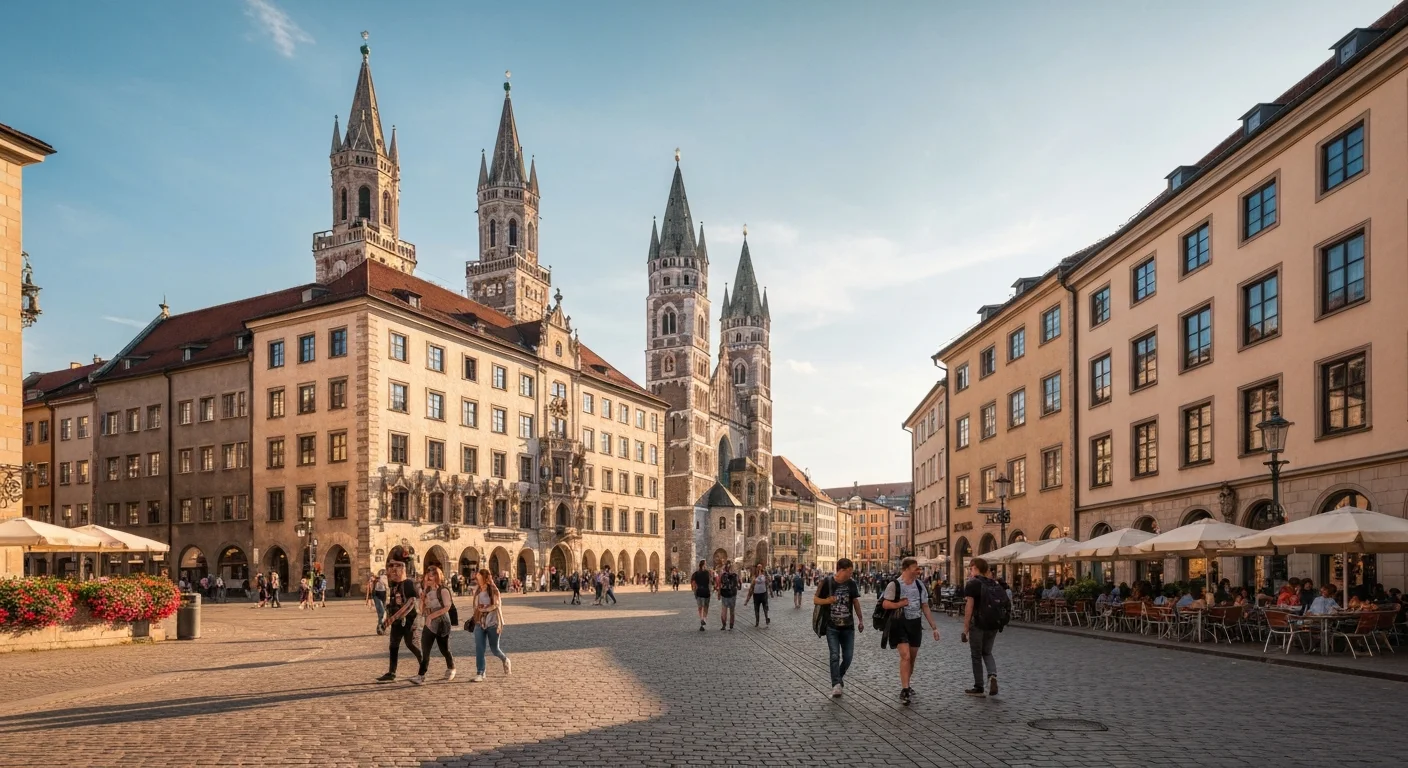
Study in Munich
Germany's Top-Ranked University City
Munich is home to two of Germany's top-ranked universities and over 130,000 students. A thriving tech hub with world-class research institutions and unmatched career opportunities.
30+
Universities
130,000+
Students
€0
Tuition at Public Unis
€1,100–1,400
Monthly Cost
Top Universities in Munich
Munich is one of Germany's strongest academic hubs, home to several genuinely world-class public institutions.
- Technical University of Munich (TUM) — a member of the TU9 group of leading technical universities, known internationally for engineering, computer science, natural sciences, and a large catalogue of English-taught master's programmes.
- Ludwig Maximilian University of Munich (LMU) — a member of the U15 research universities, especially strong in medicine, natural sciences, law, economics, and the humanities.
- Munich University of Applied Sciences (Hochschule Munchen / HM) — one of Germany's largest universities of applied sciences, with a practice-oriented, industry-linked focus in engineering, business, and design.
Munich also hosts specialised public institutions in the arts, film, and music for students targeting those fields.
Cost of Living in Munich
Munich is widely regarded as the most expensive city in Germany for students, mainly because of housing. Budget conservatively and apply for accommodation early.
- Rent (room in a shared flat / WG): roughly EUR 600-900+ per month, often higher near the centre; student-residence places are cheaper but very competitive.
- Food and groceries: typically around EUR 250-350 per month.
- Transport: a discounted public-transport pass is usually available to students; budget roughly EUR 40-60 per month.
Altogether, a realistic monthly total is often around EUR 1,200-1,600, noticeably more than cities like Leipzig, Dresden, or many smaller university towns.
Student Life in Munich
Munich combines a high quality of life with a large, diverse international student community, so newcomers from India, Vietnam, China, and Southeast Asia tend to settle in quickly.
Popular student-friendly areas include Schwabing, Maxvorstadt (near the main university campuses), Haidhausen, and the more affordable outer districts reachable by the extensive U-Bahn, S-Bahn, tram, and bus network. The city is safe, clean, and very walkable and bike-friendly.
The English Garden, beer gardens, museums, and easy day trips to the Alps and nearby lakes are major draws. Many master's programmes are taught in English, but learning German strongly improves daily life, part-time work options, and long-term career prospects.
Careers & Industry in Munich
Munich has one of the strongest economies in Germany and Europe, which gives graduates excellent access to internships, working-student roles, and full-time jobs.
- Automotive and engineering: home to major employers such as BMW, plus a wide supplier and manufacturing base.
- Technology and electronics: Siemens and Infineon are headquartered in the region, alongside R&D offices of several large international tech firms.
- Insurance and finance: global players including Allianz and Munich Re are based here.
After graduating, international students can generally apply for a post-study job-seeker residence permit (commonly up to 18 months) to look for qualified work in Germany; exact conditions should be confirmed with the immigration authority.
Showing 1753–1776 of 2,320 programmes
Physik plus Meteorologie, B.Sc.
Ludwig-Maximilians-Universität München · München
Physik, B.Ed.
Universität Bayreuth · Bayreuth
Physik, B.Ed.
Universität Regensburg · Regensburg
Physik, B.Sc.
Universität Regensburg · Regensburg
Physik, B.Sc.
Universität Bayreuth · Bayreuth
Physik, B.Sc.
Technische Universität München · Garching
Physik, B.Sc.
Universität Augsburg · Augsburg
Physik, B.Sc.
Julius-Maximilians-Universität Würzburg · Würzburg
Physik, B.Sc.
Ludwig-Maximilians-Universität München · München
Physik, Bachelor - Lehramt Gymnasium: B.A. bzw. B.Sc.
Universität Bayreuth · Bayreuth
Apply by 1 Nov · 21d leftPhysik, M.Ed.
Universität Bayreuth · Bayreuth
Physik, M.Sc.
Universität Bayreuth · Bayreuth
Physik, M.Sc.
Universität Augsburg · Augsburg
Physik, M.Sc.
Universität Regensburg · Regensburg
Physik, M.Sc.
Julius-Maximilians-Universität Würzburg · Würzburg
Physiotherapie dual mit Schwerpunkt Bewegungswissenschaft, B.Sc.
Technische Hochschule Deggendorf · Deggendorf
Physiotherapie, B.Sc.
Technische Hochschule Rosenheim · Rosenheim
Apply by 30 Nov · 50d leftPhysiotherapie, B.Sc.
Ostbayerische Technische Hochschule Regensburg · Regensburg
Plant Sciences, M.Sc.
Ludwig-Maximilians-Universität München · München
Political and Social Sciences (45 ECTS), M.A.
Julius-Maximilians-Universität Würzburg · Würzburg
Political and Social Sciences, M.A.
Julius-Maximilians-Universität Würzburg · Würzburg
Political and Social Studies (Hauptfach 120 ECTS), B.A.
Julius-Maximilians-Universität Würzburg · Würzburg
Political and Social Studies (Hauptfach 75 ECTS), B.A.
Julius-Maximilians-Universität Würzburg · Würzburg
Political and Social Studies (Nebenfach 60 ECTS), B.A.
Julius-Maximilians-Universität Würzburg · Würzburg
Check My Fit
3 quick questions — every result gets a fit tag based on your budget and languages. Stored only on this device.
Tags are an indication based on tuition and teaching language — for a real assessment, get a free profile evaluation.
Frequently Asked Questions About Studying in Munich
Yes. Public universities in Bavaria (including Munich) charge no tuition fees for all students, regardless of nationality. Students pay only a semester contribution of approximately €130–€170, which covers student union services, administrative costs, and access to the university library. Unlike Berlin or Hamburg, the Munich semester fee does not include a public transport ticket. The Semesterticket IsarCard S costs around €200 per semester and must be purchased separately. Despite this, studying in Munich is vastly more affordable than comparable universities in the UK, US, or Australia, where tuition alone can reach €20,000–€40,000 per year. International students must open a blocked account with €11,904 for the German student visa. Living costs in Munich are higher than other German cities, so budget accordingly at €1,100–€1,400 per month.
Technical University of Munich (TUM) is consistently ranked Germany's #1 university (QS World University Rankings), a TU9 and EuroTech Alliance member, and one of only 11 German Universities of Excellence. TUM excels in engineering, computer science, natural sciences, and management, with over 50,000 students. Ludwig Maximilian University (LMU) is one of Europe's leading research universities, particularly strong in medicine, law, humanities, and natural sciences, with 52,000+ students and Nobel Prize-winning research. Other excellent institutions include Hochschule München (HM) — Bavaria's largest university of applied sciences — Munich Business School (private, internationally accredited), and the Academy of Fine Arts Munich. Together, Munich's universities host over 130,000 students, making it Germany's second-largest university city after Berlin.
Yes. Both TUM and LMU offer a growing number of English-taught programmes, especially at the Master's level. TUM has significantly expanded its English-language portfolio, offering over 30 Master's programmes fully in English across Engineering, Computer Science, Data Science, Robotics, Aerospace, Management, and Life Sciences. The TUM School of Management's Master in Management & Technology is taught entirely in English. LMU offers English-taught Master's in Epidemiology, Neuroscience, Physics, and several other fields. Munich Business School delivers its International Business programmes in English. Admission requirements typically include a relevant Bachelor's degree, IELTS 6.5 or TOEFL 88+ (TUM has specific requirements per programme), and an APS certificate for Indian applicants. TUM's application deadline is usually May 31 for the winter semester.
Munich is Germany's most expensive city for students. The average monthly cost ranges from €1,100 to €1,400. Rent is the largest expense: €500–€800 for a room in a shared flat (WG) or private student housing. Studierendenwerk München offers subsidised dormitory rooms starting at €300–€400, but waiting lists can be 2–3 semesters long, so apply immediately upon receiving your admission letter. Groceries and Mensa meals cost approximately €200–€280 per month. Statutory health insurance for students under 30 is roughly €110/month. Transport (Semesterticket IsarCard S at ~€200/semester) and personal expenses add €150–€200. International students must prove €11,904 in a blocked account for the visa. Despite higher living costs, Munich's zero tuition and strong job market with high graduate salaries make it an excellent investment.
Munich has Germany's strongest job market and lowest unemployment rate (under 3%). The city hosts the global headquarters of BMW, Siemens, Allianz, Munich Re, and MAN, plus major German offices of Google, Apple, Microsoft, Amazon, and Intel. The automotive, insurance, technology, and aerospace sectors (Airbus Defence & Space, MTU Aero Engines) drive continuous demand for graduates. Munich's average starting salaries of €50,000–€60,000 are among the highest in Germany, with engineering and tech roles often exceeding €55,000. International graduates benefit from Germany's 18-month post-study work visa and can transition to an EU Blue Card for long-term residency. Students can work 120 full days or 240 half days per year during their studies. Werkstudent (working student) positions at major companies typically pay €15–€22 per hour.
TUM uses its own application portal (TUMonline) with a deadline of May 31 for most winter semester Master's programmes. LMU accepts applications through its portal or uni-assist, with deadlines typically around July 15. Hochschule München (HM) uses its own online system with similar deadlines. Required documents include certified academic transcripts, degree certificates, language certificates (IELTS/TOEFL for English programmes, TestDaF/DSH for German programmes), a detailed motivation letter, and a CV. Indian applicants must obtain an APS certificate from the German Embassy in New Delhi, which takes 4–8 weeks to process. The uni-assist processing fee is approximately €75 for the first application and €30 for each additional university. Start your application at least 6–8 months before the deadline, as popular TUM programmes are highly competitive.
Explore More Programmes in Germany
Ready to Study
in Munich?
Get a free profile evaluation from our Germany education experts. We will assess your eligibility, recommend the best universities in Munich, and guide you through every step of the application process.