Germany's new dMAT test: what Indian master's applicants need to know
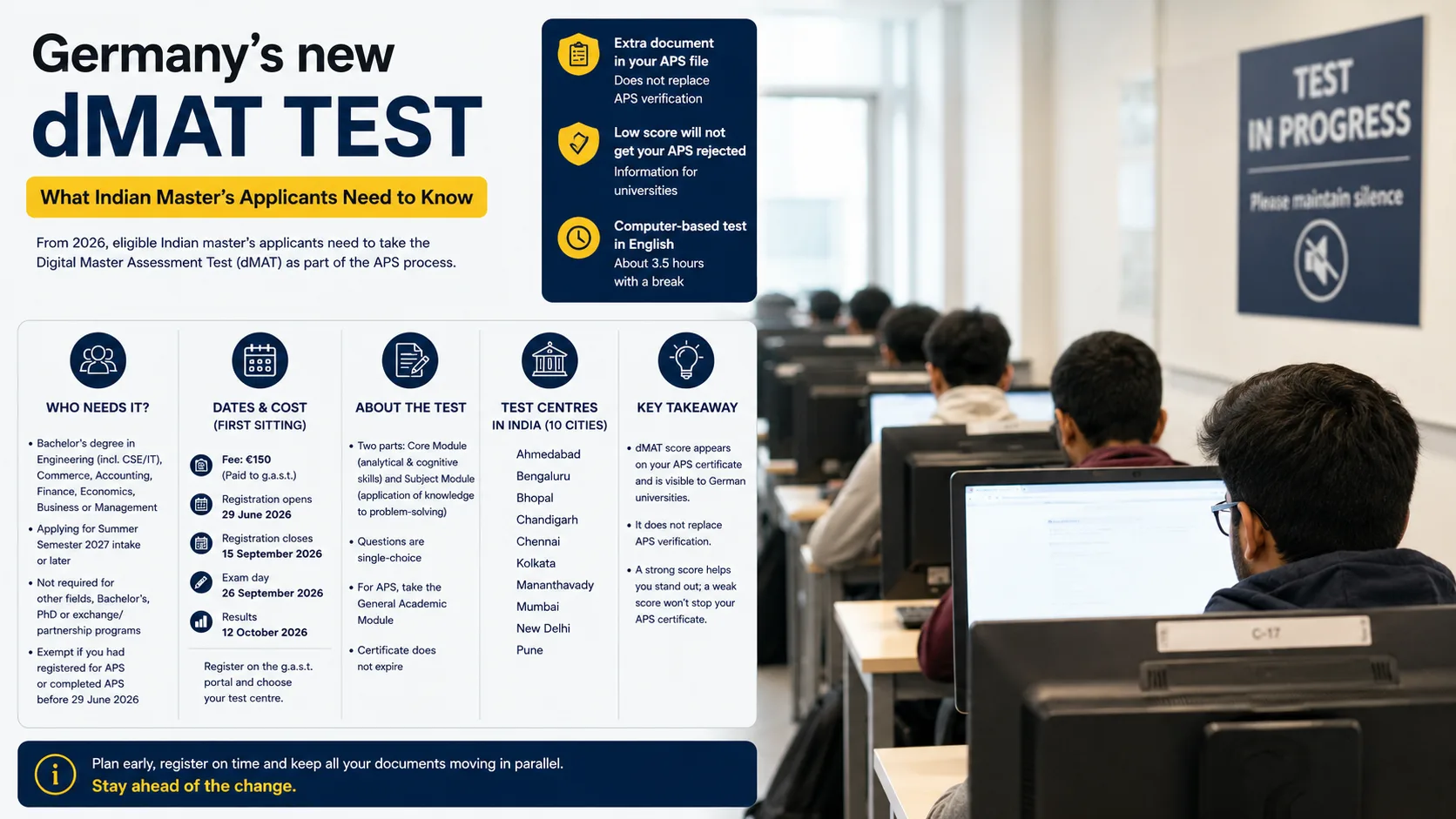
If you are an Indian graduate planning a master's in Germany, there is a new exam to know about: the dMAT. From 2026, the dMAT, short for digital Master Test, becomes part of the APS process for some Indian applicants. It is run by g.a.s.t., the body behind TestDaF and TestAS, and it is supported by the DAAD. Here is who needs it, the €150 fee, the exam dates, and how it affects your APS and your admission.
dMAT 2027 at a glance
| Key facts for Indian master’s applicants | |
|---|---|
| Important dates (first sitting) |
|
| Fee | €150 (about ₹16,300), paid to g.a.s.t. when you register |
| Exam format |
|
| Test centres in India | Ahmedabad, Bengaluru, Bhopal, Chandigarh, Chennai, Kolkata, Mananthavady, Mumbai, New Delhi and Pune |
| Who needs it | Indian applicants with a bachelor’s in Engineering, Commerce, Accounting, Finance, Economics, Business or Management, applying for the Summer 2027 intake or later |
| Pass or fail? | No. There is no cut-off to clear. Your score is shared with universities but does not decide your APS certificate. |
The dates, fee, exam format and field lists on this page follow the official APS India dMAT documentation. Sources: the APS India dMAT page and the official affected-fields list (PDF).
Do you even need to take the dMAT? A quick check
Before you worry about syllabus, centres or scores, work out whether this even applies to you. Go through these five points:
- You are applying for a master's programme, not a bachelor's. Bachelor's applicants are not affected.
- Your intake is Summer 2027 or later. Winter 2026/27 applicants are not affected.
- Your bachelor's is in engineering (including computer science and IT), commerce, accounting, finance, economics, business or management.
- You started your APS on or after 29 June 2026. If you finished your APS online registration or posted your documents before that date, or you already hold an APS certificate, you are exempt.
- You are not part of an official exchange, double-degree or university-partnership programme. Those students are exempt too.
If all five are true, the dMAT applies to you, so read on. If even one is false, you can relax. In most cases you do not need it.
Should you be worried about the dMAT? Honestly, no.
If the word “test” made your heart sink, start here. The dMAT is far less frightening than it first sounds, and the official APS office in India says as much in plain language.
Straight from the source: the Academic Evaluation Center states the dMAT “is not a stand-alone pass/fail test for the APS certificate,” and that “a low dMAT score does not automatically lead to a refusal of the APS certificate.”
Here is what settles students down once we talk it through:
- There is no cut-off to miss. The score is context for universities, not a verdict on your APS. Your certificate does not hinge on it.
- It replaces nothing. Your APS document check stays. If your course needs TestAS, that stays too. The dMAT is one extra step, not a new barrier.
- You cannot really under-prepare. It runs about three and a half hours, in English, on a computer, and tests general reasoning rather than memorised theory. No coaching institute required.
- Most of the online panic is about the wrong people. Bachelor's applicants, anyone exempt by the 29 June 2026 cut-off, and students in partnership programmes are all outside it.
The honest takeaway: understand it, register before the deadline, sit it calmly, and get on with your application. In our experience the students who hit trouble are not the ones with low scores. They are the ones who got so anxious they missed the registration date.
dMAT exam syllabus: what is actually on the test
The first thing to understand about the dMAT syllabus is that there is no traditional, subject-wise syllabus the way there is for GATE or a management entrance. The dMAT is an aptitude test. It looks at how well you read, reason and solve problems, not how much theory you have memorised, so there is no chapter list to cram.
Here is how the dMAT exam is actually built:
| Section | What it tests | Format |
|---|---|---|
| Core Module | General study aptitude across three short subtests of cognitive and analytical reasoning | Single-choice, English |
| General Academic Module (the one used for APS in India) | Reasoning applied to a realistic academic situation: you read a short academic scenario, then answer related questions | Single-choice, English |
For the APS process in India you sit the General Academic Module alongside the core module. (Some German programmes ask for a subject module instead, such as Computer Science or Data Science, but for APS in India the General Academic Module is the standard route.) The whole dMAT runs for around three and a half hours, in English, on a computer at an approved test centre, and every question is single-choice.
Because the dMAT for APS measures reasoning rather than subject knowledge, "studying the dMAT syllabus" really means getting comfortable with the question types, not revising textbooks.
How to prepare for the dMAT exam (without wasting time)
- Work through the official preparatory materials on the g.a.s.t / d-mat.de site so the format holds no surprises on the day.
- Practise general reasoning: reading a passage and answering inference questions, simple logic, and basic quantitative reasoning.
- Do two or three timed runs so three and a half hours of single-choice questions feels normal.
- Skip the expensive coaching packages. The dMAT score is not a pass-or-fail gate for your APS, so it does not reward months of drilling.
The dMAT is only one of several changes arriving for the 2027 intake. If you want the wider picture, read our guide to Germany's new rules for international students in 2026.
Which degrees need the dMAT? The affected field groups
APS India has published the official list of previous degree fields that fall under the dMAT. It covers three groups that are affected, plus important borderline cases and a list of fields that are not automatically covered:
- Engineering (129 fields) - B.E./B.Tech branches such as Computer Science and Engineering, Mechanical, Civil and Electronics.
- Commerce, Accounting, Finance and Economics (75 fields) - B.Com and its variants, Economics, Finance and Banking.
- Business and Management (41 fields) - BBA, BBM, BMS and related.
- Not automatically included (45 fields) - standalone Computer Science, BCA, B.Sc. Data Science, IT, Pharmacy, Architecture, Law and more.
The official title on your certificate is what decides it, not the course nickname. For the full field-by-field list, the borderline cases and the official source, see our dMAT affected fields guide.
dMAT at a glance
| Question | Answer |
|---|---|
| What is the dMAT? | The digital Master Test, a computer-based aptitude test for master's applicants to Germany. |
| Who needs it in 2026? | Indian applicants with a bachelor's in engineering, commerce, accounting, finance, economics, business or management, applying for summer semester 2027 or later. |
| Part of which process? | The APS India verification process. |
| Fee | €150 (about ₹16,300), paid to g.a.s.t. during registration. |
| First exam dates | Register 29 June to 15 September 2026, exam on 26 September 2026, results on 12 October 2026. |
| Format | About 3.5 hours, in English, single-choice questions, a core module plus a subject module. |
| Where | g.a.s.t. test centres in ten Indian cities. |
| Validity | The certificate does not expire. |
What the dMAT is
Read Also: The Study Shift: What You’ll Pay in 2026
dMAT stands for digital Master Test. It is a computer-based test you take at an approved centre, in English, lasting about three and a half hours with a break in the middle. It checks general academic ability: how you reason, analyse and apply what you have learned, rather than how much you can memorise. For the APS process in India you take the General Academic Module, which is the part that matters for most master's applicants.
One point to be clear about from the start. The dMAT is an extra document in your APS file. It does not replace APS verification, and a weak score does not get your APS rejected. More on that below, because it is the question everyone asks.
Who needs the dMAT in 2026
This is where most of the confusion sits. The dMAT is not for every Indian master's applicant, at least not yet. In its first phase it applies only if your bachelor's degree is in one of these fields:
- Engineering, which includes computer science and IT engineering degrees
- Commerce, accounting, finance or economics
- Business or management
And it only applies if you are aiming for the summer semester 2027 intake or any intake after that. If your degree sits outside those fields, or you are applying for a bachelor's or a PhD, you do not need the dMAT right now.
Who is exempt from the dMAT
You are exempt if, before 29 June 2026, you had already registered for APS online, shipped your complete APS documents, or received your APS certificate. So if your APS is already done or in motion, this change does not touch you. Students coming through an official exchange, double-degree or university partnership programme are also exempt.
dMAT fee and exam dates
The dMAT fee is €150, which is about ₹16,300 at the mid-2026 euro to rupee rate of roughly ₹108 to ₹110 (the rate moves daily, so check it on the day you pay). You pay it to g.a.s.t. when you register, on top of the usual APS fee. Registration for the first sitting opened on 29 June 2026.
- Registration closes: 15 September 2026
- Exam day: 26 September 2026
- Results: 12 October 2026
Once you have the certificate it does not expire, so you sit the dMAT once.
dMAT exam pattern and syllabus / What is the syllabus for the dMAT?
The dMAT has no fixed, chapter-wise syllabus to cram. It is an aptitude test in two parts: a Core Module that measures general cognitive and analytical skills across three short subtests, and a subject module, which for the APS India route is the General Academic Module. The format is single-choice, so you pick one answer from the options.
In practice, the dMAT tests these skills:
- Logical and analytical reasoning, through figure sequences where you work out how shapes change and continue the pattern.
- Numerical reasoning and basic arithmetic, through systems of mathematical equations you solve for unknown values.
- Structured, rule-based thinking, through Latin square grids where each letter appears only once in every row and column.
- Applied academic problem-solving, through the General Academic Module, where you read a short problem and answer the questions linked to it.
The dMAT for Indian students centres on the General Academic Module, the part that counts for your APS certificate. It rewards transfer and problem-solving skills over memorised facts, so preparation means practising the question types and timing rather than revising a set list of topics.
dMAT exam centres in India
The test runs at g.a.s.t. centres in ten Indian cities: Ahmedabad, Bengaluru, Bhopal, Chandigarh, Chennai, Kolkata, Mananthavady, Mumbai, New Delhi and Pune. You pick your centre when you register through the g.a.s.t. portal.
Does the dMAT score affect your APS or admission?
Short answer: not on its own. This is the part worth slowing down on. Your dMAT score appears on your APS certificate, and German universities can see it. But APS India has said plainly that the dMAT does not replace the document check, and a low score will not stop you getting your APS certificate. It is information for universities, not a pass-or-fail gate run by APS. In practice, treat it as one more thing admissions teams look at, alongside your grades, your degree and the rest of your file. A strong score helps you stand out for the competitive programmes.
dMAT vs TestAS vs APS: what is the difference?
People mix these up, so here it is in plain terms. APS is the check that confirms your documents and degree are genuine. TestAS is a separate, optional aptitude test that some universities like to see. The dMAT is the new one, an additional test that sits inside the APS process for the affected Indian applicants. The dMAT does not replace APS or TestAS. If your field and intake are on the list, you take the dMAT as part of getting your APS done.
How to register for the dMAT
You register and book a centre through the g.a.s.t. portal, then pay the €150 fee during registration. After you sit the test and get your certificate, you submit it together with your APS documents. New to APS? Read our complete APS certificate guide for India first.
What to do now
If you fall into one of the three fields and you are targeting summer 2027 or later, build the dMAT into your timeline now. The window is short and closes in mid-September for the first sitting. Miss it and you wait for the next one, which can push your whole application back a semester.
- Check whether your degree field and intake actually require the test.
- If they do, register early in the window and book a centre near you.
- Sit the dMAT, then submit the certificate with your APS documents.
- Keep your grades, IELTS or TestDaF and other documents moving in parallel, so nothing waits on a single piece.
How GradGermany helps
Working out which test you need, in which order, against which deadline, is exactly where people lose time. At GradGermany we help Indian students plan the whole path: APS, the dMAT if it applies to you, language tests, the university shortlist, the application and the visa. The first profile evaluation is free, so if you want a second pair of eyes on your timeline before you lock in dates, start there.
Key terms explained: dMAT, APS, anabin and g.a.s.t.
If you are new to studying in Germany from India, these are the names you will keep running into:
- dMAT: the digital Master Test, the new aptitude test this article is about.
- APS: the Academic Evaluation Centre (Akademische Prüfstelle) in New Delhi. It checks that your degree and documents are genuine and issues an APS certificate, which you need to apply to German universities and for your student visa.
- anabin: Germany's official database of recognised foreign universities and qualifications. German universities check it to confirm your degree is recognised. An "H+" rating means your institution is recognised.
- g.a.s.t.: Gesellschaft für Akademische Studienvorbereitung und Testentwicklung, the German body that runs the dMAT, as well as TestDaF and TestAS. You register and pay for the dMAT on the g.a.s.t. portal.
- TestAS: a separate, often optional aptitude test for international applicants. It is not the same as the dMAT.
- DAAD: the German Academic Exchange Service, which supports the APS and the dMAT.
Official links
Always confirm the latest details on the official pages before you register or pay:
- APS India: official dMAT page (aps-india.de/dmat)
- dMAT for India: official details and rules (d-mat.de)
- dMAT main site, run by g.a.s.t.: registration and test centres (d-mat.de)
This is a developing change
The dMAT is rolling out in phases, and the official details are still being filled in. We are watching the g.a.s.t. and APS India announcements, and we will keep this article updated as new information lands: more subject fields, future test dates, and any change to the fee or the process. If you are not sure whether the test applies to you right now, check the official sources below or ask us.
Sources: d-mat.de and the official APS India page aps-india.de/dmat. Dates and fees are for the first 2026 sitting and can change. Always confirm on the official sites before you register.
Check your own degree in seconds
Not sure if the dMAT applies to you? Our free checker matches your bachelor's degree against the official APS field list.
Open the dMAT CheckerFrequently Asked Questions
You probably qualify for more than you think.
Students who get evaluated find programmes they had no idea existed — at universities that charge nothing. 2 minutes, no cost. The only downside is not checking.
Want our guides higher up in Google?
Mark GradGermany as a preferred source and Google gives our pages more room when you search about studying in Germany. Takes one tap, and you can undo it any time from the same screen.
Living this, or on your way to it? Tell your story.
If you are already in Germany and finding it hard, or still fighting to get here, other students need to hear it from someone real. Share your honest journey. We help shape it, and nothing goes live until you approve it.
Free German Quiz · No Login
Can you score 10/10 on today's German challenge?
10 new words every day · 4,500+ words from A1 to C1 · takes about a minute.