Germany Has About 630,000 Open Jobs. Here Is Where They Actually Are
TL;DR: Germany's Federal Employment Agency recorded around 630,000 open vacancies in early 2026, concentrated in technology and healthcare. Software development, healthcare professions, electrical and mechanical engineering and data science lead demand. Average first-contract salaries for one recent Indian graduate cohort came in around 53,000 euros, above the 50,700 euro EU Blue Card threshold. Which is the whole reason the study-to-work pitch works.
A vacancy number on its own is close to useless. Six hundred thousand open jobs does not help you if they are all for elder-care nurses with C1 German and you are a mechanical engineer with A2.
So here is the breakdown, and the honest version of what it means for someone choosing a master's programme in 2027.
Where the demand sits
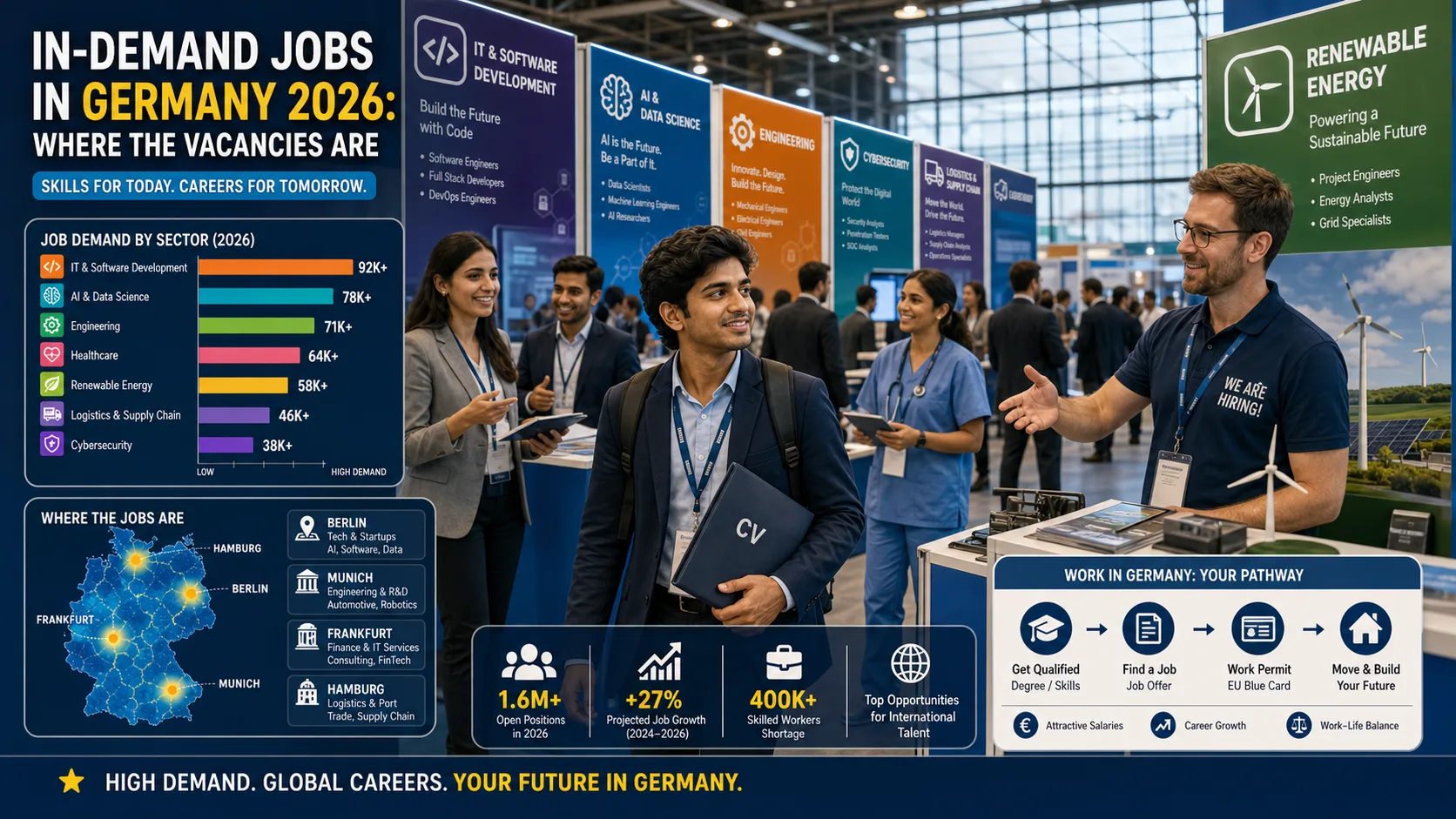
Per the Germany Study-to-Work Report for H1 2026, drawing on Federal Employment Agency data, the roughly 630,000 vacancies concentrate in technology and healthcare. The leading roles:
- Software development
- Healthcare professions
- Electrical engineering
- Mechanical engineering
- Data science
Notice what is on this list and what is not. Four of the five are things you can study in English at a German public university for the cost of a semester ticket. The fifth, healthcare, is the one where German is not optional and where recognition of foreign qualifications is its own long process.
If you are choosing between a master's in mechanical engineering and one in international business, this list is your answer.
The city question
Berlin, Munich, Heidelberg, Leipzig and Stuttgart lead as placement cities in the same report. But vacancy density and quality of life do not move together, and this is where students make an avoidable mistake.
| City | Strength | The catch |
|---|---|---|
| Munich | BMW, Siemens, Infineon, a dense tech scene, the highest salaries | The most expensive rents in Germany. Your salary advantage can vanish into housing. |
| Berlin | Startups, international workplaces, the most English-friendly job market | Lower salaries than Munich or Stuttgart, and a punishing rental market. |
| Stuttgart | Automotive and industrial engineering, Bosch, Mercedes, Porsche | German is closer to mandatory. Expensive. |
| Leipzig | Growing tech and logistics base, genuinely affordable | Smaller market, fewer international employers. |
| Heidelberg | Life sciences, biotech, research institutes | Narrow. Excellent if you are in its fields, thin if you are not. |
The underrated play is studying somewhere affordable and moving for the job. Rent in Leipzig or Magdeburg during a two-year master's, then take the Munich offer. You arrive with savings instead of debt.
What you will actually earn
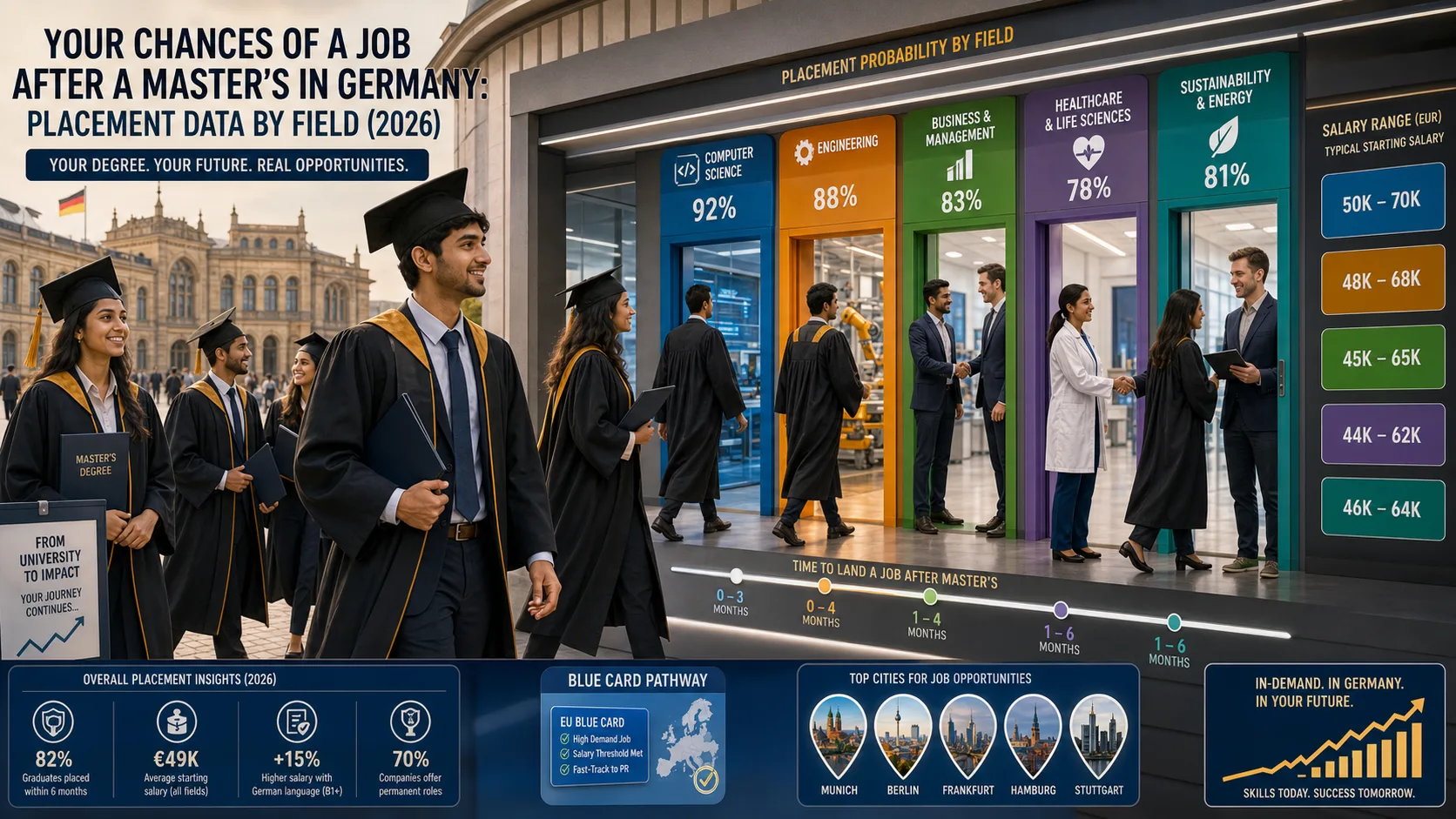
The report puts average first-contract salaries for its cohort at roughly 53,000 euros a year, against an EU Blue Card threshold it cites at 50,700 euros.
That gap matters more than it looks. Clearing the Blue Card threshold is what converts a job offer into a fast, stable residence pathway. Coming in under it does not stop you working, but it puts you on a slower route.
Be realistic about the spread, though. An average is not a promise. Software and engineering roles at large firms clear it comfortably. Roles at small companies, in the east, or in non-technical fields often do not, especially in a first job. And the number before tax is not the number in your account, since German deductions on a 53,000 euro salary are substantial.
The thing that decides all of it
German. Again.
The vacancy list is real, but a large share of those 630,000 roles are advertised in German, interviewed in German and worked in German. Berlin startups and a set of large multinationals will hire you in English. Almost everyone else, and particularly the Mittelstand engineering firms that make Germany's job market what it is, will not.
B1 is the point where doors start opening. B2 is where you stop being a special case. The constraint is not the number of jobs. It is the language.
Building towards it while you study
Do not wait until the final semester. The students who convert this market do three things during the degree: a Werkstudent role from the second semester, a thesis written with an industry partner rather than purely in the lab, and German classes running the entire time.
A thesis at Bosch or Siemens is the single most reliable route into a full-time offer at Bosch or Siemens. It is also how you avoid competing as an anonymous applicant against everyone else finishing that summer.
For the mechanics of the transition afterwards, see our guides to the post-study job-seeker permit and finding a job after a German master's.
Sources
Frequently Asked Questions
You probably qualify for more than you think.
Students who get evaluated find programmes they had no idea existed — at universities that charge nothing. 2 minutes, no cost. The only downside is not checking.
Want our guides higher up in Google?
Mark GradGermany as a preferred source and Google gives our pages more room when you search about studying in Germany. Takes one tap, and you can undo it any time from the same screen.
Living this, or on your way to it? Tell your story.
If you are already in Germany and finding it hard, or still fighting to get here, other students need to hear it from someone real. Share your honest journey. We help shape it, and nothing goes live until you approve it.
Free German Quiz · No Login
Can you score 10/10 on today's German challenge?
10 new words every day · 4,500+ words from A1 to C1 · takes about a minute.
Related Articles

Study in Germany
Tourismus-, Hotel- und Eventmanagement mit Praxissemester, B.A.
Hochschule Fresenius
München, Hamburg, Köln, Düsseldorf, Wiesbaden
B.Sc.Multimediale Kommunikation und Dokumentation, B.Sc.
Technische Hochschule Aschaffenburg
Aschaffenburg
M.Ed.Sonder- und Inklusionspädagogik (Ein-Fach-Studiengang), M.Ed.
Universität Rostock
Rostock