Scholarships for Nepali Students in Germany: Options Beyond DAAD
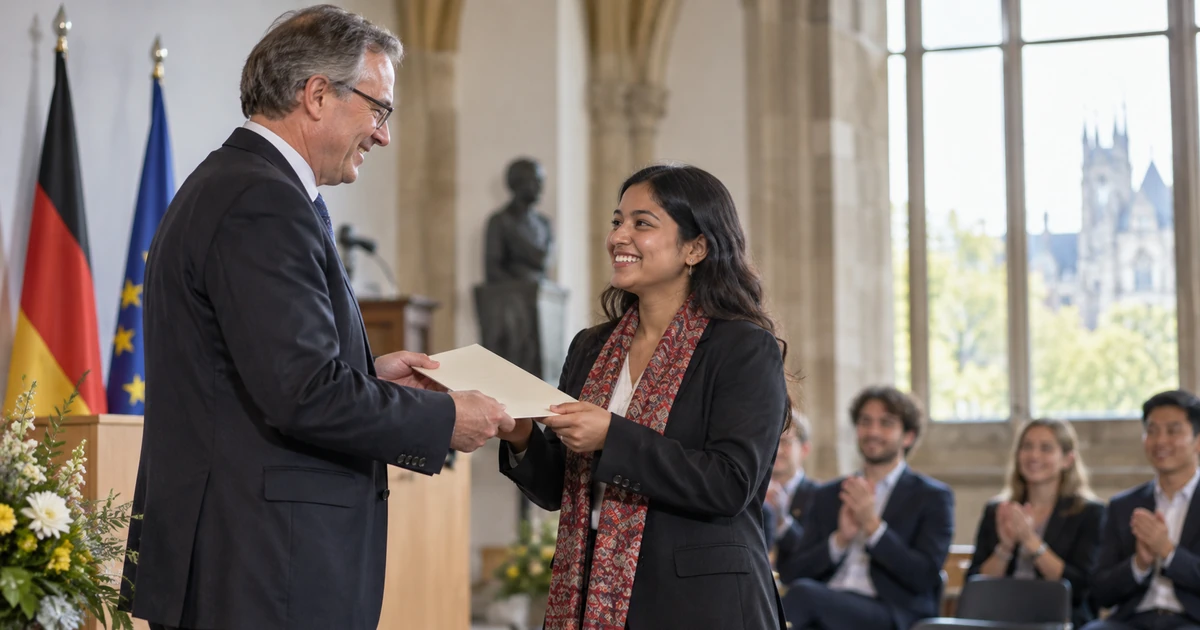
Most conversations about German scholarships start and end with DAAD. It is the biggest funder, but for a Nepali applicant it is also one of the hardest to get, because its main master's routes expect years of work experience. This guide covers what else exists, what each option pays and when you can apply. Every amount below was checked on the funder's own pages in October 2026.
Measure every scholarship against EUR 992
Before you compare scholarships, look at the number the visa process uses. The legal benchmark for a student's living costs is EUR 992 a month. The German Embassy in Kathmandu accepts a scholarship confirmation as proof of funds, so an award that pays at least that much can stand in for the money you would otherwise have to show. A smaller award helps you live, but you still have to cover the rest of the benchmark, usually with a blocked account or other proof of funds.
There is a smaller perk too. Holders of scholarships from German public funds, with DAAD as the Embassy's example, do not pay the EUR 75 visa fee in Kathmandu.
DAAD in one paragraph
EPOS and the Helmut-Schmidt-Programme are DAAD's main funded master's routes for Nepali applicants, and both pay EUR 992 a month, but EPOS wants at least two years of work after your bachelor's. Courses, deadlines and the problem for fresh graduates are covered in our DAAD guide for Nepali students.
Deutschlandstipendium: EUR 300 a month, any nationality
The Deutschlandstipendium pays EUR 300 a month. A private sponsor, such as a company, a foundation or alumni, puts in EUR 150 and the federal government matches it. Your nationality plays no part, and neither does your parents' income.
You apply through your university, and only if it takes part; public and state-recognised universities can offer it. Funding normally runs for at least two semesters and can continue to the end of the standard period of study. First-semester students may apply, but each university runs its own selection on its own timetable.
For planning purposes, treat it as a bonus. EUR 300 is less than a third of the visa benchmark, and because the university picks the winners, you cannot count on it while you are still preparing your visa file in Nepal.
Heinrich Boell Foundation: funding that requires German
Germany has 13 scholarship foundations funded by the federal research ministry, the Begabtenfoerderungswerke, presented together on Stipendium Plus. Each has its own political, religious or social profile and its own rules for applicants from abroad.
The Heinrich Boell Foundation runs a clear track for international master's students. Its scholarship page says students who completed their first degree abroad can apply before starting a master's in Germany, with priority for applicants from DAC countries who do not yet live in Germany. Nepal appears on the DAC list.
Its information sheet for international students contains the details that decide whether it is realistic for you:
- EUR 992 a month for non-EU students, plus individual allowances
- German at level B2 or DSH 1, with a certificate, for every applicant
- A degree course at a state or state-recognised university in Germany
- Two references: one on your social commitment from someone who is neither a friend nor a relative, and an academic report from a university lecturer
- Application windows in 2027 from 15 January to 1 March and from 15 July to 1 September
The March round lines up with a winter start. The foundation interviews shortlisted applicants in two stages, announces awards in June or July and starts payments by 1 October at the latest. The German requirement rules out many applicants bound for English-taught programmes; if you are already working towards B2, our guide to German language requirements shows where that level also helps.
Erasmus Mundus: Europe-wide master's, Germany as one stop
Erasmus Mundus Joint Masters are run by groups of at least three universities in different countries, and every student studies in at least two of those countries for at least a semester each. The EU programme guide sets the scholarship at EUR 1,400 a month for the length of the programme, up to 24 months, to cover travel, visa, settling-in and living costs.
Students from anywhere can apply, and you apply to the consortium that runs the programme, not to the EU. One rule helps applicants from smaller sending countries such as Nepal: a consortium may give no more than 10 percent of its scholarships to a single nationality. Expect to spend part of the degree outside Germany.
Fee waivers at universities that charge
Where a university charges non-EU tuition, it often has its own relief. TUM, for instance, runs merit and need-based waivers and grants that can be awarded again each semester. Which universities charge in the first place is explained in our free tuition guide. Look for the waiver page when you shortlist a fee-charging programme, not after you enrol.
Where to search
Our scholarship database lists German funding by type and level. The DAAD scholarship database can be filtered with Nepal as your country of origin. After that, read the funding page of every university on your shortlist.
Ask for references early. A lecturer at your campus in Kathmandu who gets your request a week before a deadline may not have time to write a good one, and the Boell form, for one, asks the referee for a detailed assessment rather than a standard letter.
Frequently Asked Questions
You probably qualify for more than you think.
Students who get evaluated find programmes they had no idea existed — at universities that charge nothing. 2 minutes, no cost. The only downside is not checking.
Want our guides higher up in Google?
Mark GradGermany as a preferred source and Google gives our pages more room when you search about studying in Germany. Takes one tap, and you can undo it any time from the same screen.
Get new guides as soon as they go live
Add our feed to Feedly, Inoreader or any RSS reader and every new guide on studying in Germany shows up there by itself. No email, no sign-up.
Living this, or on your way to it? Tell your story.
If you are already in Germany and finding it hard, or still fighting to get here, other students need to hear it from someone real. Share your honest journey. We help shape it, and nothing goes live until you approve it.
Free German Quiz · No Login
Can you score 10/10 on today's German challenge?
10 new words every day · 4,500+ words from A1 to C1 · takes about a minute.
Related Articles

Study in Germany
Elektro- und Informationstechnik, M.Sc.
Technische Hochschule Mittelhessen - THM
Gießen, Friedberg
B.A.Journalismus, B.A.
Macromedia University of Applied Sciences
Berlin, München, Stuttgart, Freiburg, Hamburg, Frankfurt am Main, Leipzig, Köln
M.Sc.Biochemie, M.Sc.
Martin-Luther-Universität Halle-Wittenberg
Halle