DAAD Scholarships for Nepali Students: What You Can Apply For in 2027

Search the DAAD scholarship database with Nepal as your home country and you get 16 DAAD programmes. One name is missing: "Study Scholarships - Master Studies for All Academic Disciplines", DAAD's general master's scholarship. It does not appear for Nepal, and neither do the STEM study scholarships. For a Nepali applicant who wants a funded master's, that leaves two main doors, EPOS and the Helmut-Schmidt-Programme, and both expect you to have worked first.
Every figure below comes from DAAD or the German Embassy Kathmandu and was checked on 8 October 2026.
Who handles DAAD for Nepal
There is no DAAD office in Nepal. The DAAD Regional Office in New Delhi is responsible for Nepal and takes questions at [email protected]. Doctoral applications from the region are reviewed by a selection committee in New Delhi in early February.
The DAAD programmes open to Nepali applicants
The main ones from the DAAD database filtered for Nepal, with the deadlines it shows for Nepal:
| Programme | Who it suits | Monthly payment | Deadline shown for Nepal |
|---|---|---|---|
| EPOS (development-related postgraduate courses) | Graduates with 2+ years of work after the bachelor's | EUR 992 | Set by each course |
| Helmut-Schmidt-Programme (Public Policy and Good Governance) | Graduates in politics, law, economics or public administration | EUR 992 | 2027 round closed 31 July 2026; 2028 call not yet published |
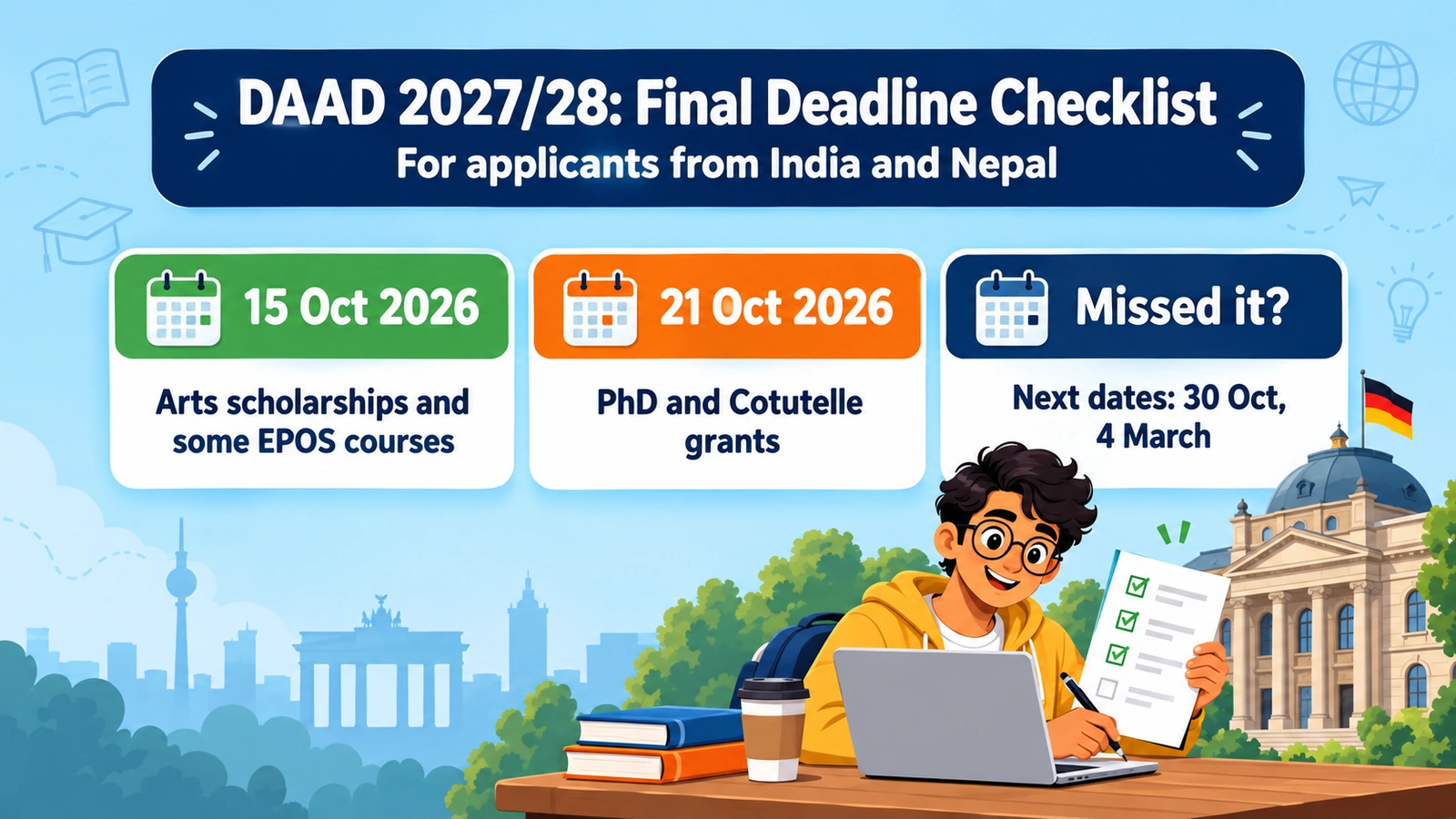
| Doctoral Programmes in Germany | A full PhD in Germany | EUR 1,400 | 21 October 2026 |
| Bi-nationally Supervised Doctoral Degrees | A PhD supervised in Nepal and Germany | See DAAD listing | 21 October 2026 |
| Research Grants in Germany | PhD students enrolled outside Germany, early postdocs | EUR 1,400 | 4 March 2027 |
| Postgraduate study: Fine Art, Design, Visual Communication and Film | Arts graduates | EUR 992 | 15 October 2026 |
| Postgraduate study: Performing Arts | Performing arts graduates | EUR 992 | 15 October 2026 |
| Postgraduate study: Architecture | Architecture and planning graduates | EUR 992 | 23 September 2026 (closed) |
| Postgraduate study: Music | Music graduates | EUR 992 | 24 September 2026 (closed) |
The other seven are narrower, such as IAESTE traineeships and a re-invitation programme for former DAAD scholars.
If you have just finished your bachelor's
A fresh BE, BSc or BBA graduate from Nepal has very few DAAD options. EPOS wants two years of work after the bachelor's. Helmut-Schmidt accepts internships and volunteering as experience, but only for degrees in politics, law, economics or public administration, and each course sets its own minimum. Beyond those, the arts and architecture scholarships are the only DAAD master's funding for Nepal that does not list work experience as a requirement.
So most people either work two years and then apply for EPOS, or start a master's on their own funds and look for other money on our scholarships page. A free profile evaluation can tell you which plan fits your record.
EPOS: the route for people already working
DAAD funds master's study on a fixed list of courses built for professionals from developing countries, and Nepal is on the EPOS country list. Our EPOS overview has the general background.
What it pays
EUR 992 a month for master's students, payments towards health, accident and personal liability insurance, and a travel allowance unless your home country or another funder already covers it. Some scholars also get a monthly rent subsidy and an allowance for family members who come along. Funding lasts 12 to 42 months, depending on the course.
Who gets it
DAAD's typical scholar works for a public authority or a state or private company in a developing country, on projects with a development angle. The formal rules, from the EPOS listing:
- A bachelor's degree, normally four years, in a related subject
- Results in the upper third
- At least two years of related work after the bachelor's, counted up to the day you apply
- Degrees normally not more than six years old
- No more than 15 months living in Germany at the deadline
Two of these deserve a second look. The work clock starts after your bachelor's, so jobs and internships during your degree do not count. And if your bachelor's was a three-year programme, email the course coordinator before you spend weeks on the application.
Courses that match work in Nepal
DAAD's EPOS course list for the 2027/2028 intake (updated June 2026) includes several that line up with jobs people hold in Nepal:
- Hydropower, irrigation or water supply: Hydro Science and Engineering, TU Dresden
- Structural or earthquake engineering: Natural Hazards and Risks in Structural Engineering, Bauhaus University Weimar
- Forestry and conservation: Tropical Forestry, TU Dresden
- Municipal planning: Urban Management, TU Berlin
- Public health: International Health (Charite Berlin or Heidelberg) and Global Health (Bonn)
Nearly all EPOS courses are taught in English. The one German-taught course includes a six-month German course in Germany, but you need B1 when you apply and must pass DSH 2 or TestDaF 4 before it starts.
Deadlines are set by each course
There is no single EPOS deadline, so check each course on your shortlist. The two we checked both close this autumn for an October 2027 start:
- Tropical Forestry, TU Dresden: EPOS applications from 1 September to 30 October of the year before you start, so 1 September to 30 October 2026.
- Hydro Science and Engineering, TU Dresden: 15 October each year if you apply to TU Dresden directly, or 31 July each year through the German Embassy or the DAAD Regional Office. It also asks for C1 English.
How the application works
You apply to the course, not to DAAD, which will not forward applications sent to it. You can apply to up to three EPOS courses, ranked, with one motivation letter that explains your choices and their order; the same letter goes to every course. The course's committee proposes candidates, and DAAD then asks them to upload their full file to the DAAD portal.
Besides the signed checklist and the EPOS application form, DAAD asks for:
- A Europass CV in reverse order, with no unexplained gaps
- A recommendation from your current employer on letterhead, signed, stamped and dated, not in a sealed envelope
- Employment certificates showing two years of relevant work after the bachelor's and, if possible, a guarantee that your employer will take you back
- IELTS or TOEFL (the institutional TOEFL is not accepted)
- Degree certificates and your full transcript, with an explanation of the grading system if the transcript has none
Helmut-Schmidt-Programme: for policy, law and economics
This is DAAD's Public Policy and Good Governance scholarship, funded by the Federal Foreign Office. Nepal is on the OECD aid-recipient (DAC) list the programme uses for eligibility. More background is on our Helmut-Schmidt page.
For the 2027 intake, the call offered EUR 992 a month, health insurance, fixed travel lump sums, a study and research grant, rent and family supplements where they apply, and a compulsory German course of up to four months in Germany before the master's.
The subject rule is strict: a degree in social and political sciences, law, economics, or public policy and administration, with upper-third grades. The experience rule is looser than EPOS. Paid work, internships, political work and NGO volunteering all count. There is a date limit too: for the 2027 round, your last degree had to be issued on or after 1 January 2020.
You pick up to two of seven English-taught master's courses, at Bonn-Rhein-Sieg, Duisburg-Essen, the Willy Brandt School in Erfurt, Magdeburg, Osnabrueck and Passau (two courses). Applications go to the courses, not to DAAD.
The 2027 call ran from 1 June to 31 July 2026, and DAAD has not published the 2028 call. If you are aiming for it, collect your experience letters now. DAAD wants them on headed paper with an original (not scanned) or certified digital signature, a date and a stamp.
PhD and research funding
If you hold a master's, the Doctoral Programmes in Germany scholarship is the one to act on this month. DAAD shows 21 October 2026 as the deadline for Nepal, with selection around February 2027 and funding from October 2027.
- EUR 1,400 a month, insurance payments and a EUR 460 annual research allowance
- Up to four years: three at first, then a possible fourth after review
- Your latest degree should normally be no more than six years old at the deadline
- A supervisor's confirmation and a proposal of up to 10 pages, including earlier work
- A 2 to 4 month German course in Germany before the PhD
Already doing a PhD at Tribhuvan or Kathmandu University? Research Grants fund 2 to 12 months in Germany at EUR 1,400 a month. The 7 October 2026 cut-off has passed; the next is 4 March 2027, with funding from July 2027 at the earliest.
Arts and architecture graduates
Four study scholarships pay EUR 992 a month, plus a travel allowance on request and a one-off study allowance. The Fine Art, Design, Visual Communication and Film scholarship and the Performing Arts scholarship both close on 15 October 2026. Architecture (23 September) and Music (24 September) have closed for 2027; DAAD notes its deadlines usually fall in the same period each year.
DAAD's two Young Ambassadors from Nepal are an architecture scholar at Anhalt University of Applied Sciences and an EPOS scholar in water resources at Leibniz University Hannover, so both routes have someone you can ask.
After selection: the visa in Kathmandu
The German Embassy Kathmandu issues the study visa. The points on its page that matter for a Nepali DAAD scholar:
- You can apply online through the Consular Services Portal, then attend an appointment with your originals for fingerprints and a photo.
- The fee is the NPR equivalent of EUR 75, in cash, but holders of publicly funded stipends such as DAAD are exempt.
- Your scholarship confirmation counts as proof of funds. A blocked account is not mandatory but may be requested.
- APS is mandatory only for Chinese and Indian school or university degrees, so a Nepali degree needs none. With an Indian degree you would normally need APS, but the embassy exempts holders of German or European public scholarships.
- If you need to prove German, only certificates from the Goethe-Zentrum Kathmandu, the VHS centres in Bhaktapur, Kathmandu and Pokhara, or telc are accepted, and they must come with the application.
- Bring your citizenship certificate (original and copy), birth certificate, school leaving and higher secondary certificates with marksheets, and degree and transcripts, in English or German or with a certified translation.
- Minimum processing time is about 3 to 4 weeks.
Getting documents ready in Nepal
DAAD portal uploads can be plain, non-certified scans, though DAAD and some universities may ask for certified copies. If a course sends you through uni-assist, its Nepal page asks for your Class XII certificate and your degree, each with grades. Ask your campus for a letter that explains the grading scale, so reviewers can see where "upper third" falls on your marks, and give your employer weeks, not days, for the stamped recommendation and re-employment letters.
What makes a Nepali application stronger
Write the motivation letter about your own work. A planner who names the municipality she works for and the problem she wants to fix reads better than one who writes about "development in South Asia". Our guide to the German CV and motivation letter covers structure; the content has to come from your job. For first-hand advice, DAAD's Nepal page also points to the Nepal German Academic Association (NEGAAS).
Frequently Asked Questions
You probably qualify for more than you think.
Students who get evaluated find programmes they had no idea existed — at universities that charge nothing. 2 minutes, no cost. The only downside is not checking.
Want our guides higher up in Google?
Mark GradGermany as a preferred source and Google gives our pages more room when you search about studying in Germany. Takes one tap, and you can undo it any time from the same screen.
Get new guides as soon as they go live
Add our feed to Feedly, Inoreader or any RSS reader and every new guide on studying in Germany shows up there by itself. No email, no sign-up.
Living this, or on your way to it? Tell your story.
If you are already in Germany and finding it hard, or still fighting to get here, other students need to hear it from someone real. Share your honest journey. We help shape it, and nothing goes live until you approve it.
Related Guides
Free German Quiz · No Login
Can you score 10/10 on today's German challenge?
10 new words every day · 4,500+ words from A1 to C1 · takes about a minute.