Study in Germany for Chinese Students: APS Beijing, English Masters
TL;DR: Chinese students need an APS certificate from APS China, a 11,904 euros blocked account, and a national student visa. Germany is tuition-free at public universities, and English-taught master's programmes are the main route. China is one of Germany's biggest source countries.
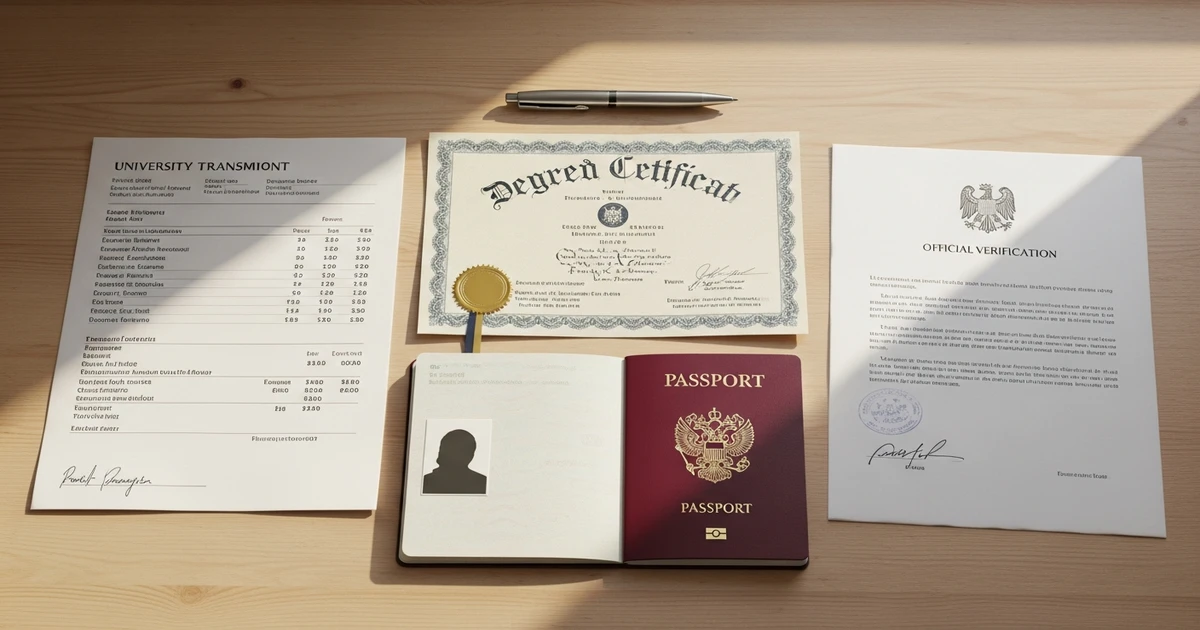
APS China is not a formality. The office in Beijing verifies your degree, your transcripts and your educational history, and without its certificate the visa section will not process your file, no matter how good your admission letter is. Many universities want to see it at application stage too. It takes weeks to months, which makes it the one deadline that sets every other deadline in your plan.
Everything after that is comparatively mechanical, and China has an advantage most sending countries do not: German has been taught seriously in Chinese schools for years, so a German-taught degree is a realistic option rather than a theoretical one.
APS China, and why it goes first
Get the APS certificate started before you shortlist universities. Nothing about the process rewards waiting, and holding a valid certificate early only widens your options, since several universities will accept it in place of a separate uni-assist VPD.
Two conditions decide whether you can use APS at all. It verifies only study completed at an institution recognised by China's Ministry of Education, and the Akademische Pruefstelle states plainly that it has no cooperation with Chinese educational institutions and that using an agency is not required. Check your own university's recognition status before you build a plan around it. The steps and documents otherwise mirror the ones in our full walkthrough of APS verification, run through the Beijing office.
Which APS procedure you fall into, and what it costs
There is no single APS fee. The office runs a different procedure for each kind of applicant and prices them separately, as of its April 2025 schedule.
| Procedure | Who it is for | Fee |
|---|---|---|
| China procedure, interview or TestAS | Standard route with Chinese study time or a degree | 2,500 yuan |
| Gaokao procedure | School leavers heading for Studienkolleg or a bachelor's | 2,500 yuan |
| Repeat interview | Second or third attempt after a failed interview | 2,500 yuan |
| Programme students | Joint German-Chinese degree programmes | 2,000 yuan |
| Exchange procedure | Exchange students not taking a German degree | 2,000 yuan |
| Re-examination | Your qualification changed since the last check | 2,000 yuan |
| Document review | Scholarship holders, doctoral candidates, EU spouses | 1,000 yuan |
Two rules make picking the right one matter. The fees do not include the visa fee, and withdrawing from an APS procedure once filed is not possible. So the 1,500 yuan gap between the document review and the interview route is not something you can undo by changing your mind. Documents are handed in at the Beijing and Shanghai offices, Monday to Thursday between 08:30 and 11:00.
English or German: a real choice here
Germany has about 2,400 English-taught master's programmes, and that is the default route. For those you need IELTS 6.0-7.0 or TOEFL. For a German-taught programme you need TestDaF TDN 4, DSH-2 or Goethe B2 to C1. Given how many Chinese applicants already have several years of German behind them, the German route is worth pricing properly: it opens departments and employers that never advertise in English. See the English-taught catalogue and how TestDaF, DSH, Goethe and telc compare.
The teaching language also moves your deadline, sometimes by a month. At TU Berlin, restricted-admission master's programmes taught in English closed on 15 May 2026 for winter semester 2026/27 while the German-taught ones ran to 15 June. Read the programme page, not the national date.
Sending the application
Some universities take applications through uni-assist, others directly. uni-assist charges EUR 75 for the first course of study you select in a semester and EUR 30 for each further one, at the same rates whether you are making a full application or only requesting a VPD. Applying to five programmes in one batch therefore costs EUR 195, while spreading them over two semesters costs EUR 240 for identical work. With APS in hand, several universities will waive the separate VPD step. See how a uni-assist application is processed.
Proving the money
The visa needs a Sperrkonto, a blocked account, holding 11,904 euros and releasing 992 euros to you each month after you arrive. The Federal Foreign Office ties that figure to the maximum BAfoeG support rates, which is why it is a national number and not adjusted for Munich. If you are coming on the Opportunity Card rather than a study visa, Fintiba lists a higher requirement of 13,092 euros, or 1,091 euros a month.
It is not a fee and nobody keeps it: the money is yours, paid back in instalments to live on. Note that the Foreign Office deleted its published list of providers in 2022 and now makes no recommendation and accepts no liability if a provider becomes insolvent, so the due diligence is yours. See how the blocked account works.
Scholarships
DAAD and the German political foundations both fund Chinese students, and China-Germany exchange programmes exist across most technical fields. A fully funded award replaces the blocked account in your visa file. See what DAAD panels look for.
Where to apply for the visa
The national (type D) student visa is issued by the German embassy in Beijing and the consulates in Shanghai, Guangzhou, Chengdu and Shenyang. The Akademische Pruefstelle also accepts visa applications at its Beijing and Shanghai offices, in the same Monday-to-Thursday morning window it uses for document submission.
Bring your admission letter, blocked account or scholarship award, health insurance, APS certificate and passport. The fee is fixed by the Residence Regulation at EUR 75 to issue a category D visa, with EUR 25 to extend one later. See the student visa document list.
Health insurance, which the file also wants
Statutory student cover is a fixed monthly cost you should budget from day one. At Techniker Krankenkasse the student rate from January 2026 is 141.16 euros a month under 23 or with a child, and 146.29 euros from 23 without children. Enrolment does not proceed without cover in place, so this is not a bill you can defer to the second semester.
Working while you study
Section 16b of the Residence Act lets a non-EU student work 140 full days or 280 half days per calendar year, where anything up to four hours counts as a half day. Work as a student assistant at your own university does not count against that account at all, which is why those jobs are worth chasing first. At the statutory minimum wage of 13.90 euros an hour, ten hours a week comes to roughly 598 euros gross a month. A Werkstudent role in your field is how most international students in Germany get their first full-time offer. See how the day limit is counted.
After graduation, and the passport question
Section 20 of the Residence Act gives graduates of German universities a residence permit of up to 18 months to look for work, conditional on being able to support yourself. Once you are employed as a skilled worker, the settlement permit comes faster than most people expect: section 18c normally requires three years, but that drops to two years, with 24 months of pension contributions, precisely because you completed your degree in Germany. EU Blue Card holders reach it at 27 months, or 21 months with sufficient German.
Naturalisation is the separate question, and section 10 of the Nationality Act sets it at five years of lawful habitual residence. For Chinese nationals that last step is the complicated one, because Chinese nationality law does not allow dual citizenship, so a German passport means giving up the Chinese one. Permanent residence does not, which is where most Chinese graduates settle. See what the job-seeker permit covers.
Sources
- Akademische Pruefstelle Beijing - fee table
- Residence Act, section 16b - study and work
- Residence Act, section 18c - settlement permit
- uni-assist - handling fees
- DAAD
Applying from China? A free profile evaluation will tell you which programmes your grades reach and when to book APS.
Frequently Asked Questions
You probably qualify for more than you think.
Students who get evaluated find programmes they had no idea existed — at universities that charge nothing. 2 minutes, no cost. The only downside is not checking.
Want our guides higher up in Google?
Mark GradGermany as a preferred source and Google gives our pages more room when you search about studying in Germany. Takes one tap, and you can undo it any time from the same screen.
Living this, or on your way to it? Tell your story.
If you are already in Germany and finding it hard, or still fighting to get here, other students need to hear it from someone real. Share your honest journey. We help shape it, and nothing goes live until you approve it.
Related Guides
Free German Quiz · No Login
Can you score 10/10 on today's German challenge?
10 new words every day · 4,500+ words from A1 to C1 · takes about a minute.
Related Articles
Study in Germany
Fahrzeugtechnik - Lehramt an Berufskollegs (LA Bk), M.Ed.
FH Münster University of Applied Sciences
Steinfurt
M.Sc.Lehramt an Berufskollegs II (LA BK II), Studienstrukturmodell, M.Sc.
Universität zu Köln
Köln
B.Mus.Klavier (künstlerisch-pädagogische Ausbildung), B.Mus.
Hochschule für Katholische Kirchenmusik und Musikpädagogik
Regensburg