Technical University of Munich Fees 2026 Guide
The Technical University of Munich has introduced tuition fees for many international students. If you are targeting TUM in 2026, here is the concise answer: non‑EU/EEA students newly enrolling in Bachelor’s or Master’s programs pay per‑semester tuition (in addition to the semester fee), with clear exemptions and multiple waiver paths. This guide explains the new TUM fees, who pays, who is exempt, and how to plan your finances.
What is the Technical University of Munich known for in 2026?
The Technical University of Munich (TUM) is Germany’s flagship technical university, ranked among Europe’s best for engineering, computer science, natural sciences, and business innovation. As a leading member of Germany’s elite technical ecosystem, often compared with the TU9 group, TUM combines cutting‑edge research with strong industry ties in Bavaria’s high‑tech corridor. In 2026, TUM remains a top pick for AI, robotics, automotive, aerospace, life sciences, and management, now operating under a modernized fee model for many international students.
New TUM tuition fees for international students: who pays in 2026?
Beginning with Winter Semester 2024/25 and fully in effect for 2026 intakes, TUM charges tuition fees to newly enrolling non‑EU/EEA students in Bachelor’s and Master’s programs. These fees are program‑specific and are paid per semester. MBA and executive programs maintain separate, higher totals. In addition, all students pay a modest semester fee to cover student union services and basic transport.
Typical TUM tuition by level (per semester)
| Program level | Typical tuition (per semester) | Notes |
|---|---|---|
| Bachelor’s | €2,000 - €3,000 | For newly enrolling non‑EU/EEA students |
| Master’s | €4,000 - €6,000 | Program‑specific; check your exact fee before applying |
| MBA / Executive | €16,000 - €32,000+ (total) | Varies widely; separate fee structures |
| Semester fee (all students) | ~€150 | Covers student union services and basic transit |
Important: Each degree page publishes the exact amount. Use the program’s fee page or the university’s tuition navigator before you submit your application.
Who is exempt from TUM tuition in 2026?
These groups generally do not pay the new tuition fees:
- EU/EEA citizens (including Iceland, Liechtenstein, Norway)
- German education pathway: Applicants who earned a university entrance qualification (e.g., Abitur) or a prior degree within the German education system
- Established ties to Germany: Individuals who have lived in Germany for at least 5 years before starting studies, or whose parent worked in Germany for 3 of the last 6 years
- Refugees/Asylum seekers with recognized protection status
- Doctoral candidates (PhD)
- Continuing students enrolled at TUM before Winter 2024/25 (grandfathered)
If you fit any of the above, confirm your status during application; you may be required to provide documentation to secure the exemption.
Key 2026 facts and costs for TUM international students
Planning your finances at TUM involves more than tuition. The following table consolidates 2026 essentials every international student should know.
| Item (2026) | Figure | Why it matters |
|---|---|---|
| TUM tuition (non‑EU/EEA; newly enrolling) | Bachelor’s: €2,000-€3,000/semester; Master’s: €4,000-€6,000/semester | Program‑specific; payable each semester |
| Semester fee (all students) | ~€150/semester | Student union and basic transport |
| Blocked account requirement | €11,208/year (€934/month) | Standard proof of funds for visas; setup via blocked account providers |
| Health insurance (student, under 30) | ~€140/month | Mandatory; compare statutory providers; read our health insurance guide |
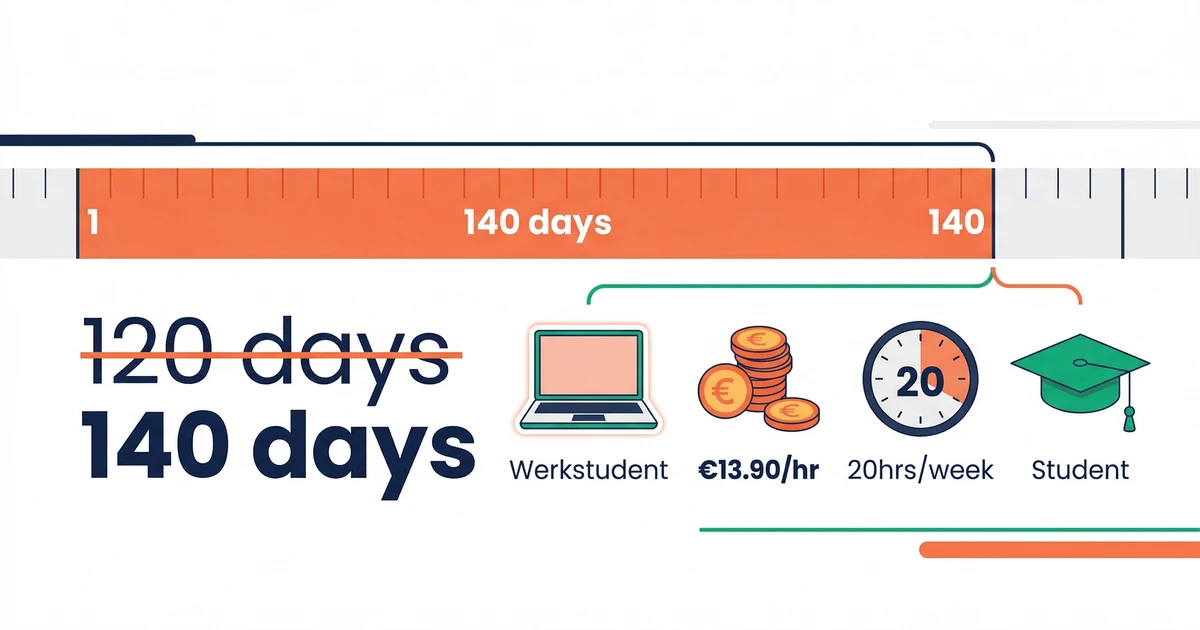
| Student work limit | Up to 140 full days or 280 half days/year | Part‑time work is allowed with limits; plan around lecture periods |
| Minimum wage | €13.90/hour | Benchmark for part‑time job earnings |
| National visa fee | €75 | Payable at submission; see our student visa checklist |
| APS (for India) | INR 18,000 | APS certificate required for India; see the APS certificate explainer |
| Post‑study work visa | 18 months | Stay to job‑hunt after graduation; details in our post-study visa guide |
| EU Blue Card salary threshold | €45,934 (shortage) / €50,700 (general) | Target figures for skilled employment after studies |
Why did TUM introduce tuition for many international students?
TUM’s shift aligns with the Bavarian Higher Education Innovation Act. The university earmarks revenue to strengthen international student support, modernize labs and digital infrastructure, and recruit global faculty, particularly in areas like AI, sustainable mobility, and quantum technologies. The message is clear: maintain world‑class standards while safeguarding access through targeted waivers and scholarships.
Scholarships, waivers, and fee relief at TUM in 2026
TUM operates several mechanisms so that fees are not a barrier for high‑potential applicants, especially from developing regions:
- Merit‑based waivers: For Master’s students, awards can start in the first semester if you rank among the top performers at your home university (e.g., top 5%). Bachelor’s students can typically apply after their second semester based on TUM grades.
- Need‑based waivers: For candidates who can demonstrate that the fee causes major financial hardship. Expect to submit detailed financial documentation, such as up to 18 months of bank statements and income proofs.
- Hardship waivers: For unexpected crises arising after enrollment (e.g., political instability, family emergencies) that temporarily disrupt your ability to pay.
Deadline watch (Winter 2026/27): Waiver scholarship applications typically close by May 31, 2026. Confirm your program’s exact timeline and prepare translations in advance.
Step‑by‑step: how to check your exact TUM fee and apply smartly
Read Also: The Study Shift: What You’ll Pay in 2026
- Identify your program and fee: Open the degree page and review the tuition section for the precise per‑semester amount. Save a PDF/screenshot for your records.
- Verify your exemption status: Check whether you qualify based on EU/EEA citizenship, German schooling/degree, residency or parental employment history in Germany, refugee status, doctoral status, or grandfathering (pre‑Winter 2024/25 enrollment).
- Plan your financial proofs: Prepare liquid funds for the blocked account (€11,208/year), keep tuition and semester fee amounts visible in your budget, and list mandatory monthly costs such as health insurance (~€140 under 30).
- Check waiver options: Review merit and need‑based criteria. If you’re a Master’s applicant in the top cohort of your class, assemble rank letters and transcripts. If you need aid, gather bank statements and income proofs.
- Translate documents early: Use sworn translators for non‑English/German documents (financial proofs, rank certificates). Don’t wait for the last week; translated packets take time.
- Submit on time: Track the waiver deadline (e.g., May 31, 2026 for Winter 2026/27) and your degree application deadline. Upload all supporting evidence in the requested formats.
- Prepare for your visa: After receiving admission and, where applicable, your waiver decision, book your appointment and follow the student visa process, including APS if required for your country.
How much will you actually pay per semester at TUM?
Your out‑of‑pocket each semester is the sum of program‑specific tuition plus the semester fee. Tuition generally falls in these bands for newly enrolling non‑EU/EEA students:
- Bachelor’s programs: €2,000-€3,000 per semester
- Master’s programs: €4,000-€6,000 per semester
- Semester fee: around €150 per semester (applies to everyone)
Remember that tuition is separate from living costs, visa preparation, and health insurance. Even if you anticipate part‑time income, budget conservatively, earnings are capped by the 140 full‑day/280 half‑day rule, and academic workload at TUM is intensive.
How TUM fees compare with global options in 2026
While the era of universally “free” study at TUM has changed for many international students, the total cost remains competitive relative to top global universities. In 2026, per‑semester tuition in the low thousands of euros still undercuts common figures at leading institutions in the US or UK, where annual tuition can be many times higher. For a broader budgeting picture across Germany (tuition + living), see our countrywide cost of studying breakdown.
What documents should you prepare for TUM tuition and waivers?
Document requirements vary by program, but for fee assessment and waivers, you should anticipate:
- Passport, CV, and transcripts (official, sealed if required by the program)
- Proof of ranking/merit (e.g., top‑percentage letter from your home university)
- Financial documents for need‑based waivers (bank statements, income proofs, sponsorship letters)
- Sworn translations into German or English for non‑English/German documents
- Evidence for exemption categories (e.g., residence history, parental employment records)
- Standard visa proofs including the blocked account confirmation and health insurance
Budgeting blueprint for a TUM admit in 2026
Use this checklist to assemble a semester‑by‑semester budget before you arrive:
- Tuition line item: Add your program’s exact figure (€2,000-€3,000 Bachelor’s; €4,000-€6,000 Master’s) multiplied by the number of semesters.
- Semester fee: Add ~€150 per semester.
- Compulsory monthly costs: Enter ~€140 for statutory student health insurance (if under 30). Compare providers to optimize coverage and cost.
- Visa‑ready funds: Ensure your blocked account shows €11,208 per year. If you win a waiver, keep documentation ready to show lower tuition outflow alongside living funds.
- Part‑time planning: Model earnings using the €13.90 minimum wage and the 140/280 day rule; don’t over‑assume shifts during exam season.
- Emergency buffer: Set aside funds for unexpected expenses; hardship waivers exist but are not guaranteed or instant.
Admission pointers for TUM hopefuls
TUM’s selectivity reflects its global reputation. Strengthen your profile before you apply:
- Academic excellence: Strong CGPA and rigorous coursework aligned with your target program
- Portfolio and projects: Especially for CS/AI, robotics, data science, and design‑heavy tracks
- Evidence of impact: Internships, open‑source contributions, competition wins, or publications
- Language readiness: Meet English and/or German requirements indicated by the program
- Process confidence: If your program routes via a centralized application platform, study our uni-assist guide to avoid technical pitfalls
Living and working while studying at TUM
Munich is a major European tech hub with strong student employment opportunities, especially in software, automotive, and consulting. Yet, the academic load is demanding, so pace your work hours and focus on roles that build your CV. Learn more strategies and job types in our primer on part-time jobs for students in Germany.
TUM fees and your visa timeline: integrate early
Visa officers look for a complete, consistent financial narrative. Align TUM tuition with your overall proof of funds and timelines:
- Admission + fee decisions: Keep your waiver application synced with your degree application to avoid delays.
- Blocked account confirmation: Open it early and deposit €11,208 to meet the yearly requirement.
- Insurance confirmation: Prepare a statutory student plan (~€140/month) acceptance or pre‑approval letter.
- Visa appointment: Carry receipts for the €75 visa fee and any APS documents (INR 18,000 for India) as applicable.
Expert tips to strengthen your TUM application and finances
- Start with the curriculum: Map your prior courses to TUM’s modules and highlight fit in your motivation letter.
- Quantify achievement: Use GPA percentile, class rank, or standardized test scores where accepted.
- Publish or present: Even a poster or workshop talk can differentiate STEM profiles.
- Line up recommenders early: Professors who can vouch for your top‑cohort standing help waiver prospects.
- Budget on facts, not hope: Include tuition, semester fee, €11,208 blocked account, and ~€140/month insurance before estimating part‑time income.
- Track deadlines: Put both program and waiver milestones on a single calendar to avoid clashes.
Your pathway from TUM to the German job market
TUM’s ecosystem, career services, alumni networks, and industry partnerships, supports internships and graduate roles. Use the 18‑month post‑study visa to target positions that meet EU Blue Card thresholds (€45,934 shortage; €50,700 general in 2026). Plan your skill stack around high‑demand niches (ML engineering, embedded systems, battery tech, medtech data) and align thesis projects with potential employers.
Final checklist before you click “Apply”
- Exact tuition for your chosen TUM program noted and saved
- Exemption status verified (and documents ready)
- Waiver category chosen (merit/need/hardship) and evidence prepared
- Translations requested from sworn translators
- Blocked account plan initiated and funds arranged
- Health insurance options compared (~€140/month)
- Visa timeline plotted; student visa documents checklist completed
- Career plan drafted with target roles and salary thresholds
Still researching options beyond TUM? Explore Germany’s broader tech ecosystem and shortlists through our curated universities directory and program finder.
Ready to secure your TUM admit and budget?
If you want a second pair of expert eyes on your profile, program match, and fee‑waiver strategy, our advisors can help you maximize admits and minimize cost. Get a personalized roadmap, including documents, timelines, and funding options, start with a free profile evaluation today.
Frequently Asked Questions
You probably qualify for more than you think.
Students who get evaluated find programmes they had no idea existed — at universities that charge nothing. 2 minutes, no cost. The only downside is not checking.
Want our guides higher up in Google?
Mark GradGermany as a preferred source and Google gives our pages more room when you search about studying in Germany. Takes one tap, and you can undo it any time from the same screen.
Living this, or on your way to it? Tell your story.
If you are already in Germany and finding it hard, or still fighting to get here, other students need to hear it from someone real. Share your honest journey. We help shape it, and nothing goes live until you approve it.
Free German Quiz · No Login
Can you score 10/10 on today's German challenge?
10 new words every day · 4,500+ words from A1 to C1 · takes about a minute.
Related Articles


Study in Germany
Mechatronik (dual), B.Eng.
Hochschule Wismar - University of Applied Sciences: Technology, Business and Design
Wismar
B.Sc.BWL/Konsumentenpsychologie und Marktforschung (vorher: BW/Marktforschung und Konsumentenpsychologie (BMFKP)), B.Sc.
Hochschule Pforzheim - Gestaltung, Technik, Wirtschaft und Recht
Pforzheim
M.Sc.IT-Sicherheit, M.Sc.
Hochschule für angewandte Wissenschaften München
München