TUM Acceptance Rate 8%: How Competitive Is It Really?
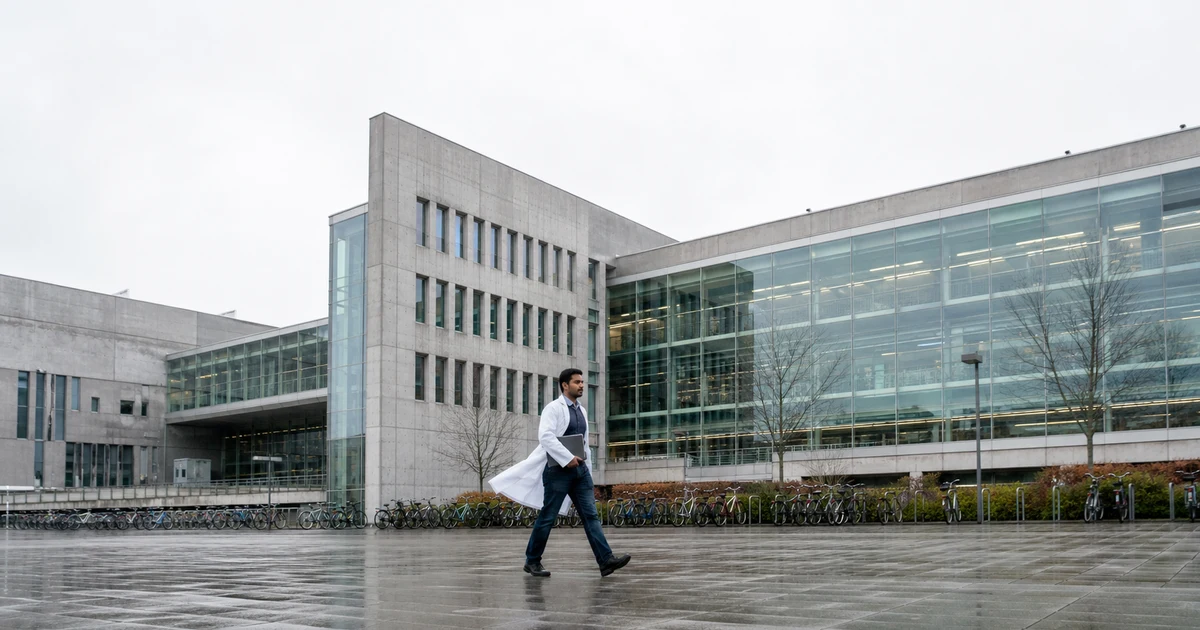
TL;DR: The ~8% figure is not a number TUM publishes. It belongs to a handful of TUM's oversubscribed CS, data and management master's. TUM's master's admission is not a rank-and-cut cutoff at all: it is a two-stage aptitude assessment with points first and a 20-minute interview second. Judge your programme, not the university.
Eight percent is the number that circulates, and it does more damage to good applicants than to weak ones. People with a genuinely matching profile talk themselves out of applying; people with no module fit apply anyway and are counted in the denominator. Here is what the figure is actually measuring.
What TUM itself publishes, and what it does not
TUM does not put an institution-wide acceptance rate on its own pages. What it does publish, as of the winter semester 2025/26, is that it has 51,954 students, that 45 percent of them are international, that it runs 177 degree programmes, and that its students come from about 140 countries.
Sit with the first two figures for a moment. Forty-five percent of nearly fifty-two thousand is roughly 23,000 international students currently enrolled at one university. That is not the profile of an institution that turns away nineteen applicants in twenty across the board. It is the profile of an institution where a small number of famous programmes are brutally oversubscribed and the other hundred and seventy-odd are not.
Which programmes produce the 8%
Computer science, data science, AI and robotics, management, and a few engineering fields. These take applications from every continent for a cohort of a few hundred seats, and a few thousand applicants against a modest intake drives a rate down fast. Nothing about the number describes TUM as a whole, and TUM's own catalogue of 177 programmes is the reason why.
How TUM actually decides, which is not a cutoff
This is the part that changes how you should prepare, and almost nobody quoting the eight percent mentions it. TUM's master's admission runs through an aptitude assessment procedure in two stages.
In the first stage your bachelor grades and your written application materials are scored on a point system. Depending on the points you accumulate, one of three things happens: you are admitted outright, you are rejected, or you are invited to an interview. The second stage is that interview: TUM describes it as a 20-minute admissions interview conducted by the department, and for international applicants a telephone interview can take the place of an in-person one.
Three consequences follow. First, a borderline grade average is not automatically fatal, because the written materials carry points of their own and there is a second stage to reach. Second, the letter of motivation and CV are being marked, not skimmed, so a generic one costs you real points. Third, if you are invited to the interview, that is a signal you are already in contention, and you should prepare for it like a viva on your own bachelor's work rather than treating it as a formality.
What the rate quietly excludes
An acceptance rate counts everyone who pressed submit. That pool includes applicants with missing documents, applicants whose transcript never carried the prerequisite modules, and applicants who were never eligible in the first place. None of them were ever in competition with you.
Your own odds are set by module fit, grades and a complete file, and a candidate who has all three converts at a much better rate than the headline implies. We go through the maths of that in how hard German admission actually is.
Where the competition is thinner
TUM also runs less saturated engineering degrees, interdisciplinary programmes and newer ones where the pressure is nothing like the headline. Across 177 programmes the gap between the selective end and the rest of the catalogue is wide.
| Program area | Competition | Note |
|---|---|---|
| CS/data/AI | Very high | Drives ~8% |
| Management | High | Selective |
| Engineering | Mixed | Varies by program |
| Newer/interdisciplinary | Lower | More attainable |
For how TUM sits against the rest of the country, see which German universities are genuinely hard to get into.
There is no single TUM deadline, and that catches people out
Do not look for one date. TUM's own dates and deadlines page says, for both bachelor's and master's, to refer to the specific programme for its application deadline. A friend's deadline is not your deadline, and last year's is not this year's.
The dates TUM does publish centrally are the edges of the calendar. The Studienkolleg application window runs May 15 to July 15 for the winter semester and November 15 to January 15 for the summer. Enrolment itself happens in February at the earliest for the summer semester and not before August for the winter one. Work backwards from your own programme page, and read the whole calendar in TUM's admissions deadlines and VPD requirements.
Tuition is a filter too
TUM charges non-EU students tuition on top of everything else: usually 2,000 or 3,000 euros per semester for a bachelor's and 4,000 or 6,000 euros per semester for a master's. That price thins the applicant pool in the fee-heavy programmes compared with a no-fee alternative elsewhere, which is one reason the headline rate is a poor guide to your own chances. It also means TUM plus Munich rent is one of the more expensive public routes in Germany, so check the brand genuinely serves the career you want before you pay for it. The fee schedule and the exemption list are in TUM's tuition for international students.
What actually moves your odds
Apply across a mix of TUM programmes and stronger backups, verify module fit line by line rather than by impression, and submit a complete file early. The VPD and APS have to be finished before, not during. Because the first stage scores your written materials, write the motivation letter against the specific programme's own module list rather than against TUM as a brand. Read the application mistakes that sink German applications and which route your application takes.
A low rate is not a reason to skip TUM if your profile fits. It is a reason not to let one selective programme carry your entire plan, which is the point of the guide to Germany's most competitive master's.
If you do apply
Budget the 11,904 euros blocked account and start the student visa timeline early, because the appointment queue is often the binding constraint. See blocked account costs and the student visa walkthrough.
Sources
- TUM in figures
- TUM master's application and aptitude assessment
- TUM dates, periods and deadlines
- TUM tuition fees
- DAAD
Want to know where you sit against that pool? The free profile evaluation checks your profile against TUM's most competitive programmes.
Frequently Asked Questions
You probably qualify for more than you think.
Students who get evaluated find programmes they had no idea existed — at universities that charge nothing. 2 minutes, no cost. The only downside is not checking.
Want our guides higher up in Google?
Mark GradGermany as a preferred source and Google gives our pages more room when you search about studying in Germany. Takes one tap, and you can undo it any time from the same screen.
Living this, or on your way to it? Tell your story.
If you are already in Germany and finding it hard, or still fighting to get here, other students need to hear it from someone real. Share your honest journey. We help shape it, and nothing goes live until you approve it.
Related Guides
Free German Quiz · No Login
Can you score 10/10 on today's German challenge?
10 new words every day · 4,500+ words from A1 to C1 · takes about a minute.
Related Articles
Study in Germany
Physician Assistance Klinische Akut- und Notfallmedizin (90CP), M.Sc.
Fachhochschule des Mittelstands (FHM)
Rostock, Berlin, Bielefeld, Köln, Bamberg, Hannover, Düren, Frechen, Waldshut
M.A.Komparatistik: Welt I Literatur I Medien, M.A.
Johannes Gutenberg-Universität Mainz
Mainz
M.Sc.Game Technologies, M.Sc.
Hochschule Bonn-Rhein-Sieg, University of Applied Sciences
Sankt Augustin