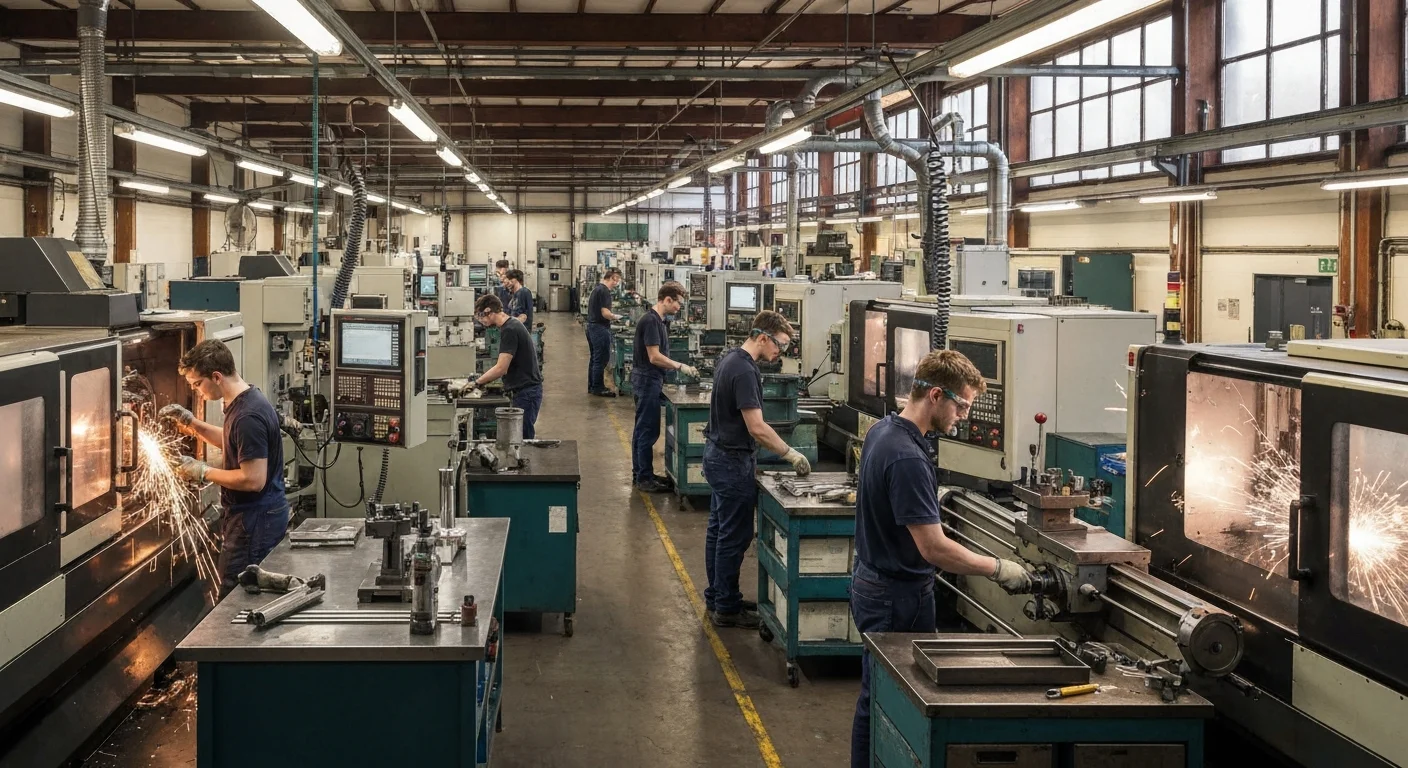
Mechanical Engineering in Germany
Germany is the world's engineering capital -- home to BMW, Mercedes-Benz, Bosch, and Siemens. Study Mechanical Engineering at elite TU9 universities with zero tuition fees, cutting-edge Industry 4.0 research, and an 18-month post-study work visa.
JEE Main to mechanical engineering in Germany
Indian students who wrote JEE Main can apply directly to Germany's top mechanical engineering Bachelor's programmes at RWTH Aachen, TU Munich, KIT and others. JEE Main score + Class 12 + APS certificate is the standard admission pack.
Leading Universities in Germany
World-class education with strong industry ties and international recognition.
Technische Hochschule Deggendorf
Deggendorf, Bayern
Applied mechanical engineering with strong automotive and manufacturing industry ties.
Technische Universität München
München, Bayern
Germany's top TU for mechanical engineering. Close ties with BMW, Siemens, and MAN.
RWTH Aachen
Aachen, Nordrhein-Westfalen
Europe's largest mechanical engineering faculty with world-class research labs.
Universität Stuttgart
Stuttgart, Baden-Württemberg
Heart of Germany's automotive industry. Partnered with Porsche, Daimler, and Bosch.
Karlsruher Institut für Technologie
Karlsruhe, Baden-Württemberg
Leading research in production science, automotive, and materials engineering.
Technische Universität Darmstadt
Darmstadt, Hessen
Strong mechanical engineering with focus on simulation, mechatronics, and production.
Showing 481–504 of 1,548 programmes
Maschinenbau / Werkstofftechnik, B.Eng.
Hochschule für Technik, Wirtschaft und Medien Offenburg · Offenburg
Maschinenbau ausbildungsintegriert, B.Eng.
Hochschule Kaiserslautern (University of Applied Sciences) · Kaiserslautern
Apply by 15 Nov · 60d leftMaschinenbau berufsbegleitend, B.Eng.
Hochschule Heilbronn, Technik, Wirtschaft, Informatik · Heilbronn
Maschinenbau dual ausbildungsintegrierend, B.Eng.
Fachhochschule Südwestfalen · Soest
Maschinenbau dual praxisintegrierend, B.Eng.
Fachhochschule Südwestfalen · Soest
Maschinenbau dual, B.Eng.
Jade Hochschule - Wilhelmshaven/Oldenburg/Elsfleth · Wilhelmshaven
Maschinenbau im Praxisverbund, B.Eng.
Hochschule Braunschweig/Wolfenbüttel, Ostfalia Hochschule für angewandte Wissenschaften · Wolfenbüttel
Maschinenbau in Teilzeit, B.Sc.
FH Münster University of Applied Sciences · Steinfurt
Apply by 15 Nov · 60d leftMaschinenbau in Teilzeit, M.Sc.
FH Münster University of Applied Sciences · Steinfurt
Apply by 15 Nov · 60d leftMaschinenbau International, Bachelor, B.Eng.
Hochschule für Angewandte Wissenschaften Hof · Hof
Apply by 30 NovMaschinenbau Master, M.Sc.
Hochschule Karlsruhe - Technik und Wirtschaft · Karlsruhe
Maschinenbau Mechatronik, M.Sc.
Technische Hochschule Mittelhessen - THM · Friedberg
Maschinenbau mit angewandter Informatik, M.Sc.
Technische Universität Kaiserslautern (jetzt: RPTU) · Kaiserslautern
Maschinenbau mit BWL, B.Sc.
Technische Universität Kaiserslautern (jetzt: RPTU) · Kaiserslautern
Maschinenbau mit BWL, M.Sc.
Technische Universität Kaiserslautern (jetzt: RPTU) · Kaiserslautern
Maschinenbau mit Praxissemester, B.Eng.
Fachhochschule Dortmund · Dortmund
Maschinenbau mit Praxissemester, B.Sc.
Hochschule Osnabrück · Osnabrück
Maschinenbau mit Schwerpunkt Digitalisierung, B.Eng.
Hochschule Bremen · Bremen
Maschinenbau PLuS, B.Eng.
FH Aachen · Jülich
Maschinenbau und Design im Praxisverbund, B.Eng.
Hochschule Emden/Leer · Emden
Apply by 30 Sep · 14d leftMaschinenbau und Design, B.Eng.
Hochschule Emden/Leer · Emden
Maschinenbau und Digitalisierung (Berufsbegleitendes Studienprogramm des Graduate Campus der Hochschule Aalen), M.Eng.
Hochschule Aalen - Technik, Wirtschaft und Gesundheit · Aalen
Maschinenbau und Management, M.Eng.
Hochschule Schmalkalden · Schmalkalden
Maschinenbau und Produktion (dual), B.Sc.
HAW Hamburg · Hamburg
Check My Fit
3 quick questions — every result gets a fit tag based on your budget and languages. Stored only on this device.
Tags are an indication based on tuition and teaching language — for a real assessment, get a free profile evaluation.
What you’ll study — core subjects & specializations
A German mechanical engineering degree builds on a strong base of engineering science before letting you branch into a specialization. Bachelor’s programmes are broad and theory-heavy in the early semesters; Master’s programmes are where you focus deeply on a research or industry track. The exact module names vary by university, but the foundations below are common across most institutions.
Typical core foundations
- · Engineering mathematics, statics & dynamics
- · Thermodynamics & fluid mechanics
- · Materials science & strength of materials
- · Machine elements & engineering design (CAD)
- · Control engineering, electrical fundamentals & measurement
- · Manufacturing technology & a final thesis project
Common specialization tracks
- · Automotive & powertrain engineering
- · Production engineering & Industry 4.0 / automation
- · Mechatronics & robotics
- · Energy & power engineering (incl. renewables)
- · Aerospace & lightweight construction
- · Simulation, CAE & computational mechanics
Not sure which track fits your background? A free profile evaluation will map your degree and interests to the right specialization and shortlist matching programmes.
Entry requirements for mechanical engineering in Germany
Requirements vary by university and degree level, so always confirm against the specific programme page. The points below describe what is generally expected for international applicants — treat them as a starting checklist rather than a guarantee.
Academic background
For a Master’s, you typically need a recognised Bachelor’s in mechanical engineering or a closely related field, with strong grades in core subjects. For a Bachelor’s, a school-leaving qualification considered equivalent to the German Abitur is generally required; some applicants first complete a Studienkolleg foundation year.
Language proof
For English-taught programmes you usually submit IELTS or TOEFL (commonly IELTS around 6.5). For German-taught programmes you generally need TestDaF or DSH at the level the university specifies. The GRE is usually not required, though a few programmes request or recommend it.
APS & application route
Applicants from India, China and Vietnam generally need an APS certificate verifying their academic documents before applying. Many universities also process applications through the uni-assist portal, while others accept direct applications — check each programme.
Because requirements and portals differ so much between universities, the safest approach is to confirm each item on the official programme page. Our team can help you assemble the right document pack — start with the GradGermany homepage to see how the process works.
Careers & salaries for mechanical engineers in Germany
Germany’s industrial base — automotive, machinery, energy and aerospace — gives mechanical engineering graduates one of the deepest job markets in Europe. The figures below are typical, approximate ranges; actual pay depends heavily on region, employer, sector and experience, and salaries evolve over time.
Typical roles
- · Design / development engineer
- · Production & manufacturing engineer
- · Simulation / CAE engineer
- · Quality & process engineer
- · R&D engineer in automotive, energy or aerospace
Approximate salary ranges
- · Entry-level roles typically pay around €48,000–€58,000 per year
- · With a few years’ experience, generally around €60,000–€80,000
- · Senior & specialist roles can exceed €90,000, especially in automotive
Ranges are indicative only and vary by employer, region and qualifications.
Staying to work after graduation
After completing a degree in Germany, international graduates can generally apply for an 18-month residence permit to look for a job related to their qualification. Once you secure a suitable position, you can usually switch to a work residence permit or the EU Blue Card. Given the strong demand for engineers, mechanical engineering is one of the fields where this pathway tends to work well — though immigration rules can change, so verify current conditions before you rely on them.
Frequently Asked Questions About Mechanical Engineering in Germany
Germany is synonymous with engineering excellence. It is the birthplace of the automobile and the global leader in precision manufacturing, home to iconic companies like BMW, Mercedes-Benz, Volkswagen, Porsche, Bosch, Siemens, ThyssenKrupp, and BASF. The prestigious TU9 alliance of technical universities -- including TU Munich, RWTH Aachen, KIT Karlsruhe, University of Stuttgart, TU Darmstadt, and TU Dresden -- consistently rank among the world's top 50 for mechanical and automotive engineering in QS and THE rankings. Germany's mechanical engineering sector employs over 1.3 million people and generates annual revenue exceeding €230 billion, making it the country's largest industrial employer. This unmatched ecosystem of academic excellence and industrial demand ensures outstanding career prospects for graduates. Germany also leads Europe in patent filings for mechanical and automotive innovations, and its dual education system creates a unique bridge between academic research and practical industry application that benefits international students.
Yes. The vast majority of public universities charge no tuition fees for Mechanical Engineering programmes, even for international students. Students pay only a nominal semester contribution of approximately €150–€350, which typically includes a public transport pass. The sole exception is Baden-Württemberg, where non-EU students pay €1,500 per semester at universities like KIT Karlsruhe and University of Stuttgart. Even so, a two-year ME Master's in Germany costs under €25,000 total including living expenses, compared to $50,000–$100,000 at top US engineering schools. This makes a world-class engineering education dramatically more affordable than comparable programmes in the US, UK, Canada, or Australia, and students can work up to 140 full days or 280 half days per year to offset costs. Indian students must open a blocked account (Sperrkonto) of €11,904 for the student visa, covering one year of living expenses. Many engineering students take paid HiWi (research assistant) positions at their university or institute.
Yes, a growing number of German universities offer Mechanical Engineering Master's programmes taught entirely in English. Notable English-taught options include RWTH Aachen's Production Systems Engineering, TU Munich's Mechanical Engineering, KIT Karlsruhe's Mechanical Engineering, and University of Stuttgart's Computational Mechanics of Materials and Structures (COMMAS). Some programmes are bilingual, starting in English and transitioning to German. Bachelor's programmes in English are less common but available at select institutions such as RWTH Aachen and Rhine-Waal University. Learning German to at least B1 level is strongly recommended because it greatly enhances career prospects with German manufacturers. Many universities offer free German language courses alongside the main engineering programme. Bachelor's programmes in English are less common but available at institutions such as RWTH Aachen International Academy and Rhine-Waal University of Applied Sciences. The automotive sector in particular values engineers with both English and German proficiency, as technical documentation and factory-floor communication are typically conducted in German.
Germany is at the forefront of Industry 4.0 -- the fourth industrial revolution integrating smart manufacturing, IoT, cyber-physical systems, and AI into production processes. The term was coined in Germany at the Hannover Messe trade fair, and German companies like Siemens, Bosch, and Festo are global leaders in implementing these technologies. Students studying Mechanical Engineering in Germany gain first-hand exposure to smart factory concepts, digital twins, additive manufacturing, and predictive maintenance through university research labs, Fraunhofer and Leibniz institute collaborations, and internship programmes at leading manufacturers. The federal government has invested over €200 million in Industry 4.0 research platforms, positioning graduates at the cutting edge of modern engineering practice. The Hannover Messe, the world's largest industrial technology trade fair held annually in Germany, showcases the latest Industry 4.0 innovations and provides excellent networking opportunities for students and graduates in mechanical engineering.
Career prospects are outstanding. Germany faces a persistent shortage of qualified engineers across the automotive, aerospace, energy, and manufacturing sectors, with the VDMA (German Engineering Federation) reporting tens of thousands of unfilled positions annually. Starting salaries average €50,000–€55,000 per year, with experienced professionals earning €70,000–€95,000 or more, and senior engineers at companies like BMW, Porsche, or Siemens exceeding €100,000. Germany's 18-month post-study job seeker visa provides ample time to secure employment. After just two years of work with a German degree, you become eligible for permanent residency (Niederlassungserlaubnis), offering a clear and reliable pathway to settling in Europe's strongest economy. The EU Blue Card is also available for engineers earning above €45,300 per year, providing an additional fast-track immigration option. Many German companies offer structured graduate training programmes (Trainee-Programme) that combine rotational assignments across departments with mentorship from senior engineers.
Admission typically requires a Bachelor's degree in Mechanical Engineering or a closely related discipline (Automotive Engineering, Aerospace Engineering, Mechatronics, or Production Engineering) with a minimum GPA equivalent of 2.5 on the German scale or approximately 65%+ in the Indian grading system. You also need English proficiency at B2/C1 level (IELTS 6.5+ or TOEFL 90+), strong academic transcripts, a statement of purpose, and a CV detailing any internships or project work. Indian applicants must also obtain an APS certificate from the German Embassy in New Delhi, which involves document verification and a brief academic interview, typically taking 4–8 weeks and costing approximately €150. GRE scores are generally not required by German universities, removing a significant financial and logistical barrier compared to US admissions. Most applications are submitted through uni-assist, the centralised portal, which charges €75 for the first application and €30 for each additional one.
The automotive industry employs over 800,000 people in Germany and generates annual revenue exceeding €500 billion, making it the world's third-largest auto producer. The sector is undergoing a massive transformation towards electric mobility and autonomous driving, creating enormous demand for engineers skilled in battery technology, electric powertrains, and ADAS systems. Regions like Stuttgart (Mercedes-Benz, Porsche, Bosch), Munich (BMW, MAN), Wolfsburg (Volkswagen), and Ingolstadt (Audi) are global centres of automotive innovation. Graduates find outstanding career opportunities in powertrain engineering, lightweight construction, battery technology, vehicle dynamics, and production automation. Starting salaries in the German automotive sector average €52,000–€58,000, among the highest for ME graduates. The shift to electric vehicles has created thousands of new roles in battery engineering, electric drivetrain design, and charging infrastructure. German OEMs and Tier-1 suppliers like ZF Friedrichshafen, Continental, and Schaeffler are also major employers of mechanical engineers.
The leading institutions include TU Munich (ranked #1 in Germany and top 25 globally), RWTH Aachen (Europe's largest technical university with over 47,000 students), KIT Karlsruhe (the German MIT, combining a university and national research centre), University of Stuttgart (located in the heart of Germany's automotive region), TU Darmstadt (strong in production engineering and mechatronics), and TU Dresden (known for lightweight construction and materials science). These TU9 universities are globally recognised for research in automotive engineering, robotics, fluid dynamics, thermodynamics, materials science, production engineering, and renewable energy systems, and maintain close partnerships with major industry employers. Other excellent options include TU Braunschweig (strong in automotive and aerospace research), Leibniz University Hannover (production engineering and additive manufacturing), and University of Erlangen-Nürnberg (materials science and manufacturing technology). These universities offer state-of-the-art laboratories, industry-funded research projects, and mandatory internship components that give students hands-on experience before graduation.
Explore More Programmes in Germany
Ready to Study Mechanical Engineering
in Germany?
Get a free profile evaluation from our experts. We will assess your academic background, recommend the best Mechanical Engineering programmes for your profile, and guide you through the entire application process.