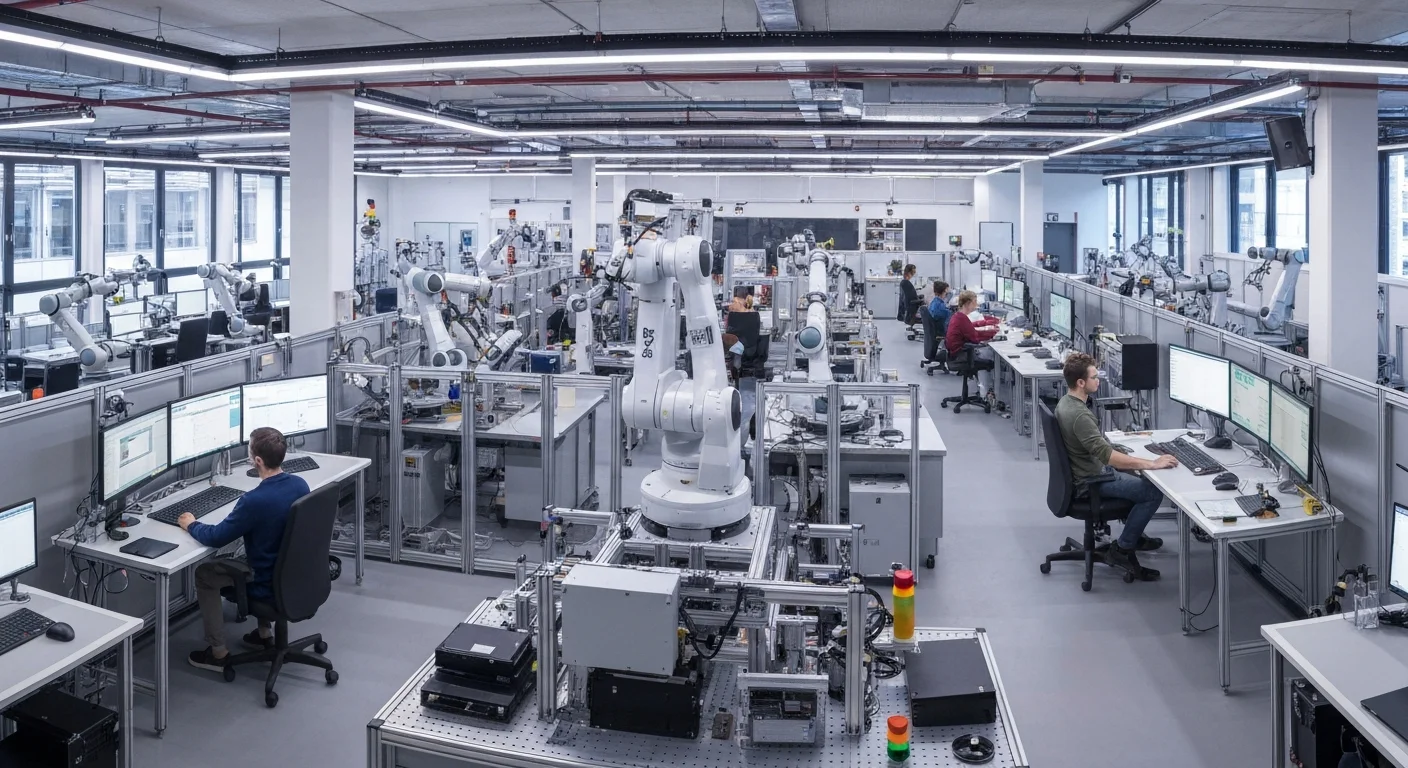
Mechatronics & Robotics in Germany
Germany leads the world in mechatronics and robotics -- home to KUKA, Festo, Franka Emika, and Bosch. Study at elite TU9 universities with zero tuition fees, hands-on Industry 4.0 research, and an 18-month post-study work visa.
Leading Universities in Germany
World-class education with strong industry ties and international recognition.
Technische Hochschule Deggendorf
Deggendorf, Bayern
Strong mechatronics & IoT programmes with industry labs.
Technische Universität München
München, Bayern
World-leading robotics research, DLR partnership.
RWTH Aachen
Aachen, Nordrhein-Westfalen
IGMR institute - top robotics & mechanism design.
Karlsruher Institut für Technologie
Karlsruhe, Baden-Württemberg
Cyber-physical systems, KUKA collaboration.
Technische Universität Darmstadt
Darmstadt, Hessen
Control engineering & automation excellence.
Universität Stuttgart
Stuttgart, Baden-Württemberg
Mechatronics & smart systems engineering.
Showing 1–24 of 162 programmes
Advanced Systems Design (Systemtechnik), M.Sc.
Hochschule Aalen - Technik, Wirtschaft und Gesundheit · Aalen
AI Engineering of Autonomous Systems, M.Eng.
Technische Hochschule Ingolstadt · Ingolstadt
Analytic Instruments, Measurement and SensorTechnology (AIMS), M.Eng.
Hochschule für angewandte Wissenschaften Coburg · Coburg
Apply by 2 DecAngewandte Forschung und Entwicklung in den Ingenieurswissenschaften, M.Sc.
Technische Hochschule Rosenheim · Rosenheim
Apply by 30 NovAngewandte Robotik, M.Eng.
Hochschule für Technik und Wirtschaft Dresden · Dresden
Apply by 15 Nov · 60d leftApplied Research in Engineering Sciences, M.Sc.
Ostbayerische Technische Hochschule Amberg-Weiden · Amberg
Apply by 1 DecApplied Research in Engineering Sciences, M.Sc.
Ostbayerische Technische Hochschule Regensburg · Regensburg
Applied Research in Engineering Sciences, M.Sc.
Hochschule für angewandte Wissenschaften Ansbach · Ansbach
Apply by 15 DecArtificial Intelligence and Robotics, M.Sc.
Technische Universität Nürnberg (UTN) · Nürnberg
Artificial Intelligence and Robotics, M.Sc.
Hochschule für Angewandte Wissenschaften Hof · Hof
Artificial Intelligence, M.Sc.
Brandenburgische Technische Universität Cottbus-Senftenberg · Cottbus
Automation and Control, M.Sc.
Technische Universität Kaiserslautern (jetzt: RPTU) · Kaiserslautern
Automation and IT, M.Eng.
Technische Hochschule Köln · Gummersbach
Automation and Production, deutsch-französischer Studiengang, M.Eng.
Hochschule für angewandte Wissenschaften München · München
Automation and Robotics, M.Sc.
Technische Universität Dortmund · Dortmund
Automation and Safety (ISE), M.Sc.
Universität Duisburg-Essen · Duisburg
Automatisierung, M.Sc.
HAW Hamburg · Hamburg
Automatisierungstechnik (dual), M.Ed.
Bergische Universität Wuppertal · Wuppertal
Automatisierungstechnik und Informatik, M.Eng.
Hochschule Merseburg · Merseburg
Apply by 15 DecAutomatisierungstechnik und Robotik, M.Eng.
Hochschule für angewandte Wissenschaften Kempten · Kempten
Automatisierungstechnik, kleine berufliche Fachrichtung, M.Ed.
Universität Paderborn · Paderborn
Automatisierungstechnik, M.Ed.
Rheinland-Pfälzische Technische Universität Kaiserslautern-Landau · Kaiserslautern
Automatisierungstechnik, M.Ed.
Bergische Universität Wuppertal · Wuppertal
Automatisierungstechnik, M.Sc.
Fachhochschule Westküste, Hochschule für Wirtschaft und Technik · Heide
Apply by 15 Nov · 60d leftCheck My Fit
3 quick questions — every result gets a fit tag based on your budget and languages. Stored only on this device.
Tags are an indication based on tuition and teaching language — for a real assessment, get a free profile evaluation.
What You’ll Study — Core Subjects & Specializations
Mechatronics sits at the intersection of mechanical engineering, electronics, computer science, and control theory. A German Bachelor’s typically builds a broad engineering foundation, while a Master’s — where most international students enter — lets you specialise in robotics, automation, or intelligent systems. Curricula are generally hands-on, with significant lab work and an industry-linked thesis project.
Core foundations
- · Engineering mathematics, mechanics & dynamics
- · Electrical engineering, sensors & actuators
- · Control systems & signal processing
- · Programming, embedded systems & microcontrollers
- · CAD, simulation & system modelling
Common specialization tracks
- · Industrial & service robotics
- · Automation & Industry 4.0 / smart manufacturing
- · Autonomous systems & mobile robotics
- · Artificial intelligence & machine learning for robotics
- · Mechatronic product design & mechatronic systems
Not sure which track fits your background? A free profile evaluation can map your degree and interests to suitable programmes.
Entry Requirements for International Students
Requirements vary by university and programme, but most Mechatronics & Robotics applicants are assessed on the same core criteria. Always confirm the exact requirements on the official programme page before applying.
Academic background
A recognised Bachelor’s in mechatronics, mechanical, electrical, electronics, or a closely related engineering field. Master’s programmes generally expect a solid grounding in mathematics, control, and programming.
Language proficiency
English-taught programmes typically require IELTS (often around 6.5) or an equivalent TOEFL score. German-taught programmes usually require proof such as TestDaF or DSH. Learning German alongside your studies generally helps with internships and jobs.
APS certificate
Students from India, China, and Vietnam generally need an APS certificate verifying their academic documents before applying or applying for a visa. It is valid indefinitely once issued and can be reused across applications.
Application & uni-assist
Many universities process international applications through uni-assist, which checks documents and converts grades. Others use their own portals — check each programme’s instructions carefully.
GRE
Unlike the US, the GRE is usually not required for engineering Master’s programmes in Germany. A small number of programmes may request it — verify on the programme page.
Proof of funds & visa
A student visa generally requires proof of finances, typically via a blocked account, plus health insurance. Amounts are revised periodically, so check the current figure with your German mission before applying.
Careers & Salaries in Germany
Germany’s strength in automation, automotive, and industrial machinery makes it one of the best places in Europe to launch a mechatronics or robotics career. Graduates are recruited by automation and robotics firms such as KUKA, Festo, and Bosch, as well as automotive groups, machine builders (the “Mittelstand”), and a growing robotics start-up scene. The figures below are approximate ranges and vary by role, employer, region, and experience.
Typical roles
- · Robotics / automation engineer
- · Mechatronics engineer
- · Control systems engineer
- · Embedded systems engineer
- · R&D / product development engineer
Approximate salary ranges
Entry-level engineering roles typically pay around €48,000–€60,000 per year gross. With a few years of experience this generally rises into the roughly €65,000–€85,000 range, with senior and specialised roles often higher. Salaries are usually highest in the south (Bavaria, Baden-Württemberg).
Staying after graduation
Non-EU graduates of a German university can generally apply for an 18-month post-study residence permit to look for a job related to their qualification. Once employed at the required salary level, many engineers transition to an EU Blue Card and, over time, toward permanent residence.
Want help shortlisting programmes that lead to these careers? Start with the GradGermany homepage or get a free profile evaluation.
Frequently Asked Questions About Mechatronics & Robotics in Germany
Germany is the undisputed global leader in industrial robotics and automation. It is home to KUKA (one of the world's largest industrial robot manufacturers), Festo (bionic robotics pioneer), Franka Emika (collaborative robots), Bosch, and Siemens. The prestigious TU9 alliance of technical universities offers world-class mechatronics programmes with cutting-edge labs, and Germany's strong manufacturing sector means students gain direct exposure to real-world smart systems and Industry 4.0 technologies. Programmes at TU Munich, KIT Karlsruhe, and RWTH Aachen consistently rank among Europe's best for robotics and intelligent systems. With zero tuition fees at public universities, starting salaries of €52,000–€58,000, and an 18-month post-study work visa, Germany is the most attractive destination for aspiring mechatronics engineers globally.
Yes. The vast majority of public universities charge no tuition fees for Mechatronics & Robotics programmes, even for international students. Students pay only a nominal semester contribution of approximately €150–€350, which typically includes a public transport pass valid across the state. This applies at institutions like TU Munich, KIT Karlsruhe, RWTH Aachen, TU Darmstadt, and University of Stuttgart. The sole exception is Baden-Württemberg, where non-EU students pay €1,500 per semester — still far below comparable programmes in the US ($30,000–$60,000 per year) or UK (£20,000+). For your student visa, you will need a blocked account with €11,904 to cover annual living expenses. This makes world-class mechatronics and robotics education dramatically more affordable than any comparable destination worldwide.
Yes, several German universities offer Mechatronics and Robotics Master's programmes taught entirely in English. English-taught options are available at TU Munich (Robotics, Cognition, Intelligence), KIT Karlsruhe (Mechatronics and Information Technology), TU Darmstadt (Autonomous Systems), and RWTH Aachen (Robotic Systems Engineering). These programmes cover intelligent systems, autonomous robotics, and smart manufacturing. Application deadlines typically fall in July for the winter semester and January for the summer intake. English proficiency requirements include IELTS 6.5+ or TOEFL 90+. Some programmes are bilingual (English and German). Indian applicants should also prepare their APS certificate early. Learning German alongside your studies can further boost your career prospects when working at employers like KUKA, Festo, Bosch, and Siemens.
Mechatronics is an interdisciplinary field that combines mechanical engineering, electrical engineering, and computer science into a unified discipline. While mechanical engineering focuses on physical systems and machines, mechatronics integrates sensors, actuators, embedded controllers, and software to create intelligent, automated systems. Think of a robotic arm in a factory: the mechanics are mechanical engineering, but the sensors, motors, control algorithms, and programming that make it move autonomously are mechatronics. In Germany, this field is called Mechatronik and is taught at all major TU9 universities including TU Munich, KIT Karlsruhe, and TU Darmstadt. The curriculum typically spans 4 semesters at the Master's level and includes hands-on lab work with industrial robots, PLCs, embedded microcontrollers, and computer vision systems — skills directly applicable to Germany's booming Industry 4.0 manufacturing sector.
Career prospects are outstanding. Germany faces a severe shortage of qualified mechatronics and robotics engineers across the automotive, manufacturing, logistics, and healthcare sectors. Starting salaries average €52,000–€58,000 per year, with experienced professionals in automation, robotics systems design, or smart manufacturing earning €75,000–€100,000 or more. Top employers include KUKA (Augsburg), Festo (Esslingen), Bosch (Stuttgart), Siemens (Munich), and BMW (Munich), all of which actively recruit international graduates. Engineers in Munich and Stuttgart typically earn 10–15% above the national average. Germany's 18-month post-study job seeker visa provides ample time to secure employment and transition to an EU Blue Card, with a clear pathway to permanent residency after 21–33 months of qualifying employment.
Admission typically requires a Bachelor's degree in Mechatronics, Mechanical Engineering, Electrical Engineering, or a closely related discipline with a minimum GPA equivalent to the German grade of 2.5 or better. English proficiency must be at B2/C1 level (IELTS 6.5+ or TOEFL 90+), and strong academic transcripts with a solid foundation in mathematics, physics, and programming are essential. GRE scores are generally not required by German universities, removing a significant barrier compared to US admissions. Application deadlines are typically July 15 for the winter semester and January 15 for the summer intake. Most international applicants apply through the uni-assist portal (€75 fee). Indian students must also obtain an APS certificate and open a blocked account with €11,904 for the student visa application.
Germany coined the term Industry 4.0 and leads its global implementation. Mechatronics is the foundational discipline of Industry 4.0, combining cyber-physical systems, IoT sensors, embedded computing, and intelligent automation into smart factories. Students studying mechatronics in Germany gain first-hand exposure through university research labs partnered with companies like Siemens, Bosch, and KUKA, often with opportunities for paid internships paying €12–€15 per hour and thesis projects directly in Industry 4.0 environments. RWTH Aachen operates the Aachen Center for Additive Manufacturing, TU Munich hosts the Munich School of Robotics and Machine Intelligence, and KIT Karlsruhe runs a dedicated smart production lab. Graduates with Industry 4.0 expertise command starting salaries of €52,000–€58,000, among the highest for engineering graduates in Europe.
The leading institutions include TU Munich (renowned for robotics and autonomous systems research at the Munich Institute of Robotics and Machine Intelligence), KIT Karlsruhe (leading mechatronics and intelligent systems lab with Industry 4.0 pilot factories), RWTH Aachen (automation, production technology, and close ties to Fraunhofer IPT), TU Darmstadt (robotics, autonomous systems, and human-robot interaction, with its own RoboCup championship team), and University of Stuttgart (smart manufacturing and cyber-physical systems adjacent to Bosch and Festo). All belong to the prestigious TU9 alliance of Germany's top technical universities. These institutions maintain strong partnerships with KUKA, Siemens, and Bosch, and offer state-of-the-art robotics laboratories where students build and programme industrial and collaborative robots.
Explore More Programmes in Germany
Ready to Study Mechatronics & Robotics
in Germany?
Get a free profile evaluation from our experts. We will assess your academic background, recommend the best Mechatronics & Robotics programmes for your profile, and guide you through the entire application process.