Germany vs Canada vs Australia for Nepali Students: Costs Compared
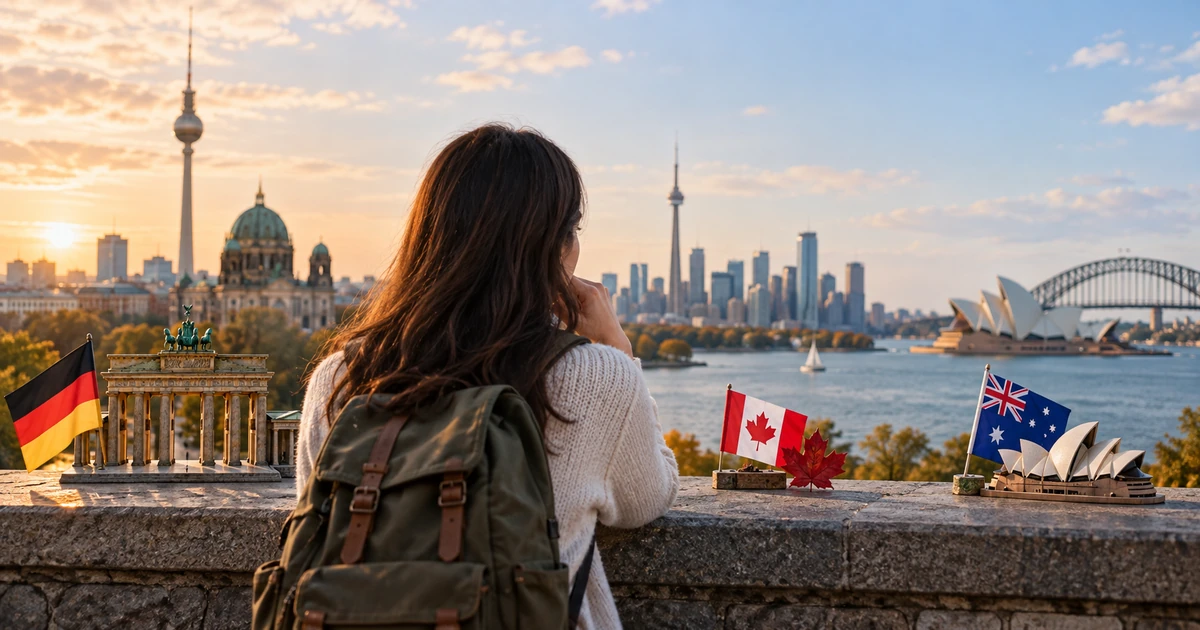
For a Nepali family choosing between Germany, Canada and Australia, the decision usually comes down to four numbers: how much money you must show for the visa, what tuition costs, how many hours you can work while studying, and how long you can stay after graduating. This page puts those numbers side by side, from each government's own pages, converted to rupees at Nepal Rastra Bank selling rates on 9 October 2026 (EUR 173.50, CAD 108.78, AUD 107.86). Banks will quote slightly different rates on the day you pay.
The four numbers, side by side
| Germany | Canada | Australia | |
|---|---|---|---|
| Living costs you must show for one year | EUR 11,904 (about NPR 20.7 lakh) | CAD 23,448 (about NPR 25.5 lakh), plus first-year tuition and travel | AUD 29,710 (about NPR 32 lakh), plus 12 months of course fees and AUD 2,000 travel |
| Visa fee | EUR 75 (about NPR 13,000) | CAD 150 study permit plus CAD 85 biometrics (about NPR 25,600) | From AUD 2,500 (about NPR 2.7 lakh) |
| Typical tuition | None at most public universities; Baden-Wuerttemberg EUR 1,500 a semester; TUM more | Average international fees 2025/26: CAD 41,746 undergraduate, CAD 24,028 graduate per year | Set per course; no official national average |
| Work during term | 140 full or 280 half days a year, or 20 hours a week | 24 hours a week off campus | 48 hours a fortnight |
| Stay after graduating | Up to 18 months to find a job | Post-graduation work permit of up to 3 years | Temporary Graduate visa, 2 to 3 years depending on degree |
Sources: Germany, Make it in Germany and the German Embassy Kathmandu; Canada, IRCC on proof of funds, fees and work hours, and Statistics Canada for tuition; Australia, the Department of Home Affairs and Study Australia.
Money you must show, and money you must spend
Look at the first row again. Canada and Australia ask for their living-cost amount on top of your first year's tuition, and Australia adds a travel allowance. Germany's EUR 11,904 is the whole requirement for most students, because most public universities charge no tuition.
Kathmandu also has a quirk that helps Nepali applicants. The German Embassy does not require a blocked account up front; it may ask for one during processing, and it also accepts scholarships, a sponsor's formal obligation letter or documented family finances. Our blocked account guide covers the options.
Visa fees show the same gap at a smaller scale. A German student visa costs about NPR 13,000. An Australian one starts at about NPR 2.7 lakh, about twenty times as much.
Tuition is where the gap gets large
Statistics Canada puts the average international undergraduate fee at CAD 41,746 a year for 2025/26, about NPR 45 lakh, and the average international graduate fee at CAD 24,028, about NPR 26 lakh. Provinces differ widely: international undergraduates pay an average of CAD 49,802 in Ontario and CAD 18,867 in Newfoundland and Labrador. Australia publishes no national average, so check the course page; fees there are set by each university and course.
In Germany, a two-year master's at most public universities costs only the semester contribution, roughly EUR 70 to 430 per semester according to DAAD, often including a public transport ticket. The exceptions, Baden-Wuerttemberg and TUM, are listed in our free tuition guide.
Working while you study
Australia and Canada look similar here. Australia allows 48 hours a fortnight during term, and Canada allows 24 hours a week off campus during regular sessions; both allow more during scheduled breaks. Germany counts working days instead: 140 full or 280 half days a year, or up to 20 hours a week during the semester, with jobs as a student assistant at the university not counted at all.
The hours are comparable. The real difference is language. Part-time work in Canada and Australia runs in English. In Germany, a student who speaks German at B1 or above has many more jobs open than one who does not.
After graduation
Canada is the most generous on paper: a master's of at least eight months can lead to a three-year post-graduation work permit, though most applicants now have to submit language test results (IRCC). Australia's Post-Higher Education Work stream gives 2 years after a bachelor's or coursework master's and 3 after a research master's or PhD, for applicants aged 35 or under (Home Affairs).
Germany gives 18 months to find a job, during which you may work in any job. Once you find qualified work, you switch to a skilled-worker permit or EU Blue Card. The 2026 Blue Card salary floor is EUR 50,700, falling to EUR 45,934.20 for graduates within three years of their degree (Federal Gazette). The whole post-study path is in our post-study work visa guide.
Language: the real trade-off
This is the honest case for Canada and Australia. Everything, from lectures to supermarket small talk to job interviews, happens in English. Germany has many English-taught master's programmes, but daily life, many part-time jobs and many graduate jobs outside tech expect German. A Nepali student who arrives with A1 and stops there will find Germany harder than the cost table suggests. One who reaches B1 or B2 during the degree opens up the German job market. Our guide to German language requirements explains what each level gets you.
Two practical points also matter from Kathmandu. Canada now asks most study permit applicants for a provincial attestation letter, though master's and doctoral students at public institutions starting from 1 January 2026 are exempt (IRCC). Germany's Embassy has moved visa appointments to a waiting list, so start early.
Which country fits which student
- Germany fits a student with a strong academic record, a tight budget and the patience to learn German, especially in engineering, computer science and the natural sciences.
- Canada fits a family that can afford the tuition and wants a long post-study window in an English-speaking job market.
- Australia fits a student who wants English throughout, can fund high fees and a large visa charge, and will be 35 or younger when applying for the graduate visa.
For the broader case for Germany, including what life there is like, read why Nepali students choose Germany. If you want a straight answer on where your profile fits, our free profile evaluation looks at your grades, budget and goals.
Frequently Asked Questions
You probably qualify for more than you think.
Students who get evaluated find programmes they had no idea existed — at universities that charge nothing. 2 minutes, no cost. The only downside is not checking.
Want our guides higher up in Google?
Mark GradGermany as a preferred source and Google gives our pages more room when you search about studying in Germany. Takes one tap, and you can undo it any time from the same screen.
Get new guides as soon as they go live
Add our feed to Feedly, Inoreader or any RSS reader and every new guide on studying in Germany shows up there by itself. No email, no sign-up.
Living this, or on your way to it? Tell your story.
If you are already in Germany and finding it hard, or still fighting to get here, other students need to hear it from someone real. Share your honest journey. We help shape it, and nothing goes live until you approve it.
Free German Quiz · No Login
Can you score 10/10 on today's German challenge?
10 new words every day · 4,500+ words from A1 to C1 · takes about a minute.