Indian Students in Germany Cross 69,800: What the 2025/26 Numbers Mean for You

TL;DR: 69,816 Indian students were enrolled at German universities in winter semester 2025/26, roughly 10,400 more than the year before, a 17.5 percent jump. India is now the single largest source country for international students in Germany, well ahead of China. Good news for the ecosystem. Slightly worse news for your odds at the ten universities everyone applies to.
The headline number landed in August 2026 and it is genuinely large: 69,816 Indian students at German universities in winter semester 2025/26. That is about 10,400 more than the previous winter, a rise of 17.5 percent in a single year, and it keeps India in first place as Germany's largest group of international students.
Most coverage stops at the number. The more useful question is what a run of double-digit growth like this actually changes for someone applying for 2027. So let's go through it honestly, including the parts that do not flatter the trend.
Where the number comes from
The 69,816 figure was reported in August 2026 by Business Standard, drawing on data from the German Academic Exchange Service (DAAD).
The year before it, DAAD's own press release of 26 November 2025 put the total at just under 59,000 Indian students, itself a 20 percent rise. That release also recorded 402,000 international students and doctoral candidates in Germany overall, and 116,600 international first-year students, a record.
Two consecutive years of roughly 20 percent growth is not something that reverses on its own.
India vs China, and why the gap keeps widening
| Country of origin | Students (DAAD, WS 2024/25) | Direction |
|---|---|---|
| India | Just under 59,000 | Up 20 percent year on year |
| China | 38,600 | Down 7 percent since 2019/20 |
China held the top spot for years. It no longer does. Chinese enrolment has been drifting down since before the pandemic while Indian enrolment has compounded, and the 2025/26 figure of 69,816 pushes the gap wider still.
The reasons are not mysterious. Public universities charge no tuition, so the cost of a German master's is mostly rent and the semester contribution. The post-study job-seeker route runs 18 months. Immigration policy in the US, UK, Canada and Australia has tightened at exactly the moment Germany's has loosened. If you have been reading our comparison of why Indian students are choosing Europe, none of this is new.
What growth actually does to your application
Here is the part that gets skipped. More Indian students in Germany does not mean it is easier to get in. In some respects it is the opposite.
- Restricted programmes get more restricted. Numerus clausus courses have a fixed number of seats. When applications double and seats do not, the effective cut-off grade rises. That is arithmetic, not opinion.
- The famous ten absorb the surge. TU Munich, RWTH Aachen, TU Berlin, KIT and the rest of the TU9 group receive a wildly disproportionate share of Indian applications. Meanwhile excellent universities in Magdeburg, Kaiserslautern, Ilmenau and Cottbus stay comparatively open.
- Housing tightens before admissions do. Student accommodation in Munich, Berlin and Stuttgart was already the binding constraint. Another 10,000 arrivals a year does not help.
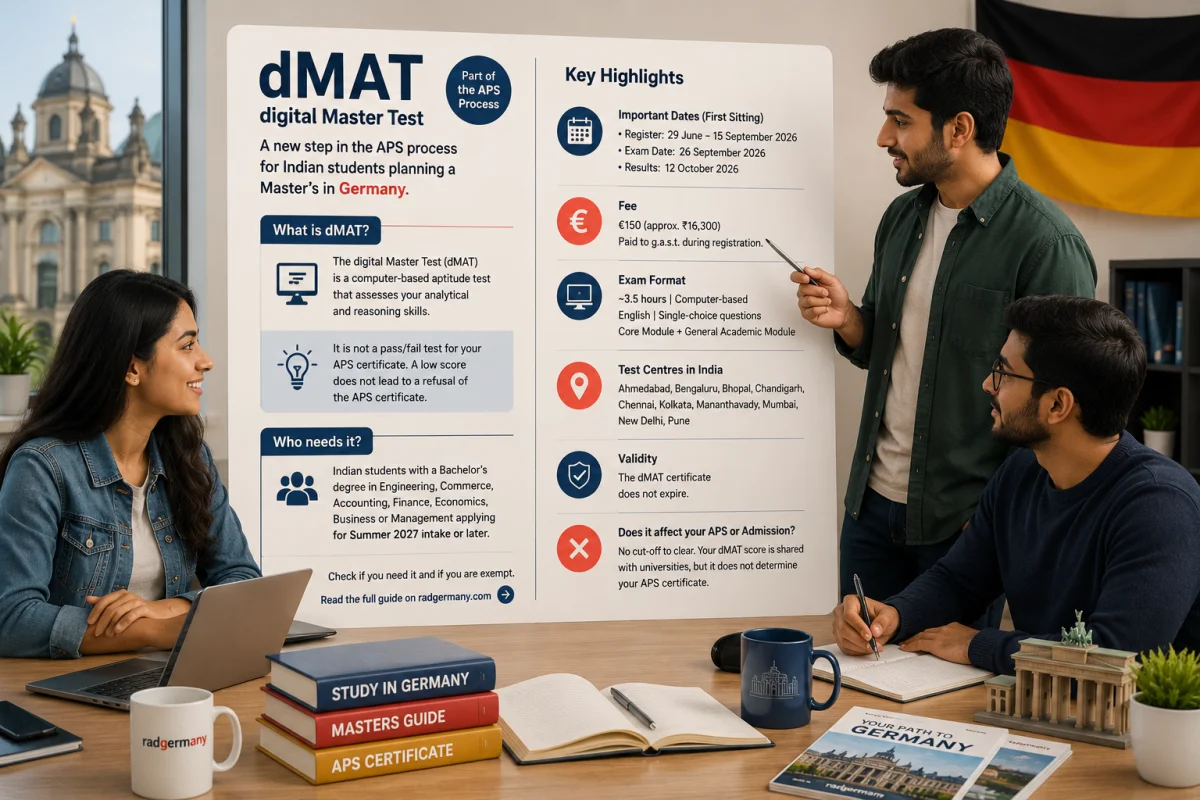
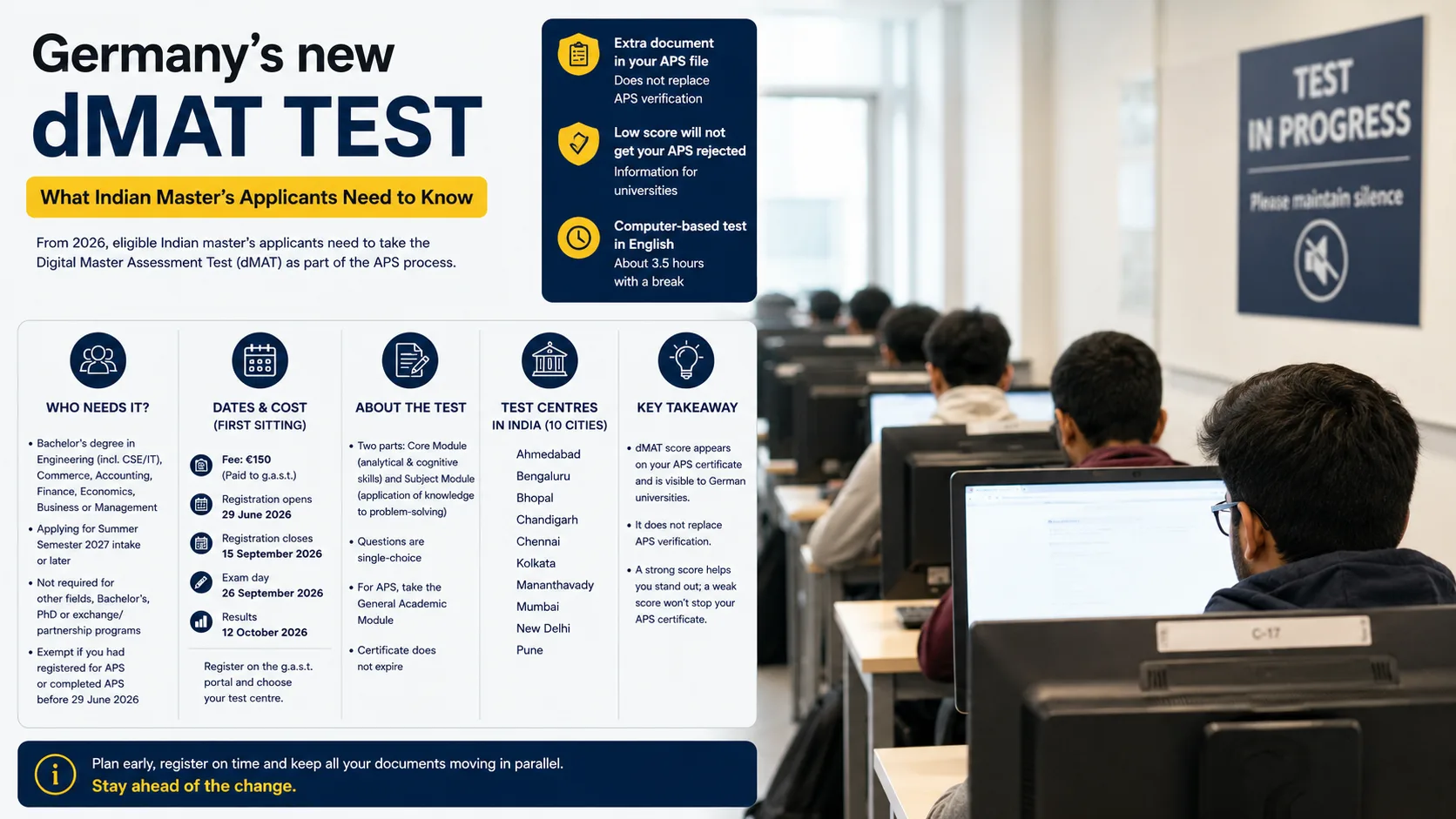
- The paperwork bar keeps rising. Volume brings scrutiny. APS and the newer dMAT requirement both exist because the pipeline grew faster than the verification systems behind it.
The dropout number nobody quotes
The same DAAD release carried a figure that deserves more attention than the enrolment headline. Among international students in Germany, the bachelor's dropout rate is 16 percent, against 13 percent for German students. At master's level it is 9 percent against 6 percent.
Those gaps are modest, and DAAD framed them as lower than previously assumed. Still, roughly one in eleven international master's students does not finish. Language, money and isolation do most of that damage, and all three are manageable if you plan for them before you fly rather than after.
What to do differently for 2027
If you are applying into a market growing at 17.5 percent a year, applying the way everyone else does is the weakest available strategy.
Apply to eight to ten programmes, not three, and make sure at least half are outside the TU9 and outside Munich and Berlin. Get your APS certificate moving months earlier than feels necessary, because APS plus uni-assist processing quietly eats six weeks off every published deadline. Check whether the dMAT applies to your bachelor's field before you plan anything else. And if your target course is taught in German, treat the language certificate as a twelve-month project.
The scholarship side is where most applicants leave money on the table. Germany's political foundations, the Deutschlandstipendium and Erasmus Mundus all take applications from Indian students, and all of them receive far fewer applications than DAAD does.
Sources
Frequently Asked Questions
You probably qualify for more than you think.
Students who get evaluated find programmes they had no idea existed — at universities that charge nothing. 2 minutes, no cost. The only downside is not checking.
Want our guides higher up in Google?
Mark GradGermany as a preferred source and Google gives our pages more room when you search about studying in Germany. Takes one tap, and you can undo it any time from the same screen.
Living this, or on your way to it? Tell your story.
If you are already in Germany and finding it hard, or still fighting to get here, other students need to hear it from someone real. Share your honest journey. We help shape it, and nothing goes live until you approve it.
Related Guides
Free German Quiz · No Login
Can you score 10/10 on today's German challenge?
10 new words every day · 4,500+ words from A1 to C1 · takes about a minute.