Saxony and Mecklenburg-Vorpommern EUR 1,500 Fee Bills: Where They Stand
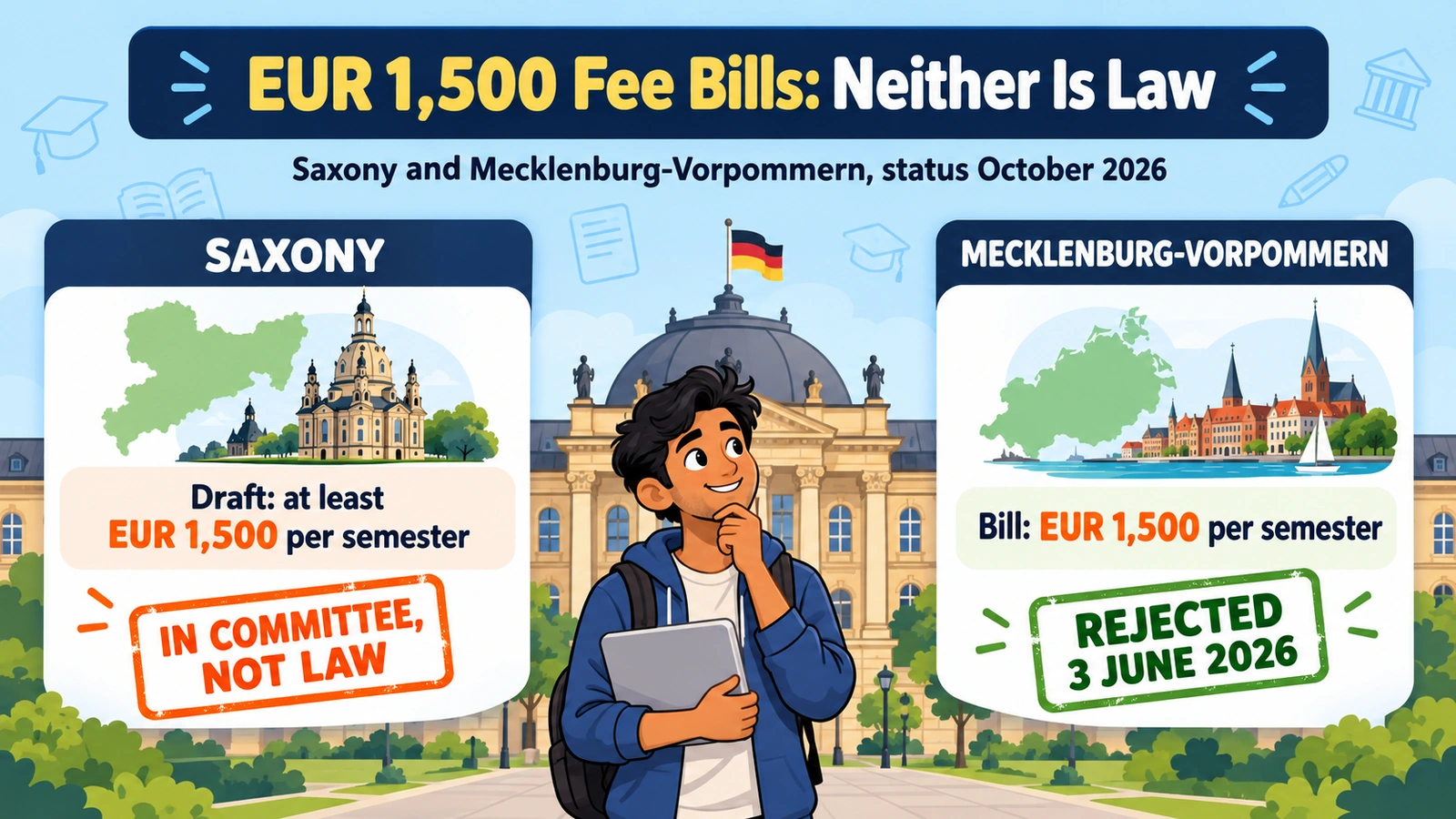
TL;DR: Saxony tuition fees for international students are still only a proposal: an AfD bill asking non-EU students for at least EUR 1,500 per semester has sat in committee since December 2025 and is not law. Mecklenburg-Vorpommern's version (EUR 1,500, or EUR 3,000 for medicine) was voted down on 3 June 2026. Saxon universities can already charge non-EU students under current law if they also run a scholarship scheme, so your programme page at TU Dresden or Leipzig decides what you pay.
Who proposed the EUR 1,500 fees
You may have read that Saxony and Mecklenburg-Vorpommern (MV) plan EUR 1,500 fees. Neither bill comes from a state government. Both were tabled by the AfD group in each state's parliament (Landtag), and a group bill only becomes law if a majority votes for it.
Saxony's bill is Drucksache 8/4703, received on 4 November 2025. MV's is Drucksache 8/6316, dated 4 March 2026. Both name Baden-Wuerttemberg as the model, where non-EU students have paid EUR 1,500 per semester since winter 2017/18 (see our Baden-Wuerttemberg fee guide).
Saxony tuition fees for international students: what the bill says
The draft would make the fee compulsory at every state university in Saxony, from TU Dresden and Leipzig University to TU Chemnitz and TU Bergakademie Freiberg. Point by point:
- Amount: at least EUR 1,500 per semester. The draft sets a floor and no upper limit.
- Who pays: anyone who is not an EU or EEA citizen. Indian and Nepali passport holders are in this group.
- Which degrees: first degrees and consecutive master's programmes, both free under Saxon law today.
- Start: winter semester 2026/27, as written.
- Students already enrolled: no transition rule. The fee would fall due at each re-registration (Rueckmeldung).
Exemptions and the refund
You would not pay with a German school-leaving qualification such as the Abitur, after at least five years' main residence in Saxony before starting, or if a parent worked and paid tax in Saxony for three years or more. Hardship cases, students whose disability seriously affects their studies, and semesters on leave or in practical training are covered too. Universities could waive the fee for especially gifted students, up to 5 percent of international first-year students.
The unusual part is a refund. Graduates who then work and pay tax in Saxony for five uninterrupted years could reclaim their fees if they apply within the following year. The bill expects up to EUR 48 million a year from about 16,000 non-EU students.
Where the Saxony bill stands on 12 October 2026
The first reading was on 4 December 2025. Only the AfD spoke, and the bill went to committee. The science committee heard seven experts at a public hearing on 27 April 2026. The Landtag's document system shows no step after that: no committee recommendation, no second reading, status "nicht erledigt" (not concluded). The planned start, winter 2026/27, has begun without it.
Mecklenburg-Vorpommern: the bill was rejected
MV's draft was simpler: EUR 1,500 per semester, EUR 3,000 in human medicine, due within a month of enrolment, with no start semester named. Exemptions included holders of a German school-leaving qualification, people who had already finished both a bachelor's and a master's in Germany, and merit waivers for up to 10 percent of a university's foreign students.
At the first reading on 18 March 2026, the Landtag refused to send it to committee; only the AfD and one independent member voted for referral. Science minister Bettina Martin (SPD) told the chamber that tuition fees "are exactly the opposite of equal opportunity" (our translation). On 3 June 2026, at the final vote, the Landtag rejected the bill. If you are looking at Rostock or Greifswald, this fee is off the table.
MV then elected a new Landtag on 20 September 2026. The AfD came first with 38.2 percent and won 32 of 71 seats, short of a majority on its own. Any new fee would need a fresh bill and a majority in that parliament.
Saxony, MV and Baden-Wuerttemberg compared
| Point | Saxony | Mecklenburg-Vorpommern | Baden-Wuerttemberg |
|---|---|---|---|
| Legal basis | Drs 8/4703, AfD group bill | Drs 8/6316, AfD group bill | State law |
| Fee per semester | At least EUR 1,500 | EUR 1,500 (EUR 3,000 in medicine) | EUR 1,500 |
| Who pays | Non-EU/EEA citizens | Non-EU/EEA citizens | Non-EU/EEA citizens |
| Start | Winter 2026/27 (as drafted) | Day after publication | Winter 2017/18 |
| Status, 12 Oct 2026 | In committee, not law | Rejected 3 June 2026 | In force |
All 16 states are in our Germany tuition fees by state 2026 overview.
TU Dresden tuition fees: the option that already exists
Section 13(3) of the Saxon Higher Education Act already lets each university charge non-EU students in first degrees and consecutive master's programmes, on one condition: it must offer a scholarship programme for the same group. The AfD bill would turn that option into a duty with a minimum.
At the April hearing, TU Dresden's vice-rector for education, Niels Modler, said the university already charges fees in continuing-education programmes and "does not rule out tuition fees for the future if needed" (our translation). He added that "considerations on this are being made" (our translation). So a TU Dresden fee could come from the university itself, with no new law. We found no announced fee for its regular degrees as of 12 October 2026.
What it means if you apply for 2026/27 or 2027
- Starting winter 2026/27 in Saxony: no state fee applies today. If the bill passed unchanged, the fee would be due at your next re-registration, because the draft has no transition rule. The committee could add one. Nothing guarantees it.
- Summer 2027 or winter 2027/28 at TU Dresden, Leipzig or Chemnitz: keep EUR 1,500 per semester, so EUR 3,000 a year, in your budget as a contingency. Our Dresden cost guide covers rent and daily spending.
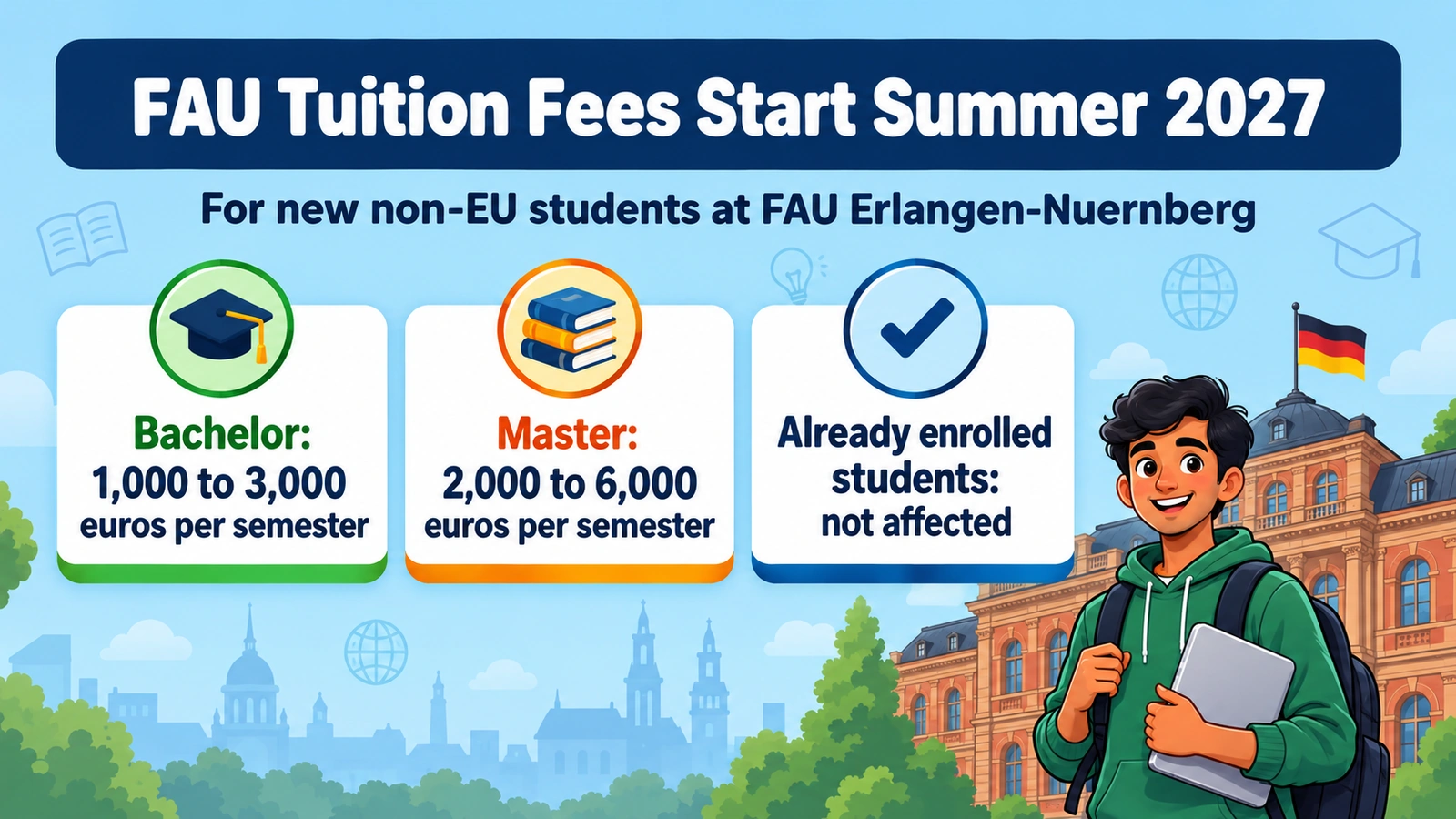
- Still choosing a state: see our free-tuition master's guide, the Bavaria guide and the FAU Erlangen 2027 update.
- Rostock or Greifswald: the MV bill was rejected on 3 June 2026. Check the programme page and budget for the normal semester contribution.
What is not known yet
- When, or whether, the Saxon science committee votes.
- Whether a final version keeps EUR 1,500 as a floor, adds a cap, protects enrolled students or picks a new start date.
- What counts as hardship. The draft leaves that to a ministry regulation.
- Whether TU Dresden or another Saxon university uses the option it already has, and what MV's new parliament does.
Until one of those changes, the only rule on non-EU tuition in Saxony is the optional one in section 13(3).
How to check the status yourself
- Search Drucksache 8/4703 in the Saxon Landtag's EDAS document system. Look for a "Beschlussempfehlung" (committee recommendation), then a "2. Beratung" (second reading).
- Read section 13 of the Saxon Higher Education Act on REVOSAX. Any change in the law shows up there.
- On your programme page, look for "Studiengebuehren" or the university's "Gebuehrenordnung" (fee regulations). The semester contribution is not tuition.
- For MV, search "Studiengebuehren" in the Landtag's ParlDok database. A new bill would carry a new Drucksache number.
Not sure which state fits your budget?
If a possible EUR 3,000 a year changes your shortlist, ask for a free profile evaluation. We match your grades, budget and intake to programmes, with fees in view.
Sources
- Saechsischer Landtag: Drs 8/4703, AfD bill on tuition fees for international students (4 November 2025)
- Saechsischer Landtag: Plenarprotokoll 8/23, first reading of Drs 8/4703 (4 December 2025)
- Saechsischer Landtag: APr AWK 8/12, transcript of the public hearing on Drs 8/4703 (27 April 2026)
- Saechsischer Landtag: EDAS documentation, process record for Drs 8/4703 (12 October 2026)
- REVOSAX Sachsen: Saechsisches Hochschulgesetz, section 13 (version valid from 1 January 2025)
- Landtag Mecklenburg-Vorpommern: Drs 8/6316, AfD bill amending the higher education act (4 March 2026)
- Landtag Mecklenburg-Vorpommern: Plenarprotokoll 8/127, first reading of Drs 8/6316 (18 March 2026)
- Landtag Mecklenburg-Vorpommern: Beschlussprotokoll of the 133rd session (3 June 2026)
- Landesamt fuer innere Verwaltung M-V: Landtagswahl 20 September 2026, final result
- Landeswahlleitung M-V: Landtagswahl 2026, seat allocation (final result)
- Universitaet Tuebingen: Studiengebuehren for international students (12 October 2026)
Frequently Asked Questions
You probably qualify for more than you think.
Students who get evaluated find programmes they had no idea existed — at universities that charge nothing. 2 minutes, no cost. The only downside is not checking.
Want our guides higher up in Google?
Mark GradGermany as a preferred source and Google gives our pages more room when you search about studying in Germany. Takes one tap, and you can undo it any time from the same screen.
Living this, or on your way to it? Tell your story.
If you are already in Germany and finding it hard, or still fighting to get here, other students need to hear it from someone real. Share your honest journey. We help shape it, and nothing goes live until you approve it.
Free German Quiz · No Login
Can you score 10/10 on today's German challenge?
10 new words every day · 4,500+ words from A1 to C1 · takes about a minute.