Study in Germany from Bangladesh: Visa, Documents & Timeline
TL;DR: Bangladeshi students need their degree and transcripts verified, a 11,904 euros blocked account, and a national student visa at EUR 75. Germany's public universities are tuition-free, and English-taught master's programmes are the main route. Apply 9-12 months early.
Bangladesh is not on the APS list, and that cuts both ways. There is no verification office to queue at, which shortens your timeline compared with India or Pakistan. There is also nobody checking your paperwork before it reaches a German admissions officer, so a translation problem or an unrecognised institution surfaces at the worst possible moment: after the deadline, with the intake gone.
So the work for a Bangladeshi applicant is front-loaded onto two things. Get the documents right. Get the money in place. Everything else, and Germany makes the rest genuinely easy, follows from those.
Check that your degree is recognised before you pay a fee
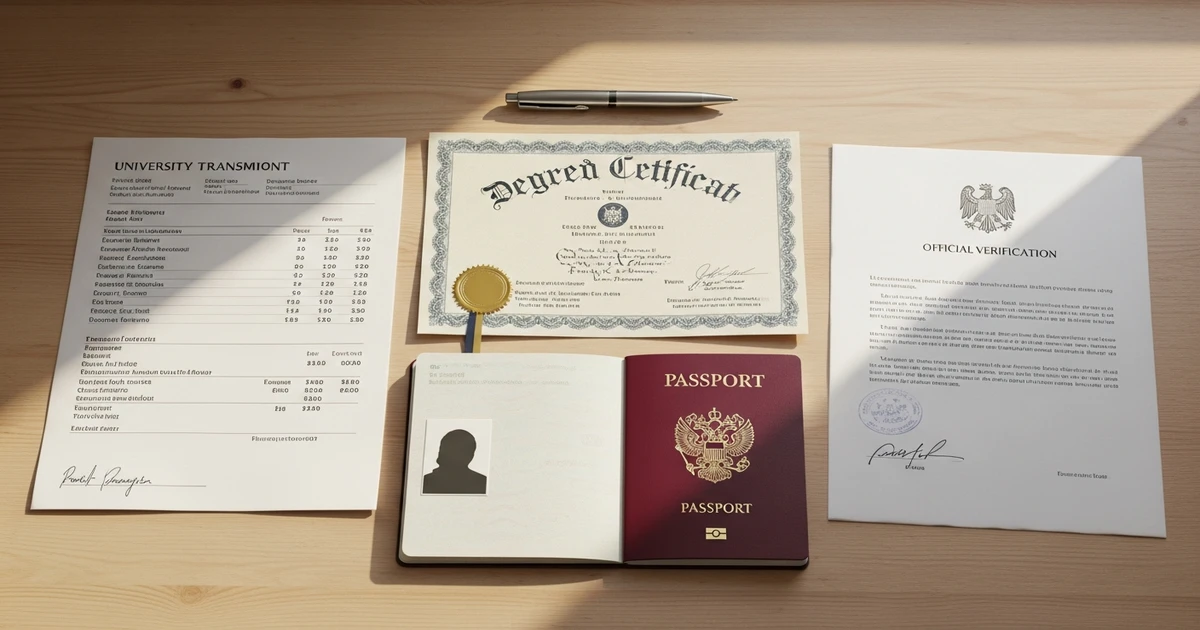
For a master's you need your degree certificate and transcripts. For a bachelor's you need your Higher Secondary Certificate and your SSC. All of it has to be translated into English or German and certified. Then comes the step people skip: recognition is checked against the anabin database, which lists how German authorities rate foreign institutions. Look your university up yourself first, using our guide to reading an anabin entry and what its ratings mean. An hour there can save you a wasted application cycle.
The deadline is earlier than you think
Applicants write "July 15" down and stop reading, but that date is a default, not a rule, and master's programmes routinely close in front of it. TU Berlin is a useful example because it publishes the whole cycle: for winter semester 2026/27, restricted-admission master's programmes taught in English closed on 15 May 2026, the German-taught ones on 15 June, and only the open-admission programmes ran to 31 August. The English-taught date, the one most Bangladeshi applicants need, is the earliest of the three.
If your university routes applications through uni-assist, the VPD has to be finished before that date, and TU Berlin warns international applicants that processing can take several weeks. Work backwards from May, not from July. See how a uni-assist application is processed.
What the application actually costs to send
uni-assist charges EUR 75 for the first course of study you select in a semester and EUR 30 for every further one, at the same rate whether you are making a full application or requesting only a VPD, and the fee covers the assessment regardless of the outcome. Applying to five programmes in one batch costs EUR 195. Spreading the same five across two intakes costs EUR 240, because the EUR 75 first-choice fee resets each semester. Some universities pay the fee for you, which appears as a note against that choice in My assist.
Money: the blocked account
The visa needs a blocked account holding 11,904 euros, which releases 992 euros to you every month once you are in Germany. The Federal Foreign Office ties that figure to the maximum BAfoeG support rates, which is why it is one national number rather than something adjusted for the city you land in. It is not a fee and it is not lost. It is your own money, parked to prove you can support yourself, and paid back to you in instalments to live on.
One thing to know before you pick a provider: the Foreign Office deleted its published list of providers in mid-2022 without replacement, and states that it makes no recommendation and takes no liability if a provider becomes insolvent. So there is no official approved list to check against. Confirm with the mission handling your application that the confirmation document is accepted, and check that the account sits with a licensed institution. Fintiba and Expatrio both serve Bangladeshi applicants; Expatrio publishes its price at EUR 119 to set up and EUR 9 a month, while Fintiba shows its fees only once you start an application. Our guide covers opening a blocked account and getting the money released.
English-taught master's are the main door
Germany has about 2,400 master's programmes taught in English, and that is where almost all Bangladeshi students go, usually into engineering or computer science. The typical requirement is IELTS 6.0-7.0 or an equivalent. Some universities will instead accept proof that your previous degree was taught in English, which is worth confirming before you book a test. See the full English-taught programme list and the universities that admit without IELTS.
Scholarships that remove the blocked account
DAAD funds Bangladeshi students across several programmes, and the fully funded ones cover living costs and insurance. That matters beyond the money: a funded student does not need a blocked account, because the award letter is the proof of financing. German political foundations run their own, smaller programmes on separate deadlines. See how DAAD applications are assessed.
| Item | What Bangladeshis need |
|---|---|
| Verification | Degree + HSC/SSC, translated |
| APS | Not required |
| Application | uni-assist, EUR 75 then EUR 30 each |
| Language | IELTS 6.0-7.0 or German |
| Financing | 11,904 euros or scholarship |
| Insurance | About EUR 141-146 a month |
| Visa | National D visa, EUR 75 |
The visa appointment in Dhaka
The national (type D) student visa is issued by the German embassy in Dhaka. Bring your admission letter, proof of financing, health insurance, verified documents and passport. The fee is fixed by the Residence Regulation at EUR 75 to issue a category D visa, with a further EUR 25 if you extend one later, and processing takes several weeks on top of the wait for an appointment slot, which is usually the longer of the two. Book it the day your admission letter lands. The document checklist is in the German student visa guide.
Health insurance belongs in the same block of work, because enrolment will not proceed without it. Statutory student cover at Techniker Krankenkasse costs 141.16 euros a month if you are under 23 or have a child and 146.29 euros from 23 without children, effective January 2026.
What a month actually costs once you land
Rent is the line that decides whether the blocked account stretches. The Moses Mendelssohn Institut, which surveys student room prices each semester, put the national average at 512 euros a month for summer semester 2026, with Munich at 800 and Berlin at 650, against 385 in Bochum and 375 in Bielefeld. Subtract those from the monthly release and the city choice, not the country choice, is what makes the budget work. Add health insurance at about 146 and you can see why an expensive city needs a job attached to it.
Working while you study
Section 16b of the Residence Act lets a non-EU student work 140 full days or 280 half days a calendar year, with anything up to four hours counting as a half day. Work as a student assistant at your own university does not count against that limit at all. At the statutory minimum wage of 13.90 euros an hour, ten hours a week is roughly 598 euros gross a month, which is most of a Bochum room. A Werkstudent job in your field pays for itself twice: once in rent, and again when the same company hires you after graduation. See how the 140-day limit is counted.
Staying on after the degree
Section 20 of the Residence Act gives graduates up to 18 months to look for work, provided you can support yourself. Once you are employed as a skilled worker, the settlement permit normally takes three years, but having completed your degree in Germany cuts that to two years with 24 months of pension contributions. EU Blue Card holders get there at 27 months, or 21 months with sufficient German. Naturalisation sits further out: the Nationality Act asks for five years of lawful habitual residence. Germany allows dual nationality, so a German passport does not cost you the Bangladeshi one. See what the post-study job-seeker permit allows.
Sources
- Federal Foreign Office - blocked account
- Residence Regulation, section 46 - visa fees
- uni-assist - handling fees
- Moses Mendelssohn Institut - student housing costs
- DAAD
Applying from Bangladesh? Get a free profile evaluation and we will check your institution's anabin status before you spend anything.
Frequently Asked Questions
You probably qualify for more than you think.
Students who get evaluated find programmes they had no idea existed — at universities that charge nothing. 2 minutes, no cost. The only downside is not checking.
Want our guides higher up in Google?
Mark GradGermany as a preferred source and Google gives our pages more room when you search about studying in Germany. Takes one tap, and you can undo it any time from the same screen.
Living this, or on your way to it? Tell your story.
If you are already in Germany and finding it hard, or still fighting to get here, other students need to hear it from someone real. Share your honest journey. We help shape it, and nothing goes live until you approve it.
Free German Quiz · No Login
Can you score 10/10 on today's German challenge?
10 new words every day · 4,500+ words from A1 to C1 · takes about a minute.