Why Study in Germany? 15 Benefits Beyond Free Tuition
TL;DR: Most German public universities charge no tuition, only a semester contribution of EUR 150-390. Add an 18-month post-study job-seeker visa, a settlement permit after two years of skilled work if you studied here, citizenship in five, and part-time work at EUR 13.90/hour. Around 402,000 international students were enrolled in winter 2024/25, just under 59,000 of them from India.
Free tuition gets the headlines and it is real. On its own it is a thin reason to move 6,000 kilometres. What makes Germany work is the machinery around the fee waiver: an admissions route you can plan against through uni-assist and APS, degree equivalence you can check yourself in anabin before you apply, and immigration law rewritten in 2023 and 2024 specifically to keep graduates in the country. Fifteen things below, grouped by what they actually change: your money, your career, your right to stay, and your daily life.
Germany against the other big destinations
Two-year master's at public universities. Private universities charge real tuition and are not in this table.
| Factor | Germany (public) | US / UK / Australia |
|---|---|---|
| Tuition, 2 years | EUR 600-1,560 in semester fees | EUR 40,000-160,000 |
| Proof of funds | EUR 11,904 blocked account | Tuition plus living costs |
| Visa fee | EUR 75 | Higher, plus health surcharge |
| Post-study stay | 18 months, unrestricted work | 12-36 months, lottery-gated |
| Permanent residence | 2 years for German graduates | 5 years or sponsor queues |
| Citizenship | 5 years (3 with exceptional integration) | 5-10 years or longer |
| Living cost | EUR 900-1,200 | EUR 1,500-3,000 |
What it does to your money
Tuition is free in fourteen of the sixteen states
Public universities charge international students nothing in fourteen states. You pay a semester contribution of EUR 150-390, usually with a travel ticket inside it. Two exceptions, and both are worth knowing before you shortlist. Baden-Wuerttemberg charges non-EU students EUR 1,500 per semester, which catches Heidelberg, Freiburg, Konstanz, Mannheim, Tuebingen and Stuttgart. TU Munich has charged non-EU students since winter 2024/25: roughly EUR 2,000-3,000 a semester for bachelor's and EUR 4,000-6,000 for master's, though some TUM master's remain free. The arithmetic is in our month-by-month cost breakdown.
Living costs stay inside a band you can plan against
Budget EUR 900-1,200 a month. The official benchmark is the blocked account, set at EUR 11,904 for twelve months and releasing EUR 992 monthly. Statutory student health insurance runs about EUR 140 a month under 30. Rent is the only line that really moves: a room in Munich can cost twice the same room in Leipzig. Applying early for a Studentenwerk hall beats every other housing tactic there is.
Part-time work covers a real share of that
Non-EU students may work 140 full days or 280 half days a year, about 20 hours a week in term. The minimum wage is EUR 13.90 an hour, so a 15-hour week brings in roughly EUR 830 a month before deductions. Werkstudent contracts at Siemens, Bosch or SAP pay well above the floor and read as experience on a German CV rather than as a side job. The day-counting thresholds are in our student work guide.
A scholarship goes straight to living costs
Because tuition is already zero, funding does not get swallowed by fees. DAAD scholarships for Indian applicants pay a monthly stipend plus health insurance and travel. The Deutschlandstipendium pays EUR 300 a month, half federal and half from a private sponsor, and is awarded by your own university rather than a national jury, which makes it one of the winnable ones. Our scholarship database lists what is currently open.
What it does to your career
Employers outside Germany know the degrees
German engineering and science qualifications travel without explanation. The TU9 group covers RWTH Aachen, KIT, TU Berlin, TU Darmstadt, TU Dresden, TU Braunschweig, Leibniz Hannover, TU Munich and Stuttgart, and recruiters in Zurich, Amsterdam and Bengaluru recognise all nine. German degrees follow the Bologna structure, so ECTS credits transfer across the EU, and the ZAB publishes equivalence rulings you can look up in anabin. Start in our university directory.
The shortage list is the list you are training for
The Federal Employment Agency publishes a shortage-occupation analysis every year, and the same fields keep reappearing: mechanical and electrical engineering, software development, data and IT security, nursing, medical technology, skilled trades. That is why the Skilled Immigration Act was loosened twice inside two years. Take a degree in one of those and you are applying into demand rather than against it.
Salaries have a published floor
Starting salaries for engineering and IT graduates commonly clear EUR 50,000 a year, and you have a number to negotiate against rather than a guess: the 2026 EU Blue Card thresholds are EUR 45,934 for shortage occupations and EUR 50,700 for everything else. An employer hiring you on a Blue Card has to meet them, which puts a hard floor under the offer.
The research institutes are on campus
Fraunhofer's applied-research institutes, the Max Planck Society, the Helmholtz centres and the Leibniz Association usually sit on or next to a university campus. In practice that means paid HiWi assistant jobs, industry-funded thesis projects and lab access a taught master's elsewhere would never include. A Fraunhofer thesis turns into the first job offer often enough to be a strategy.
What it does to your right to stay
Eighteen months to find the job
Section 20(3) of the Residence Act gives graduates of German universities an 18-month residence permit to look for work matching their qualification, with unrestricted work rights in the meantime, including an unrelated full-time job while you search. Sign a qualified contract and you switch to a work permit or an EU Blue Card. The mechanics are in our post-study visa guide.
Permanent residence arrives sooner than people expect
Section 18c of the Residence Act gives a skilled worker a settlement permit after three years, and two years if you completed your degree in Germany. Blue Card holders qualify at 27 months, or 21 months with B1 German. Citizenship follows at five years, or three with exceptional integration including C1 German, and dual citizenship has been allowed since June 2024. Taking a German course in your first semester pulls every one of those dates forward.
What it does to your daily life
You can be admitted without any German
The DAAD International Programmes database lists more than 2,400 English-taught master's programmes, concentrated in engineering, computer science, economics and the natural sciences. Admission asks for IELTS or TOEFL, not TestDaF or DSH. English-taught bachelor's programmes are rare, so school leavers usually need C1 German or a Studienkolleg year. Filter what is open in our programme finder or the masters in Germany overview.
The rest of Europe is a train ride away
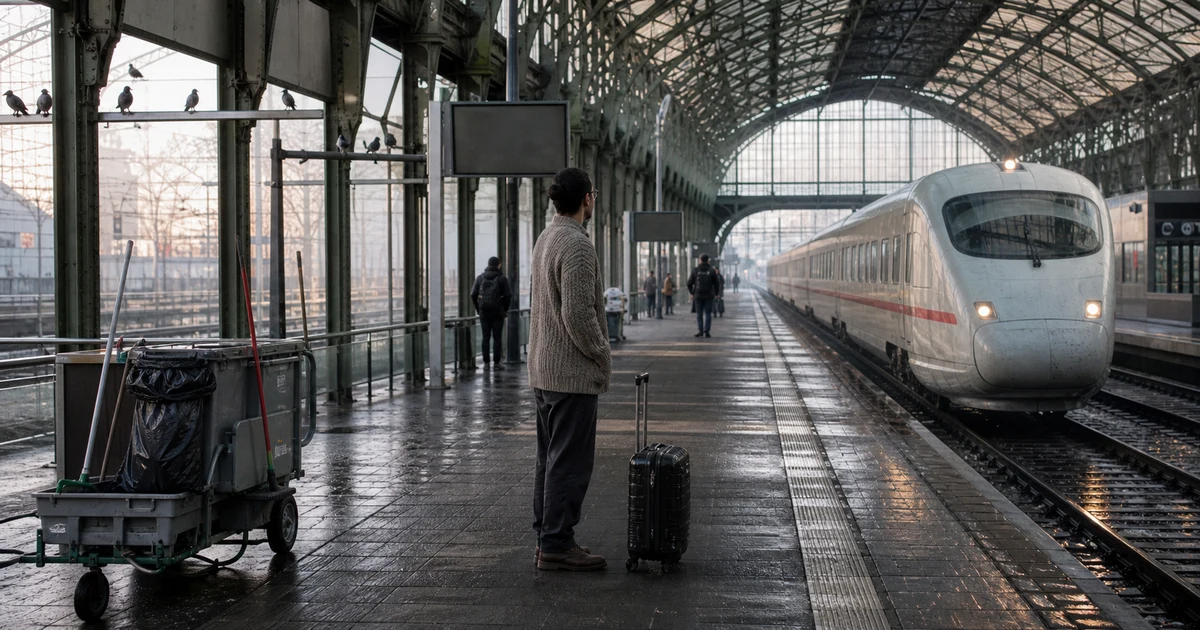
Most semester contributions include a travel ticket, so local transport is already paid for before you think about it. Cologne is one direct train from Amsterdam, Brussels and Paris. Munich is one from Zurich, Salzburg and Vienna. Berlin is one from Prague and Warsaw.
Public institutions are boring in the way you want
Trains, hospitals and university offices run to published rules. Statutory health insurance means an emergency is not also a financial event. Studentenwerk halls are the cheapest rooms in most cities and Mensa meals are subsidised. For a family funding a degree from abroad, that predictability is often what settles the decision.
You will not be the only international student on campus
Around 402,000 international students and doctoral candidates were enrolled in winter 2024/25, up about six per cent year on year, including 116,600 first-years. India is the largest country of origin at just under 59,000. What that means on the ground: Indian grocery stores in Munich, student associations in Hamburg, and someone a year ahead of you who has already survived the Auslaenderbehoerde.
The Indian admission rules are strict and published a year ahead
From winter 2026/27, Indian applicants to bachelor's programmes need 70 per cent of the maximum achievable marks in class XII, across CBSE, ICSE and every state board. The change went into anabin on 15 March 2026; applications filed before that date follow the old rules. There are two routes through it: 70 per cent plus the APS certificate leads to a Studienkolleg place, or 70 per cent plus one completed year of an Indian bachelor's leads to direct admission in the same subject area. Master's and PhD applicants are unaffected. Our grade converter maps your percentage onto the German 1.0-4.0 scale.
What undoes the free-tuition maths
- Treating free as costless. The semester fee, the EUR 11,904 blocked account, EUR 140 insurance and the EUR 75 visa fee all land before your first lecture.
- Assuming every public university is free. Baden-Wuerttemberg and TU Munich charge non-EU students. Confirm it on the programme page, not on a forum.
- Reading English-taught as English-only. Rental contracts, the Anmeldung and the immigration office all run in German.
- Underestimating lead time. APS takes weeks and uni-assist needs four to six more after your documents arrive. Deadlines are 15 July for winter and 15 January for summer.
Sources
- DAAD - Studying in Germany
- Wissenschaft weltoffen
- Section 18c AufenthG
- Make it in Germany
- anabin (KMK)
- uni-assist
- TU Munich - non-EU tuition
- Federal Foreign Office - proof of funds
Which of these fifteen apply to you? Get a free profile evaluation and a dated roadmap from the GradGermany team.
Frequently Asked Questions
You probably qualify for more than you think.
Students who get evaluated find programmes they had no idea existed — at universities that charge nothing. 2 minutes, no cost. The only downside is not checking.
Want our guides higher up in Google?
Mark GradGermany as a preferred source and Google gives our pages more room when you search about studying in Germany. Takes one tap, and you can undo it any time from the same screen.
Get new guides as soon as they go live
Add our feed to Feedly, Inoreader or any RSS reader and every new guide on studying in Germany shows up there by itself. No email, no sign-up.
Living this, or on your way to it? Tell your story.
If you are already in Germany and finding it hard, or still fighting to get here, other students need to hear it from someone real. Share your honest journey. We help shape it, and nothing goes live until you approve it.
Free German Quiz · No Login
Can you score 10/10 on today's German challenge?
10 new words every day · 4,500+ words from A1 to C1 · takes about a minute.