Germany vs Netherlands for Masters: English Programs, Fees, Work
TL;DR: A two-year MSc at TU Delft bills a non-EU student EUR 25,633 a year. The German equivalent bills a semester fee of a few hundred euros. What you buy with the difference is an English-speaking country where you can bank, job-hunt and do your paperwork without ever learning the language. If the budget is the binding constraint, Germany.
Start with the number that decides this for most people. For the 2026-2027 year, TU Delft charges non-EU/EEA master's students EUR 25,633, against a statutory rate of EUR 2,694 for EU and EEA students at the same university. A German public university charges nothing beyond the semester fee. Over a two-year MSc that is a gap of roughly 50,000 euros, which is more than the entire cost of living for a German degree. Everything else in this comparison is a rounding error next to it.
What each degree actually bills you
German public universities charge no tuition, only a semester fee that usually bundles a transport pass. The old 150 to 350 euro range still holds in much of the country, though city universities have moved past it: TU Berlin charges EUR 379.06 for winter semester 2026/27, of which EUR 226.80 is a nationwide public transport ticket. Baden-Wuerttemberg and TU Munich are the exceptions that do charge non-EU students.
In the Netherlands, tuition is real, tiered and set per faculty. The statutory rate is a single national figure, EUR 2,694 for full-time study in 2026-2027, and it applies to EU and EEA students. Everybody else pays the institutional rate, which each university sets for itself.
| Where you study | Non-EU master's tuition, 2026-2027 |
|---|---|
| German public university | 0, plus the semester fee |
| Amsterdam, social and behavioural sciences | EUR 13,200 to 23,455 |
| Amsterdam, economics and business | EUR 20,500 to 24,050 |
| Amsterdam, science | EUR 24,150 to 34,300 |
| Amsterdam, humanities or law | EUR 25,900 |
| Delft, MSc | EUR 25,633 |
Two things to take from that table. The Dutch spread is wide enough that "Netherlands tuition" is not a single number you can plan around; a science master's in Amsterdam can cost more than double a social sciences one. And the fees move each year: Amsterdam applied an indexation of 3.62% for 2026-2027, so a figure you read in an older guide is already low. Our breakdown of what German free tuition really covers has the semester-fee detail by state.
The other fees, which are small but real
Both countries charge for the permit. Germany's national visa is fixed by regulation at EUR 75 to issue, with EUR 25 to extend. The Dutch IND charges EUR 254 for a first study residence permit in 2026, and the same EUR 254 again later if you take the orientation year. Small money against the tuition gap, but worth putting in the spreadsheet rather than discovering at the counter.
Both teach in English, but only one lives in it
Germany has roughly 2,400 English-taught master's programs, which is more absolute choice than any other country on the continent. The Netherlands is smaller but has an even higher share of its catalogue in English, and, more usefully, the English does not stop at the lecture hall. Dutch pharmacies, landlords and municipal offices switch to English without blinking.
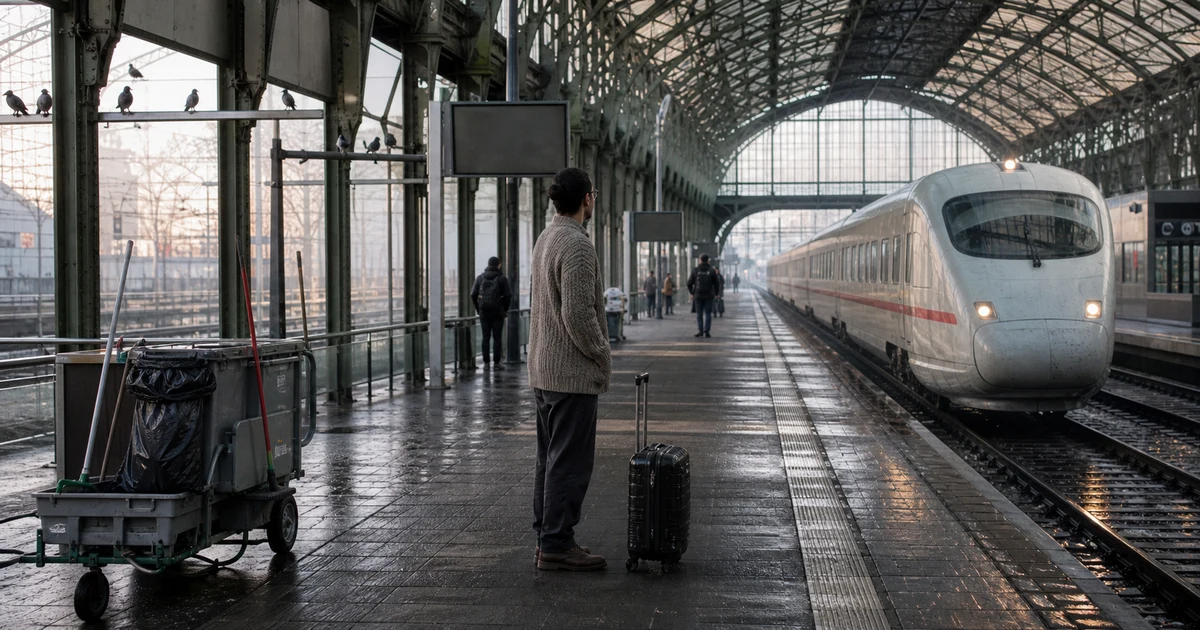
Germany does not. You can complete an entire degree in English and still find that your rental contract, your Anmeldung appointment and two thirds of the job ads are in German. That is a solvable problem, but it costs you evenings for a year. It also has a cash value in Germany: the Blue Card route to a settlement permit drops from 27 months to 21 if you can show sufficient German. See the catalogue of English-taught master's degrees in Germany if you want to know what is on offer.
Monthly costs and the Dutch housing squeeze
Germany runs 900 to 1,200 euros a month, the Netherlands 1,000 to 1,400. The gap is almost entirely rent: Dutch student housing is genuinely scarce, and in Amsterdam and Utrecht people accept rooms they would refuse anywhere else.
Germany is not uniformly cheap either, and the city matters more than the country. The Moses Mendelssohn Institut put the average German student room at 512 euros a month for summer semester 2026, with Munich at 800 and Berlin at 650, against 385 in Bochum. Statutory student health insurance is a fixed 141.16 euros a month under 23 and 146.29 from 23 without children. Pick a cheap German city and the monthly gap against the Netherlands widens; pick Munich and it closes.
Hours you are allowed to work
Germany permits 140 full days or 280 half days a calendar year under section 16b of the Residence Act, where anything up to four hours counts as a half day. Taken entirely as half days that is a ceiling of 1,120 hours a year, and student assistant jobs at your own university do not count against it at all. The statutory minimum is 13.90 euros an hour, so ten hours a week is roughly 598 euros gross a month.
The Netherlands caps international students at 16 hours a week in term, with full-time work allowed in June, July and August. Germany gives you more hours across the year; the Dutch summer window is the better earning burst. The rules and the day-counting are explained in the guide to working while you study in Germany.
| Factor | Germany | Netherlands |
|---|---|---|
| Non-EU tuition per year | 0, plus the semester fee | 13,200-34,300 euros |
| Residence permit fee | EUR 75 visa | EUR 254 |
| Monthly living cost | 900-1,200 euros | 1,000-1,400 euros |
| Work in term | 140 days a year | 16 hrs/wk |
| Post-study job search | 18 months | 1 year, not extendable |
How long you get to find a job
The Dutch orientation year, the zoekjaar, runs for 1 year and cannot be extended. Two features of it are genuinely good and often missed: you may apply at any point within three years of graduating, so you can go home first and come back, and during the year you are free to work for any employer without that employer needing a work permit.
Germany gives up to 18 months under section 20 of the Residence Act, conditional on being able to support yourself. Six extra months matters more than it sounds when German hiring processes run long and visa appointments are booked out. Both convert to a work permit once you sign, but Germany's onward route is written down in more detail: section 18c gives a skilled worker a settlement permit after three years, dropping to two years with 24 months of pension contributions if you completed your degree in Germany, and the Nationality Act sets naturalisation at five years of lawful residence. See how the German job-seeker permit works after graduation.
Where the salaries are
Dutch pay is high and Amsterdam is a genuine international hub for finance and tech, with the added advantage that English-language roles are normal rather than exceptional. German technical graduates start above 50,000 euros, and the engineering and IT shortage means you are competing against fewer candidates. The arithmetic that decides it is not the salary though; it is the salary minus the tuition you did not pay. Field by field, our salary data for graduates in Germany shows where the numbers land.
- Pick Germany if cost decides it, if you are in engineering or IT, and if you are willing to put a year into German.
- Pick the Netherlands if you want to work in English from day one, if the shorter one-year master's suits you, and if you can fund the tuition without debt you will regret.
Sources
- TU Delft - tuition fees 2026-2027
- University of Amsterdam - tuition fees
- IND - residence permit fees
- Government of the Netherlands - orientation year
- Residence Act, section 18c - settlement permit
Weighing up master's options? A free profile evaluation will tell you which country your grades and budget actually clear.
Frequently Asked Questions
You probably qualify for more than you think.
Students who get evaluated find programmes they had no idea existed — at universities that charge nothing. 2 minutes, no cost. The only downside is not checking.
Want our guides higher up in Google?
Mark GradGermany as a preferred source and Google gives our pages more room when you search about studying in Germany. Takes one tap, and you can undo it any time from the same screen.
Get new guides as soon as they go live
Add our feed to Feedly, Inoreader or any RSS reader and every new guide on studying in Germany shows up there by itself. No email, no sign-up.
Living this, or on your way to it? Tell your story.
If you are already in Germany and finding it hard, or still fighting to get here, other students need to hear it from someone real. Share your honest journey. We help shape it, and nothing goes live until you approve it.
Free German Quiz · No Login
Can you score 10/10 on today's German challenge?
10 new words every day · 4,500+ words from A1 to C1 · takes about a minute.