Computer Science in English at German Public Universities: Mostly Tuition-Free
TL;DR: Most German public universities teach computer science master's in English with no tuition, but the exceptions are not small: Baden-Wuerttemberg charges 1,500 euros/sem and TU Munich bills non-EU students 6,000 a semester for informatics. What you need is a strong CS bachelor's, an English certificate, the right ECTS on your transcript, and APS if you studied in India, China or Vietnam. Watch the deadlines: several close in spring for an October start.
Computer science is the field where studying in Germany makes the most obvious financial sense: it is the most widely available English-taught subject in the country, and at public universities it is usually free. Usually, not always, and the two exceptions are the ones people budget for too late. The examples below span research universities and applied ones, which are two quite different experiences.
Programs worth looking at first
These are examples chosen to show the range, not a ranked list and not the whole field. TU Munich is the only one here that charges tuition.
- TU Munich. The MSc Informatics is taught in English and is one of the few that bills non-EU students, at 6,000 euros a semester for full-time study, charged proportionally for part-time.
- University of Hamburg. Two English-taught routes rather than one: Data Science and Artificial Intelligence, and Intelligent Adaptive Systems. The plain MSc Informatics at Hamburg is documented in German, which tells you what language it runs in. No tuition.
- University of Gottingen. Computer science and informatics in English, no tuition.
- TU Berlin. English computer science and related programs, no tuition, applications via uni-assist. It is one of the nine TU9 institutes of technology; see which universities make up TU9.
- Technical universities of applied sciences such as Neu-Ulm and Nuremberg, with applied AI and data master's in English.
Program names and entry rules change from intake to intake, so use this as a map and not a catalogue. Run a DAAD database search for computer science taught in English at public universities to get the current list, then shortlist four to five whose deadlines fit your timeline. Mix one reach program with backups you clearly qualify for, the same way you would for any ranked admission.
The deadlines close earlier than the intake suggests
This is the single most expensive mistake in CS admissions, because the good programmes shut months before term starts and several run only one intake a year.
TU Munich takes informatics applications for the winter semester from 1 February to 31 May, and for the summer semester from 1 October to 30 November. TU Berlin closes its English-language master's with restricted admission on 15 May for the winter 2026/27 intake, six weeks before the German-language ones and two months before the bachelor's deadline. Hamburg's Data Science and Artificial Intelligence master's runs a single window every year, 15 February to 31 March, and states plainly that anything not fully submitted inside it is not considered.
Work backwards from those dates. If a university routes you through uni-assist, add the four to six weeks uni-assist quotes for an evaluation result, and if you need an APS certificate, add that queue in front of everything.
| University | Tuition |
|---|---|
| University of Hamburg | No tuition |
| University of Gottingen | No tuition |
| TU Berlin | No tuition |
| TU Munich | 6,000 euros/sem for informatics |
Where the tuition exceptions are
Most public CS master's cost nothing to attend. TU Munich charges non-EU tuition, and Baden-Wuerttemberg universities charge 1,500 euros/sem. If your first choice sits in either, decide early whether to budget for it or move your shortlist to a fee-free state. The TUM figures are broken down in what TU Munich charges international students, and which Bavarian universities actually charge covers the exemptions that can cancel the bill.
The module prerequisites that quietly reject people
Read Also: Best Public Universities in Germany 2026: Top 10 Ranking for International Students
Every guide says "relevant modules" and stops there. German departments publish exactly what they mean, in credit points, and applications that miss them are refused before anyone reads the motivation letter.
Hamburg's Data Science and Artificial Intelligence master's is a good worked example. If your bachelor's is in a CS-related field rather than computer science itself, it wants at least 24 ECTS in mathematics, of which at least 6 ECTS must be in stochastics, meaning probability and statistics, plus at least 60 ECTS in computer science matching its own bachelor's curriculum. It says applications that do not meet the minimum requirements, or that lack evidence of meeting them, are rejected directly and without exception.
Two practical consequences. Count the credits on your transcript before you apply, and if a category is short, that is a reason to pick a different programme rather than to hope. And you do not always have to have graduated: Hamburg will consider you if what remains of your degree is no more than one semester, roughly 30 ECTS, you already meet the credit minimums, and you have formally started your thesis.
English proof, and the assumption that costs people a place
Read each programme's wording rather than the general advice. Hamburg's DSAI master's accepts a C1 attestation from your university, IELTS at 6.5 or above, TOEFL at 90 or above, the Cambridge CAE or CPE, or seven years of English at a German-speaking school. It then adds the line most applicants from English-medium universities do not expect: a degree taught in English will generally not be accepted as proof of English proficiency.
Some German universities do accept a medium-of-instruction letter, and some do not. Check the one you are applying to before you skip the test, and see the routes that skip IELTS for where it genuinely works.
What every one of them asks for
- A bachelor's in CS or a closely related field, with grades to match. TUM scores your grades and documents on a point system first, then either admits, rejects or invites you to an interview.
- IELTS 6.0-7.0 or an accepted equivalent, with the exact threshold set per programme.
- Module prerequisites in programming, algorithms and mathematics, usually written as ECTS minimums.
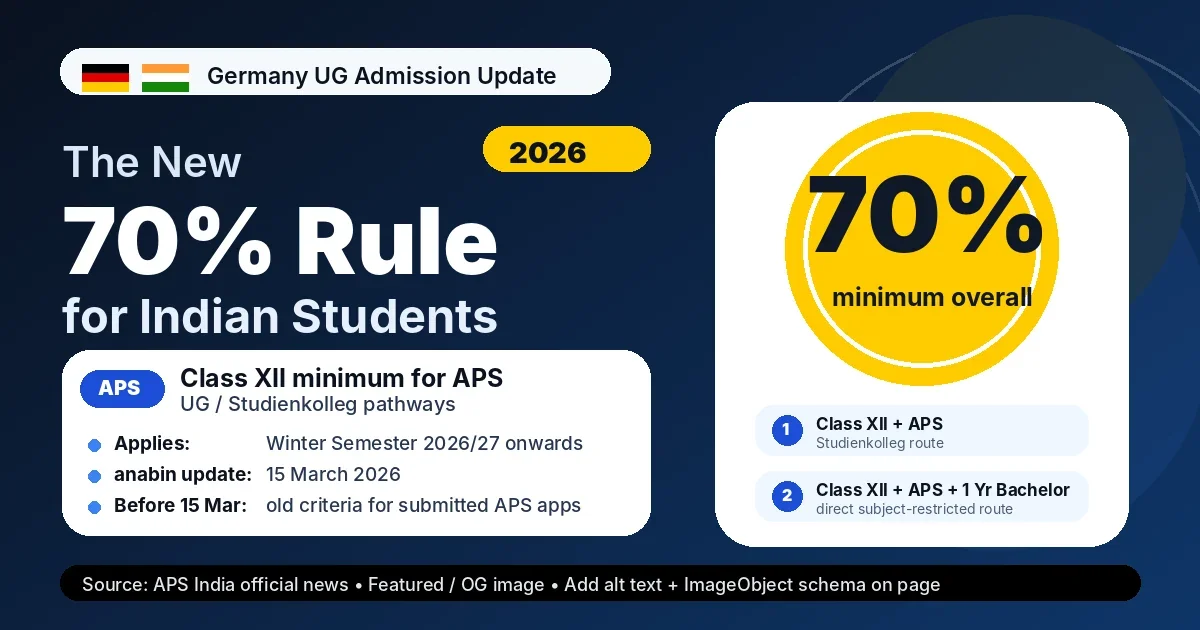
- APS for applicants who studied in India, China or Vietnam, the only three countries with an APS office. See the APS process.
How and when to apply
Some universities take applications through uni-assist, others directly. TU Berlin uses uni-assist; Hamburg runs its own STiNE portal; check each one rather than assuming. Where uni-assist applies, the fee is EUR 75 for the first chosen course of study and EUR 30 for each further one in the same semester, so keep a shortlist inside one application cycle. The paperwork sequence is in how uni-assist applications work.
Why the degree is worth the paperwork
Strong research groups, teaching in English, no tuition at most public universities, and a software job market that hires before graduation: many students are placed before their final semester. Living costs of about 900-1,200 euros a month are the real expense, and a part-time software job covers a good share of them. For a wider list of programs, see the CS master's guide and the English-taught program list.
Werkstudent work, and the visa after
You can work 140 full days or 280 half days a year at the 13.90 euros/hour minimum wage. Spend those days in a Werkstudent software role rather than anywhere else, because it is the closest thing to a guaranteed graduate pipeline, and the format allows up to 20 hours a week during the lecture period. After the degree comes the 18-month job-seeker visa. See how to get a Werkstudent job and the post-study visa rules.
Sources
- TUM: MSc Informatics, fees and application periods
- University of Hamburg: MSc Data Science and Artificial Intelligence
- TU Berlin: dates and deadlines
- uni-assist: handling fees
- DAAD
Want a shortlist of fit CS master's? Get a free profile evaluation from the GradGermany team.
Frequently Asked Questions
You probably qualify for more than you think.
Students who get evaluated find programmes they had no idea existed — at universities that charge nothing. 2 minutes, no cost. The only downside is not checking.
Want our guides higher up in Google?
Mark GradGermany as a preferred source and Google gives our pages more room when you search about studying in Germany. Takes one tap, and you can undo it any time from the same screen.
Living this, or on your way to it? Tell your story.
If you are already in Germany and finding it hard, or still fighting to get here, other students need to hear it from someone real. Share your honest journey. We help shape it, and nothing goes live until you approve it.
Free German Quiz · No Login
Can you score 10/10 on today's German challenge?
10 new words every day · 4,500+ words from A1 to C1 · takes about a minute.