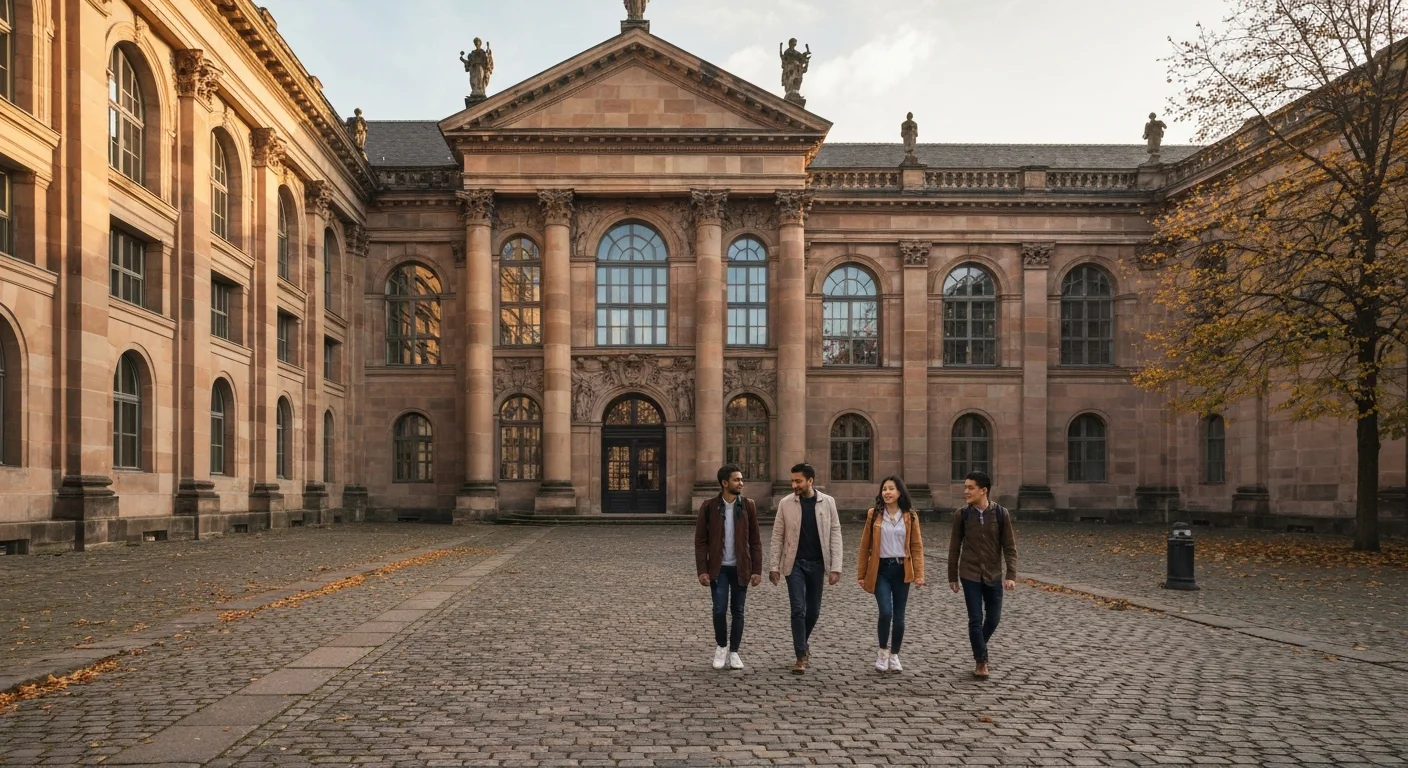
Masters in Germany
for Indian Students
Explore 10,000+ accredited Master's programmes across 400+ German universities. Study at world-class public universities with zero tuition fees and build your international career.
10,000+
Master's Programmes
400+
Universities
€0
Tuition at Public Unis
585+
English-Taught Programmes
Browse Master's by Subject
Explore specialised landing pages for the most in-demand Master's fields in Germany.
Computer Science
AI & Data Science
Data Science
MBA & Business
Mechanical Engineering
Electrical Engineering
Aerospace Engineering
Civil Engineering
Medicine & Health
Nursing & Healthcare
Business & Management
Psychology
Environmental Science
Law (LLM)
Art & Design
Mathematics
Mechatronics & Robotics
Automotive Engineering
Materials Science
Chemical Engineering
Energy Engineering
Production & Manufacturing
Logistics & Transport
Leading Universities in Germany
World-class education with strong industry ties and international recognition.
Technische Hochschule Deggendorf
Deggendorf, Bayern
Applied sciences powerhouse with strong industry ties in Bavaria's tech corridor.
Technische Universität München
München, Bayern
Germany's #1 technical university. World-class research across all engineering and science fields.
RWTH Aachen
Aachen, Nordrhein-Westfalen
Europe's largest TU with 45,000+ students and excellent cross-disciplinary programmes.
Ludwig-Maximilians-Universität München
München, Bayern
Bavaria's premier research university. Strong in humanities, sciences, and medicine.
Ruprecht-Karls-Universität Heidelberg
Heidelberg, Baden-Württemberg
Germany's oldest university (1386). Globally renowned for natural sciences and medicine.
Freie Universität Berlin
Berlin, Berlin
Berlin's top research university with strong international focus and 150+ Master's programmes.
Showing 121–144 of 10,110 programmes
Allgemeine und Vergleichende Literaturwissenschaft im Zwei-Fächer Masterstudiengang, M.A.
Ruhr-Universität Bochum · Bochum
Allgemeine und vergleichende Literaturwissenschaft, M.A.
Universität Münster · Münster
Apply by 9 Oct · 23d leftAllgemeine und Vergleichende Literaturwissenschaft, M.A.
Ruhr-Universität Bochum · Bochum
Allgemeine und Vergleichende Literaturwissenschaft, M.A.
Freie Universität Berlin · Berlin
Allgemeine und Vergleichende Literaturwissenschaft, M.A.
Universität Regensburg · Regensburg
Allgemeine und vergleichende Literaturwissenschaft, M.A.
Bergische Universität Wuppertal · Wuppertal
Allgemeine und Vergleichende Medienwissenschaft, M.A.
Universität Regensburg · Regensburg
Allgemeine und Vergleichende Sprachwissenschaft, M.A.
Universität Regensburg · Regensburg
Allgemeiner Maschinenbau, M.Eng.
Frankfurt University of Applied Sciences · Frankfurt am Main
Allgemeiner Maschinenbau, M.Sc.
RWTH Aachen · Aachen
Alltagskultur und Gesundheit - Grundschulen Profilierung Europalehramt, M.Ed.
Pädagogische Hochschule Karlsruhe · Karlsruhe
Alltagskultur und Gesundheit - Grundschulen, M.Ed.
Pädagogische Hochschule Karlsruhe · Karlsruhe
Alltagskultur und Gesundheit - Lehramt der Sekundarstufe I an allen Schulformen Profilierung Europalehramt, M.Ed.
Pädagogische Hochschule Karlsruhe · Karlsruhe
Alltagskultur und Gesundheit - Lehramt der Sekundarstufe I an allen Schulformen, M.Ed.
Pädagogische Hochschule Karlsruhe · Karlsruhe
Alltagskultur und Gesundheit - Sonderpädagogische Lehrämter, M.Ed.
Pädagogische Hochschule Heidelberg · Heidelberg
Alltagskultur und Gesundheit, M.Ed.
Pädagogische Hochschule Schwäbisch Gmünd · Schwäbisch Gmünd
Alltagskultur und Gesundheit, M.Ed.
Pädagogische Hochschule Heidelberg · Heidelberg
Alltagskultur und Gesundheit, M.Ed.
Pädagogische Hochschule Heidelberg · Heidelberg
Alphabetisierung und Grundbildung, M.A.
Pädagogische Hochschule Weingarten · Weingarten
Alt-Katholische und Ökumenische Theologie, M.A.
Rheinische Friedrich-Wilhelms-Universität Bonn · Bonn
Altbauinstandsetzung, M.Sc.
Karlsruher Institut für Technologie · Karlsruhe
Alte Geschichte - Klassikstudien, M.A.
Universität Regensburg · Regensburg
Alte Geschichte (Zwei-Fach-Studiengang), M.A.
Universität Rostock · Rostock
Apply by 30 NovAlte Geschichte, M.A.
Ruprecht-Karls-Universität Heidelberg · Heidelberg
Check My Fit
3 quick questions — every result gets a fit tag based on your budget and languages. Stored only on this device.
Tags are an indication based on tuition and teaching language — for a real assessment, get a free profile evaluation.
Entry Requirements for a Master's in Germany
Admission requirements vary by university and programme, but most Master's applications in Germany are built around the same core elements. The single most important factor is that your Bachelor's degree is recognised as equivalent — you can check your institution's status before applying through a free profile evaluation.
Recognised Bachelor's degree
A completed undergraduate degree in a related subject, recognised as equivalent by the German authorities. Most universities expect a strong academic record, generally a German grade of around 2.5 or better — roughly equivalent to 60–65% or a CGPA of about 7.5/10 for Indian applicants. Competitive programmes may set a higher bar.
Language proficiency
For English-taught Master's programmes, an IELTS score of around 6.5 (or equivalent TOEFL/PTE) is typical, though some programmes accept 6.0. German-taught programmes generally require proof of German at C1 level, such as TestDaF or DSH. Always confirm the exact threshold on the programme page.
APS certificate
Applicants who studied in India, China or Vietnam typically need an APS certificate verifying their academic documents before applying for admission and a student visa. It is issued once and can be reused for multiple applications, so it is best arranged early.
GRE / GMAT — usually not required
Unlike the US, most German universities do not ask for the GRE or GMAT. A small number of selective or business programmes may request them, but for the large majority of Master's applications they are not part of the process.
Application documents
A motivation letter (statement of purpose), a CV, academic transcripts, and one or more letters of recommendation are commonly required. Many universities collect applications through the central uni-assist portal, while others run their own online systems.
Proof of funds
For the student visa you will generally need to show proof of financial means, most commonly via a blocked account (Sperrkonto). The required amount is set by the authorities and is revised periodically, so verify the current figure before opening one.
Careers & Salaries After a Master's in Germany
Germany pairs a strong, export-driven economy with a long-standing shortage of skilled professionals, which makes it one of the more accessible job markets in Europe for international graduates. The figures below are approximate gross-salary ranges and vary widely by field, employer, region, and experience.
IT & Software
€50,000 – €70,000
Typical entry-level · per year
Software engineering, data, and cloud roles are in persistent demand across startups and large enterprises.
Mechanical & Automotive
€48,000 – €65,000
Typical entry-level · per year
Germany's engineering and automotive base offers broad entry-level openings for graduates.
Electrical Engineering
€48,000 – €65,000
Typical entry-level · per year
Automation, semiconductors, and energy systems are growing employers.
Data Science & AI
€52,000 – €72,000
Typical entry-level · per year
One of the fastest-growing fields, with demand spread across most industries.
Business & Management
€45,000 – €60,000
Typical entry-level · per year
Roles in consulting, finance, and operations; salaries scale strongly with experience.
Life Sciences & Pharma
€45,000 – €60,000
Typical entry-level · per year
Research, biotech, and pharmaceutical roles cluster around major science hubs.
The 18-month post-study job-seeker permit
After completing your degree, international graduates can generally apply to extend their stay for up to 18 months to look for a job related to their qualification. Once you secure a suitable role, you can usually switch to a work residence permit or an EU Blue Card. Salary thresholds for the Blue Card are set by the authorities and updated periodically — with lower thresholds for shortage occupations such as IT, engineering, and science — so check the current figures when you reach that stage.
Why Study a Master's in Germany
Germany combines affordability, academic depth, and a direct route into one of Europe's strongest labour markets — a rare mix among popular study destinations.
No tuition at most public universities
Public universities across most German states charge no tuition fees for Master's programmes, regardless of nationality. Students typically pay only a modest semester contribution, which often includes local public transport. Note that some non-consecutive Master's programmes and universities in certain states can charge fees, so confirm the cost for your specific programme.
Research strength and the TU9 / U15 networks
Germany hosts research-intensive universities including the TU9 alliance of leading technical universities and the U15 group of comprehensive research universities, alongside well-funded institutes such as Max Planck, Fraunhofer, and Helmholtz. This gives Master's students access to strong supervision and applied research.
Industry on your doorstep
A dense network of global employers in automotive, engineering, software, chemicals, and life sciences means many programmes are closely linked to industry through internships, working-student roles, and thesis projects with companies.
A clear path to work and stay
The post-study job-seeker period and routes such as the EU Blue Card make it realistic to begin a career in Germany after graduation, and continued residence can lead toward longer-term settlement over time.
Frequently Asked Questions About Masters in Germany
Yes. Most public universities in Germany charge no tuition fees for Master's programmes, regardless of your nationality. Students only pay a small semester contribution of approximately €150–€350, which typically includes a public transport ticket valid across buses, trams, and regional trains. The sole exception is Baden-Württemberg, where non-EU students pay €1,500 per semester at state universities such as KIT Karlsruhe and University of Stuttgart. Even so, this remains a fraction of what comparable programmes cost in the US ($30,000–$70,000 per year), UK (£15,000–£30,000), or Australia (AUD 25,000–45,000). With living costs averaging €934 per month according to the DAAD, a two-year German Master's degree can be completed for under €25,000 in total. Indian students must open a blocked account of €11,904 for the student visa, which covers one year of living expenses. This makes Germany one of the most affordable postgraduate options globally.
Germany offers over 400 universities, including world-renowned institutions in the TU9 and U15 alliances, with an unmatched combination of academic excellence, affordability, and career prospects. Nearly 60,000 Indian students are currently enrolled at German universities, making India one of the largest international student communities in the country. Top institutions like TU Munich, RWTH Aachen, Heidelberg University, and LMU Munich regularly appear in QS and THE global top 100 rankings. Germany's economy, the largest in the EU with a GDP exceeding €4 trillion, creates strong demand for STEM and business graduates across sectors like automotive, IT, manufacturing, and finance. The 18-month post-study work visa, coupled with average starting salaries of €45,000–€55,000 and a clear pathway to permanent residency within two to three years, delivers an outstanding return on investment compared to anglophone destinations like the US, UK, or Australia.
Yes. Over 585 Master's programmes are taught entirely in English across German universities, according to the DAAD database. Popular English-taught fields include Computer Science, Data Science, Mechanical Engineering, Business Administration, and Natural Sciences. Leading universities offering extensive English-taught options include TU Munich, RWTH Aachen, University of Stuttgart, KIT Karlsruhe, Jacobs University Bremen, and ESMT Berlin. Many universities also offer bilingual programmes where coursework begins in English and transitions to German, helping students integrate into the local job market after graduation. For English-taught programmes, you typically need IELTS 6.0–6.5 or TOEFL 80–100. Learning German alongside your studies is strongly recommended, as it significantly improves employability and daily life in Germany. Most universities provide free or subsidised German language courses to international students, allowing you to build proficiency while pursuing your degree. Some programmes even include a compulsory German module as part of the curriculum.
No. Most German universities do not require GRE or GMAT scores for Master's admissions, which removes a significant financial and logistical barrier compared to US applications. Typical requirements include a recognised Bachelor's degree with a minimum GPA equivalent (usually 2.5 on the German scale or 65%+ in the Indian system), language proficiency (IELTS 6.0–6.5 for English-taught programmes, or TestDaF TDN 4/DSH-2 for German-taught programmes), a statement of purpose, a CV, and an APS certificate from the German Embassy in New Delhi. The APS process involves document verification and a brief academic interview of approximately 15–20 minutes, typically taking 4–8 weeks and costing around €150. We recommend starting APS at least six months before your intended intake. Some competitive programmes at TU Munich or RWTH Aachen may require subject-specific entrance tests, but these are exceptions rather than the norm.
Germany offers an 18-month post-study work visa (job seeker visa) to all international graduates, regardless of field. The German economy, the largest in Europe with a GDP exceeding €4 trillion, has high demand for skilled professionals in engineering, IT, data science, healthcare, and business. The Bitkom industry association reports over 100,000 unfilled IT positions alone. Companies such as Siemens, SAP, BMW, Bosch, Volkswagen, Deutsche Bank, and Allianz actively recruit from German universities. The average starting salary for Master's graduates ranges from €45,000 to €55,000 per year, with fields like computer science and engineering often exceeding €55,000. During your 18-month visa period, you can work in any job while searching for a role matching your qualifications. Germany also has a clear pathway from work visa to permanent residency (Niederlassungserlaubnis), typically achievable within two to three years of employment for holders of a German degree.
German universities operate on two intake cycles. The Winter semester (October start) has application deadlines typically between January and July 15 and is the main intake with the widest selection of programmes. The Summer semester (April start) has deadlines between September and January 15, though fewer programmes offer summer admission. For Indian students, planning should begin at least 8–12 months before the deadline. Key preparatory steps include obtaining the APS certificate (4–8 weeks processing at the German Embassy in New Delhi), taking IELTS or TestDaF, gathering notarised transcripts and degree certificates, writing your statement of purpose, and securing recommendation letters. Applying through uni-assist, the centralised application portal used by many German universities, typically costs €75 for the first application and €30 for each additional submission. Visa processing at the German Embassy takes an additional 6–12 weeks, so early preparation is critical.
Yes. German universities admit international and Indian students every intake. You need a recognised bachelor's degree, proof of English (and German for German-taught courses), and, for some countries, an APS certificate. Public universities charge little or no tuition, so it is one of the most affordable study-abroad options.
It depends on the programme. Many public universities are not highly selective and admit anyone who meets the requirements, while top courses in popular fields like computer science and data science are competitive. A relevant bachelor's, a good grade and the right documents matter more than a famous name.
Often, yes. A German grade of 2.7 (roughly 65 to 70 percent, or about 7 on a 10-point CGPA) is accepted by a good number of programmes, especially universities of applied sciences. The most competitive courses want a stronger grade, but 2.7 still opens plenty of doors, particularly with a solid overall profile.
For an English-taught master's you can study without German. But even a little German, at B1 to B2 level, makes daily life easier and widens your job options a lot, since many employers still prefer some German. We recommend building your German alongside your studies.
Yes. International students can work up to 140 full days or 280 half days a year, plus on-campus student jobs. It is a common way to cover living costs and gain experience, as long as your studies stay the priority.
Yes. After you graduate you can apply for an 18-month residence permit to look for a job related to your degree. Once you find a qualifying job you can move to a work permit or an EU Blue Card, which can lead to permanent residence.
It varies by field. Master's graduates in engineering, IT and data science often start around 45,000 to 60,000 euros a year, rising with experience. Salaries are lower in some fields and higher in tech and finance. A German degree plus some German language usually improves your offers.
Tuition at most public universities is zero, with only a semester contribution of about 150 to 350 euros. You mainly budget for living costs, roughly 900 to 1,100 euros a month, plus the blocked account needed for your visa (currently around 11,900 euros for a year). A few states such as Baden-Wuerttemberg charge non-EU students about 1,500 euros a semester.
Yes. The DAAD offers well-known scholarships, and many universities and foundations run their own. They are competitive, so apply early. Keep in mind that low or no tuition at public universities already keeps the overall cost down.
Most master's programmes are two years (four semesters). Some universities of applied sciences and specialised courses offer one-year or 1.5-year options, which suit students who want to finish and start working sooner.
Usually your bachelor's transcripts and degree certificate, proof of English (IELTS or TOEFL) and German where needed, a CV, a statement of purpose, and letters of recommendation. Indian applicants also need an APS certificate, and from Summer 2027 some fields need the dMAT.
Yes. Most German master's programmes admit you on your bachelor's grades and documents, with no separate entrance exam. Some competitive or specialised courses may ask for a test or interview, but exam-free admission is the norm.
No. There is no upper age limit to apply for a master's in Germany or for a student visa. What matters is your academic background and that you meet the programme requirements.
Yes. Degrees from recognised German universities are respected worldwide and in India. You can confirm that your university is recognised in the official anabin database. A recognised degree carries weight with employers and for further study anywhere.
Indian applicants need an APS certificate to verify their documents. From the Summer 2027 intake, some Indian applicants (in engineering, commerce, finance, economics, business or management) also need the new dMAT test. See our full guides on the dMAT and the APS certificate.
Explore More Programmes in Germany
Ready to Start Your
Masters in Germany?
Get a free profile evaluation from our Germany education experts. We will assess your eligibility, recommend the best universities, and guide you through every step of the application process.
Most Master's programmes expect a German grade of 2.5 or better — use our German grade converter to see what your CGPA, percentage, or GPA equates to.