Study in Germany After Bachelor's: Masters Options & Requirements
TL;DR: Your bachelor's gets you considered. Its content gets you admitted. German master's programs check whether your transcript already covers the credits they assume you have, then look at your grade (often 70%+ or the converted German equivalent), your language certificate, and APS if you studied in India, China, Vietnam or Mongolia. Tuition is usually zero, but not at TU Munich or in Baden-Wuerttemberg.
The rejection that surprises people is not the one for weak grades. It is the one that says your degree does not cover the prerequisites, sent to a student with a strong transcript who applied to the wrong master's. Sort that out first and the rest of the requirements are straightforward.
Module fit rejects good students every year
German master's programs list the specific credits they expect you to have finished already, and they mean it literally. Universitaet Hamburg's Data Science and AI master's, for example, requires 24 ECTS in mathematics of which 6 ECTS must be stochastics or statistics, plus 60 ECTS in computer science, and states that applications lacking evidence of this are rejected directly. RWTH Aachen's Data Science master's publishes named course profiles instead: the mathematics profile expects Analysis I to III worth 24 credit points, Linear Algebra I and II worth 15, and numerical analysis with stochastics worth 18 between them. Mannheim's finance and accounting master's wants 180 ECTS overall and at least 36 ECTS of prior business administration.
Pull the entry requirements of every program on your shortlist, put your own module list beside them, and count. Do the counting before you pay anything, because the fee is due whether or not the count works out.
The exception worth hunting for
Some programmes let you make up what you are missing. Goettingen's Applied Data Science master's wants 60 ECTS in foundational data science methods, and then says that an applicant holding at least 45 may still be admitted and make up as many as 15 credits during the master's itself. That single clause changes which programmes a borderline transcript should target.
The opposite condition exists too, and it hits three-year bachelor's holders hardest. Several postgraduate programmes require a degree of 240 ECTS or four years of regular coursework, Charite's Epidemiology master's among them. A four-year B.Tech clears that; a three-year B.Sc. or B.Com does not, and no amount of work experience substitutes. Check the credit total on your degree before you build a shortlist around it.
The grade bar in German numbers
You need a completed bachelor's in a related field. Universities run your marks through the Bavarian formula and compare the result against their own cutoff, so the number that matters is the converted one, not the percentage on your transcript. Roughly 70%+, which lands around 2.5 or better in German terms, keeps most programs open, and that figure is not folklore: LMU Munich's economics master's names an overall average of at least 2.50, and Bayreuth's food quality master's names 2.5. Work yours out with the German grade conversion walkthrough.
Falling short is not always terminal. LMU's rule is that applicants below the threshold sit an admissions examination covering microeconomics, macroeconomics, empirical economics, mathematics and public economics rather than being rejected outright. Programmes that publish a second chance like this are worth more to a borderline applicant than a programme with a slightly lower cutoff and no appeal route.
English or German: which certificate you need, and which they accept
Read Also: Best Public Universities in Germany 2026: Top 10 Ranking for International Students
English-taught programs want IELTS 6.0-7.0 or a TOEFL equivalent, and the spread inside that range is wider than it looks: RWTH's data science master's is satisfied by B2, while Goethe Frankfurt, Mannheim and WHU all want C1 and IELTS 7. German-taught ones want TestDaF TDN 4, DSH-2 or Goethe C1. Pick your exam once and prepare properly, because this is a pass/fail gate.
Two acceptance rules matter more than the score. First, a medium-of-instruction letter or an English-taught bachelor's is generally not accepted as proof by RWTH Aachen or Universitaet Hamburg, so an English-medium degree does not exempt you. Second, at the visa stage the German Missions in India recognise IELTS and other ALTE members for English and Goethe-Institut, Max Mueller Bhavan, OeSD and telc for German, and do not recognise Duolingo, Pearson PTE or the TOEFL home edition. A university may admit you on a test the mission will not accept. Which German exam to sit compares them, and the English-taught program list shows what is available without German.
APS: four countries, one extra document
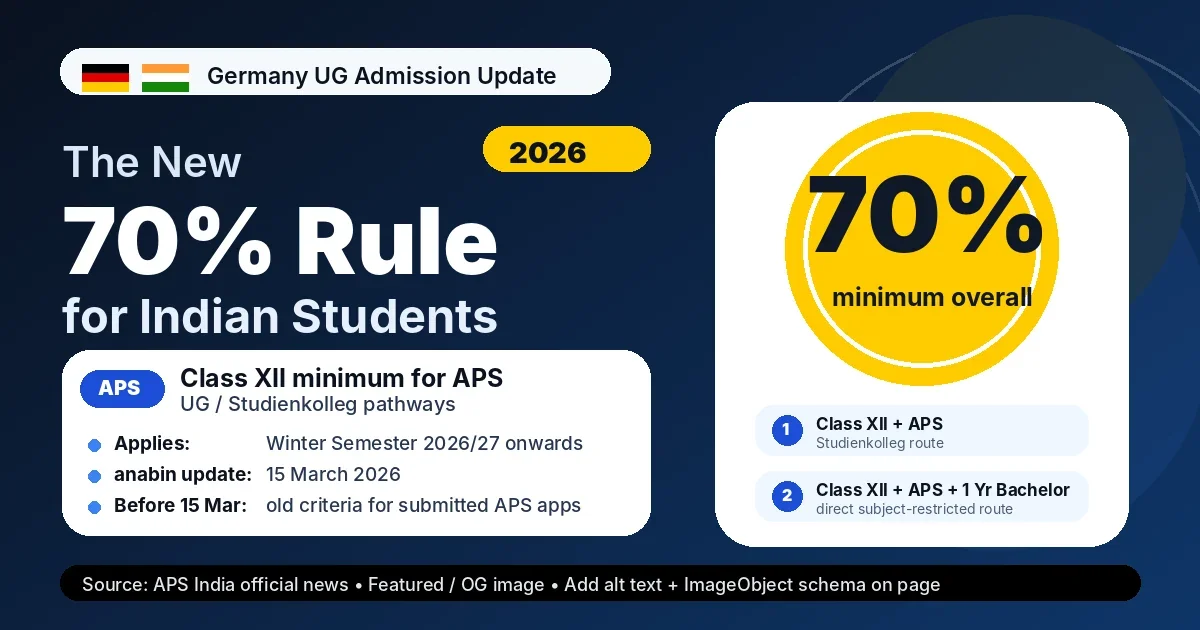
If your degree is from India, China, Vietnam or Mongolia, you need an APS certificate before you can apply. At master's level APS verifies your bachelor's, not your school marks, so the 70% class XII threshold you may have read about does not apply to you. The exemptions the missions list are narrow: PhD or postdoctoral study, a scholarship from EU or German public funds, studies leading to a non-German degree, a foreign degree that is not Indian, or an international school-leaving qualification. Book it early; the queue is the slow part. See how the APS process runs step by step.
| Requirement | Typical bar |
|---|---|
| Degree | Related bachelor's, 180 ECTS, sometimes 240 |
| Grade | ~70%+ / 2.5 or better in German terms |
| Modules | Counted in ECTS against a named list |
| Language | IELTS 6.0-7.0 or German B2-C1 |
| APS | India/China/Vietnam/Mongolia |
Consecutive or non-consecutive
- Consecutive. Builds straight on your bachelor's in the same field. This is the normal route and it rarely asks for work experience.
- Non-consecutive, including MBAs. Aimed at career changers and managers. Expect a work-experience requirement and a real fee, and read the ceiling as well as the floor: WHU's Master in Finance asks for at least twelve weeks of internships and then excludes anyone with more than four years of postgraduate work experience. Compare them in the master's in Germany overview.
Deadlines are set per programme, not nationally
The "15 July for winter, 15 January for summer" pattern is a default, not a rule, and the good programmes wander off it in both directions. Among the ones documented on this site, RWTH Aachen closes for non-EU data science applicants on 1 March for winter, Universitaet Hamburg opens for six weeks between 15 February and 31 March, LMU's economics window is the single month of April, Goettingen closes on 1 May, and TUM's compulsory deadline is 31 May with 31 March recommended for anyone needing a visa. Build one calendar with every programme on it before you write a single application, or you will lose a good option to a date you never checked.
What it actually costs, including the applying
Public universities charge no tuition, with Baden-Wuerttemberg and TU Munich as the exceptions, and the exceptions are large. Baden-Wuerttemberg charges non-EU students 1,500 euros per semester, or 650 for a second degree at the same level, which covers KIT, Stuttgart, Hohenheim and Mannheim. TUM charges anyone newly enrolling from winter semester 2024/25 usually 4,000 or 6,000 euros per semester for a master's.
Applying costs money too, which budgets often miss. Where a programme routes international applications through uni-assist, the first course of study you choose in a semester costs 75 euros and each further one 30 euros, due regardless of the outcome, so a six-programme shortlist is 225 euros before anyone reads your file. Then living is the real budget line: 900-1,200 euros a month, on top of the 11,904 euros you must show in a blocked account for the visa. The full arithmetic, in rupees, is in what a year in Germany actually costs.
Working during the degree, and staying after it
You may work 140 full days or 280 half days a year while you study, which is enough for a part-time role but not enough to fund the degree. After graduation the 18-month job-seeker visa gives you time to convert that into a job. See the student work rules and what happens after you graduate.
Sources
- uni-assist: handling fees
- TUM: tuition fees for students from non-EU countries
- KIT: Baden-Wuerttemberg tuition fees
- German Missions in India: recognised language certificates
- DAAD
- APS India
Ready to plan your master's? Get a free profile evaluation to match your bachelor's to realistic master's programs.
Frequently Asked Questions
You probably qualify for more than you think.
Students who get evaluated find programmes they had no idea existed — at universities that charge nothing. 2 minutes, no cost. The only downside is not checking.
Want our guides higher up in Google?
Mark GradGermany as a preferred source and Google gives our pages more room when you search about studying in Germany. Takes one tap, and you can undo it any time from the same screen.
Living this, or on your way to it? Tell your story.
If you are already in Germany and finding it hard, or still fighting to get here, other students need to hear it from someone real. Share your honest journey. We help shape it, and nothing goes live until you approve it.
Related Guides
Free German Quiz · No Login
Can you score 10/10 on today's German challenge?
10 new words every day · 4,500+ words from A1 to C1 · takes about a minute.