Study in Germany from Philippines: Requirements & English Programs
TL;DR: Filipino students need their transcripts verified and translated, a 11,904 euros blocked account, and a national student visa. There is no APS office and no uni-assist country checklist for the Philippines, so the anabin rating of your university is the thing to check first. Public tuition is free. Start 9-12 months early.
Before anything else, work out which of the two routes you are on, because Filipino applicants have a choice most nationalities do not. If you already hold a Philippine nursing degree, Germany has a recognition process that can put you into a paid job without a student visa at all. If you are heading for a master's in engineering, IT or anything else, you are on the standard student route described below. They share almost no paperwork, so picking the wrong one wastes months.
The nursing route, and why it is separate
Germany splits occupations into regulated and non-regulated. The federal recognition portal names medical practitioners, engineers and teachers among the regulated ones, and for those you must apply for recognition before you can work. Nursing sits there, which is why a Philippine nursing degree goes down a different track from a Philippine engineering degree.
The procedure runs in a fixed order. You identify the German reference occupation your qualification is compared against, take free advice from a counselling centre, then apply to the competent authority in the German state where you intend to work. The state matters: applying to the wrong authority restarts the clock.
The timings are published rather than guessed. The authority tells you within one month at the latest whether your documents arrived and what is missing, and issues the notice with the result within three to four months at the latest, longer if it proposes a skills analysis, which lets applicants who cannot produce all their paperwork demonstrate the knowledge in practice instead. The outcome is full recognition, partial recognition or none, and the last two are not the end: substantial differences were identified, and in most cases you close them with a training measure, an adaptation period or an examination. Our explainer on nursing recognition covers the sequence, and the principles apply whatever passport you hold.
Check anabin before you pay for anything
The first free thing to do is look up your university in anabin, the database run by the Central Office for Foreign Education. Three conditions must all hold before a German authority treats your degree as comparable: the university is listed and rated H+ or H+/-; the qualification is equivalent to a German one; and if the rating is H+/-, your specific qualification must also be listed under that university. An H+ university with an unlisted programme is not a pass. See how to look your institution up in anabin.
Four years, not three, for a Philippine bachelor's
The same database records what each Philippine qualification is worth, and the length rule is the one that catches people. A Philippine bachelor's opens direct access to all subjects only if it is an undergraduate degree of at least four years, taken at a recognised institution and, as a rule, full-time. A three-year programme does not clear that bar on its own.
Below a completed degree, the ladder runs by years of study. A transcript of records alone opens nothing. Two successful years of a bachelor's, defined as at least half the credits required for the four-year degree, route you to a Studienkolleg and the Feststellungspruefung in the stream matching your subject. Three years give direct subject-bound access to your field and neighbouring subjects; three years in a different field send you to the Studienkolleg instead.
If anabin does not answer, the ZAB will for 208 euros
Philippine institutions are not all in anabin, and this is where Filipino applicants lose weeks. If your university or your qualification is missing, or carries the wrong rating, you apply digitally to the ZAB for a Statement of Comparability, the document that describes your degree and certifies what it can be used for.
The numbers are fixed: EUR 208 for the statement and EUR 104 for a replacement certificate. Cancel and you are charged up to 50 per cent, meaning EUR 20 at minimum and EUR 104 at most. With complete documents it generally takes three months, so it belongs at the very start of your timeline, not after a rejection.
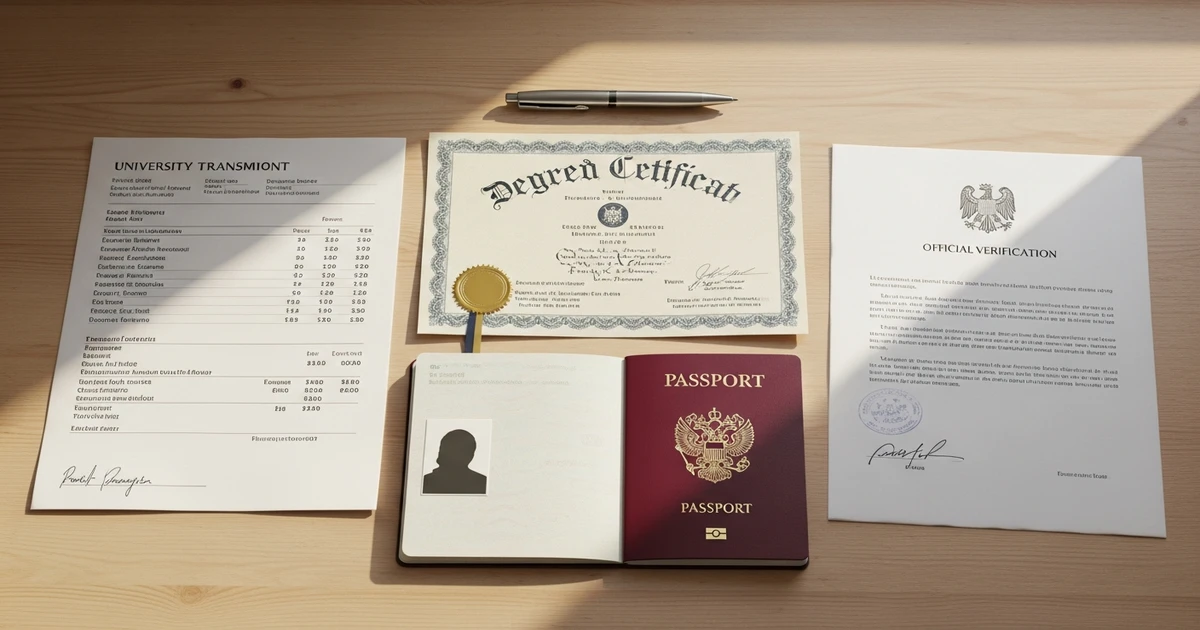
The ZAB expects the degree certificate in the original language, the full list of subjects and grades, your school-leaving certificate showing entrance qualification, written confirmation of the form and duration of the degree, final certificates for earlier degrees in the original language, and your passport. One limit worth knowing: neither an anabin entry nor a Statement of Comparability replaces the recognition procedure for a regulated profession, so a nurse still needs recognition even with a favourable statement.
No APS, and no country checklist either
India, China and Vietnam are the only countries with an APS verification office, so Filipino applicants skip that layer. That removes months from the timeline, and it also removes the safety net: nobody screens your documents before a German admissions officer sees them.
The gap goes further than most guides admit. Uni-assist publishes country-specific document notes for around 128 countries, spelling out which certificates it wants from each. The Philippines is not one of them, which is precisely why the anabin entry and, where needed, the ZAB statement carry so much weight in your file.
Documents for the student route
You need your college transcripts and degree certificate, translated into English or German and certified. Check recognition before you commit an application fee.
English-taught programmes
Almost all Filipino students go into English-taught master's programmes, of which Germany has about 2,400. IELTS 6.0-7.0 is the usual requirement, and some universities accept proof that your previous degree was taught in English, which for most Philippine graduates it was. Others explicitly refuse that substitute, so ask per programme before you skip the test. The catalogue is at English-taught master's degrees in Germany.
The blocked account
The student visa needs a blocked account holding 11,904 euros, released at 992 euros a month once you arrive. It is a deposit that comes back to you, not a fee. See how a German blocked account works.
| Item | What Filipino students need |
|---|---|
| Verification | College transcripts, translated |
| anabin rating | University must be H+ or H+/- |
| Bachelor's length | At least four years for direct access |
| If not listed | ZAB Statement of Comparability, EUR 208 |
| APS | Not required |
| Language | IELTS 6.0-7.0 or German |
| Financing | 11,904 euros or scholarship |
| Visa | National D visa, EUR 75 |
Applying at the embassy in Manila
The national (type D) student visa is issued by the German embassy in Manila. Bring your admission letter, proof of financing, health insurance, verified documents and passport. The fee is EUR 75. Appointment slots, rather than the decision, usually determine whether you make your intake, so book as soon as the admission letter arrives. See the student visa checklist.
Where a university routes you through uni-assist, budget EUR 75 for the first chosen course of study and EUR 30 for each further one in the same semester, and allow the four to six weeks uni-assist quotes for an evaluation result. See how uni-assist processes an application.
Working while you study
Non-EU students may work 140 full days or 280 half days a year, or 20 hours a week in term, at the 13.90 euros an hour minimum wage. A Werkstudent role in your field is the most direct path to a graduate offer at the same employer. See the work rules.
After graduation
You get an 18-month job-seeker visa, then a work permit, with permanent residence in about 4 years and citizenship at 5 years. Germany allows dual nationality, so a German passport does not cost you the Philippine one. See what the post-study permit covers.
Sources
- Recognition in Germany: higher education qualifications, anabin and the Statement of Comparability
- anabin, Central Office for Foreign Education: Philippine qualifications
- Recognition in Germany: how the procedure runs
- Uni-assist: country-by-country document notes
- DAAD
- German Embassy Manila
Nurse or engineer, unsure which route fits? A free profile evaluation will tell you whether recognition or a master's is the faster way in.
Frequently Asked Questions
You probably qualify for more than you think.
Students who get evaluated find programmes they had no idea existed — at universities that charge nothing. 2 minutes, no cost. The only downside is not checking.
Want our guides higher up in Google?
Mark GradGermany as a preferred source and Google gives our pages more room when you search about studying in Germany. Takes one tap, and you can undo it any time from the same screen.
Living this, or on your way to it? Tell your story.
If you are already in Germany and finding it hard, or still fighting to get here, other students need to hear it from someone real. Share your honest journey. We help shape it, and nothing goes live until you approve it.
Free German Quiz · No Login
Can you score 10/10 on today's German challenge?
10 new words every day · 4,500+ words from A1 to C1 · takes about a minute.